“Our son has been mentally ill for years, and when he got into a fight and hit his neighbor they said he'd be jailed... isn't he not responsible for himself?” This question worries many families, and it is sometimes used in the opposite direction: “Act crazy and you'll get out of it.” The legal reality is more precise than either, and that is what we explain here in simple language.
Is a mentally ill person responsible for their actions? The general rule
Criminal responsibility rests on a person's ability to have awareness, that is, to understand the nature of what they are doing, and choice, that is, the ability to control their act. Most people with mental illness keep both abilities most of the time; a person with depression, anxiety or obsessive-compulsive disorder knows what they are doing and chooses it. That is why the rule is that a mentally ill person is responsible for their actions like anyone else, and the exception is when they lose awareness or choice at the very time of the act.
This agrees with what StatPearls says about forensic psychiatry: criminal responsibility is a legal concept, not a medical diagnosis, and the presence of psychosis alone is neither necessary nor sufficient to establish a lack of responsibility; what matters is whether the illness directly caused the act or was merely present alongside it.
The text of Article 62 of the Egyptian Penal Code
Article 62 of the Penal Code was replaced by Law No. 71 of 2009 issuing the Mental Patient Care Law, and its text as published by the Parlmany website reads:
The Parlmany website notes that the Penal Code issued in 1937 spoke of “insanity or mental defect,” and that adding “psychological disorder” was a new provision that came with the 2009 law.
Loss of awareness or reduced awareness? The difference that changes the ruling
| The defendant's state at the time of the act | Legal effect | Illustrative example |
|---|---|---|
| A disorder that deprived them of awareness or choice | Not criminally liable | An acute psychotic episode in which they act on hallucinations that command them |
| A disorder that reduced their awareness or choice | Remains liable, and the penalty may be reduced | Depression or a personality disorder that affected their judgment without removing it |
| A mental illness unrelated to the act | Fully liable | A stable anxiety patient who committed an act while fully aware |
| Drug intoxication taken voluntarily | No exemption under the text of the article | Voluntary use followed by committing a crime |
Drugs and responsibility: use does not exempt
The text of Article 62 limits the exemption for drug intoxication to someone who took the drug by force or without their knowledge. That means a person who used voluntarily and then committed a crime under the influence does not benefit from this exemption. This matters for the families of people with addiction: addiction is an illness that deserves treatment, but it does not erase responsibility for actions. Substance use may also cause real psychosis, and assessing its effect in each case is for the court and its experts. The real prevention is early treatment, especially when substance use occurs together with a mental disorder in a dual diagnosis.
What happens when a defendant raises mental illness as a defense?
- The pleaRaising mental illness
The defendant or their lawyer argues that they had a psychological disorder at the time of the crime.
- InvestigationAppointing an expert
Assessing mental state is a matter of fact for the court, which must investigate the plea and appoint an expert to decide it, whether to confirm or reject it.
- ObservationAdmission for examination
The defendant may be placed under observation in a government mental health facility for periods totaling no more than 45 days.
- TrialSuspension or continuation
If it is established that they are unable to defend themselves because of a disorder that arose after the crime, the trial is suspended until they regain their sanity.
- VerdictExemption, reduction or punishment
If acquitted because of a mental disorder, they may be held in a psychiatric facility until their release is ordered after it is confirmed that they have regained their sanity.
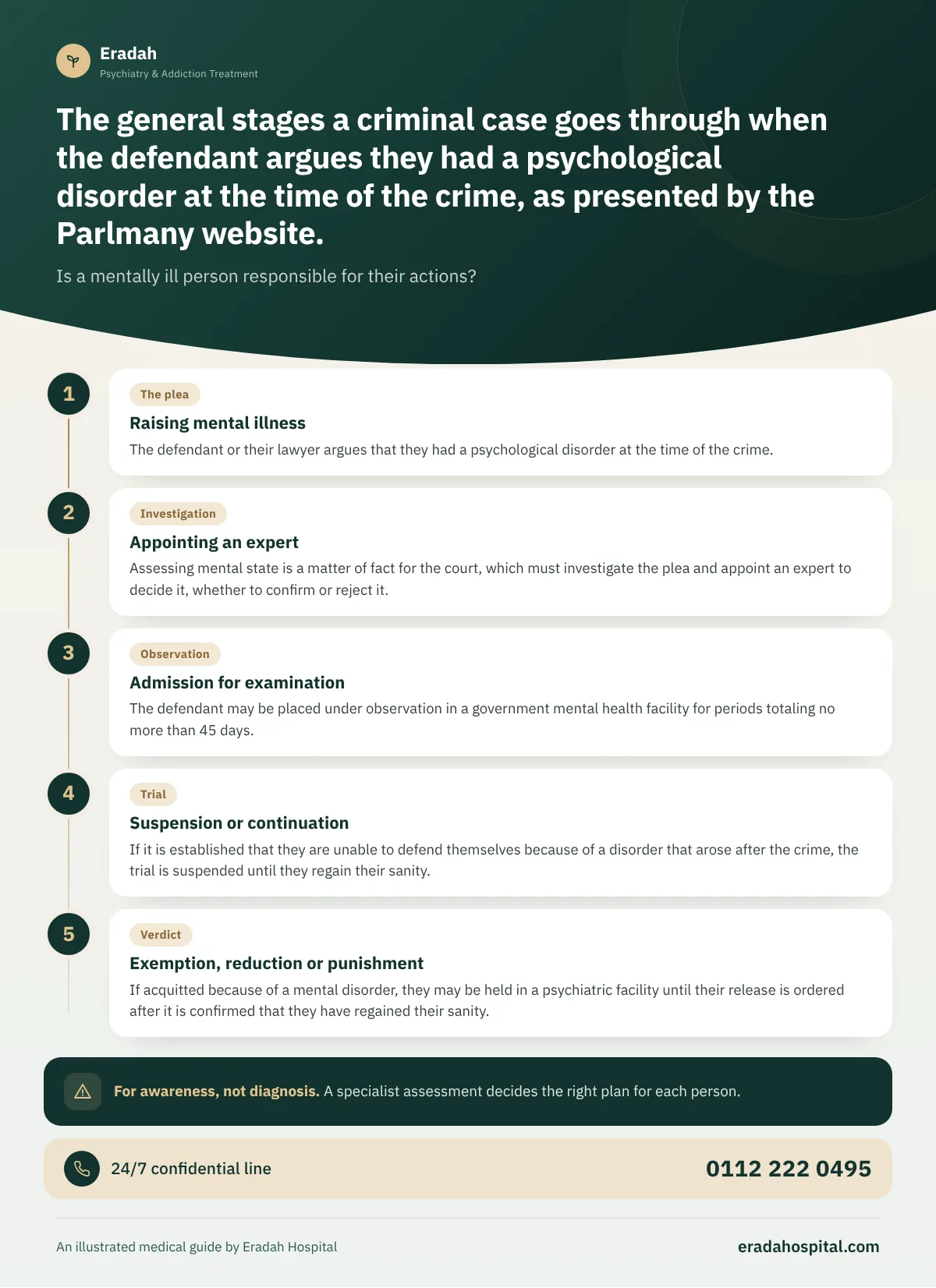
These stages are as presented by the Parlmany website, drawing on the provisions of the Code of Criminal Procedure in 2023, and their procedural details may change with any legislative amendment. In a Court of Cassation ruling in Appeal No. 27158 of Judicial Year 86, the court faulted a judgment that rejected the plea of mental illness merely because the case papers contained nothing to prove it, since raising this plea includes a call to investigate it, and it considered that a deficiency in the reasoning.
The psychiatrist's role in these cases
The doctor does not rule on innocence or guilt, but gives a technical opinion about the defendant's condition and its relation to the act. StatPearls explains that the role of the forensic evaluator is not to determine legal responsibility, but to analyze how the psychological condition relates to the capacities the law asks about at the time of the act. That is why earlier medical records help a great deal: a diagnosis documented before the incident, medications, hospital admissions, and the treating doctor's opinion.
Tips for the family of a person with mental illness
- Keep an organized medical file: diagnoses, medications, admission reports and the names of doctors.
- Do not ignore signs of relapse, as most crises begin with stopping medication, lack of sleep or substance use.
- If your relative becomes involved in an incident, immediately engage a specialist lawyer and tell them about the medical history.
- Remember that mental illness does not make a person a criminal, and most people with it are more likely to be victims than aggressors.
You can find a patient's rights inside psychiatric facilities under the Mental Patient Care Law, and how to deal with them at home, in the guide to dealing with a person with mental illness. At Eradah, any follow-up begins with a free, confidential consultation, and residential treatment for men is available at Eradah Psychiatric Hospital when the doctor decides it is needed.