What is psychosis?
A mother says: “My son has started shutting himself in, saying people are watching him from the window, and what he says doesn't hang together.” This is how many stories with psychosis begin: a change the family cannot understand, and a fear the person cannot explain. The reassuring news is that psychosis is a well-understood medical condition with treatment, and that the time that passes before treatment begins makes a big difference.
The U.S. National Institute of Mental Health (NIMH) defines psychosis as a group of symptoms affecting the mind in which there is a loss of some connection with reality, so that a person's thoughts and perceptions are disturbed and it becomes hard to tell what is real from what is not. Doctors call the appearance of these symptoms in a defined period a psychotic episode.
Psychosis is a little like “fever” in internal medicine: a sign that there is a problem, not the name of the problem itself. That is why the doctor's first question is always: what caused this episode? Is it part of a mental illness, the effect of a drug, or a symptom of a physical illness?
How common is psychosis? Psychosis in numbers
It is hard to count precisely how many people experience psychosis, because many never reach a doctor and because episodes vary in severity and length. But the available figures suggest it is closer to home than we think:
Sources: NIMH, StatPearls, and the study by McGrath and colleagues in the World Health Organization's World Mental Health Surveys (2015). No documented Egyptian figures are available, so we rely on global estimates.
The third figure needs some explanation: most of these experiences were brief, and about a third of people reported that it happened only once in their lives. So hearing a voice once or going through a strange suspicion does not necessarily mean a psychotic illness; it is repeated, persistent experiences that affect your life that call for assessment.
What does psychosis look like from the inside?
From the outside, a family sees strange behavior, but from the inside the person lives in a world whose rules have changed: voices are as clear as if someone were in the room, coincidences seem like deliberate messages, and the glances of passersby carry a threat. Because all of this seems completely real, fear is the dominant feeling, not the “hallucination” as we imagine it.
“I was certain the neighbors knew everything I was thinking, and that the ads on TV were aimed at me. It never occurred to me that I was ill; I thought everyone was deceiving me.” (An expression that recurs in different forms among many people who have had a psychotic episode, not a quotation from a specific patient.)
This is why many people do not ask for help themselves at first; limited awareness of being ill is part of the condition itself, not stubbornness, and it often improves with treatment. Here, the family's attention becomes the first door to treatment.
What are the main symptoms of psychosis?
The symptoms of psychosis revolve around three areas named by the NHS: hallucinations, most commonly hearing voices; delusions, most commonly a belief in a plot to harm you; and disorganized thinking and speech. They may be preceded by withdrawal, poor sleep and a decline in study or work, and are sometimes accompanied by “negative” symptoms such as flat emotion and reduced speech. The full details, with early warning signs, are on the page symptoms and signs of psychosis, and we also provide two guides on two of its best-known symptoms: auditory and visual hallucinations and paranoia.
How does a psychotic episode develop?
The first episode rarely comes out of nowhere. Doctors describe a typical course with many chances to intervene, though each person goes through it at their own pace:
- Before the episodeSubtle changes
Weeks or months of anxiety, isolation, disturbed sleep and declining performance, which the family takes for a “phase” or laziness.
- The acute episodePsychosis becomes clear
Hallucinations, delusions or disorganized speech; this is when the family realizes that something big has changed.
- The first weeks of treatmentStabilization
Anxiety settles first, then hallucinations and delusions gradually fade over days to weeks.
- The following monthsRecovery and return
A gradual return to regular sleep, study and work, with follow-up to learn the warning signs and prevent relapse.
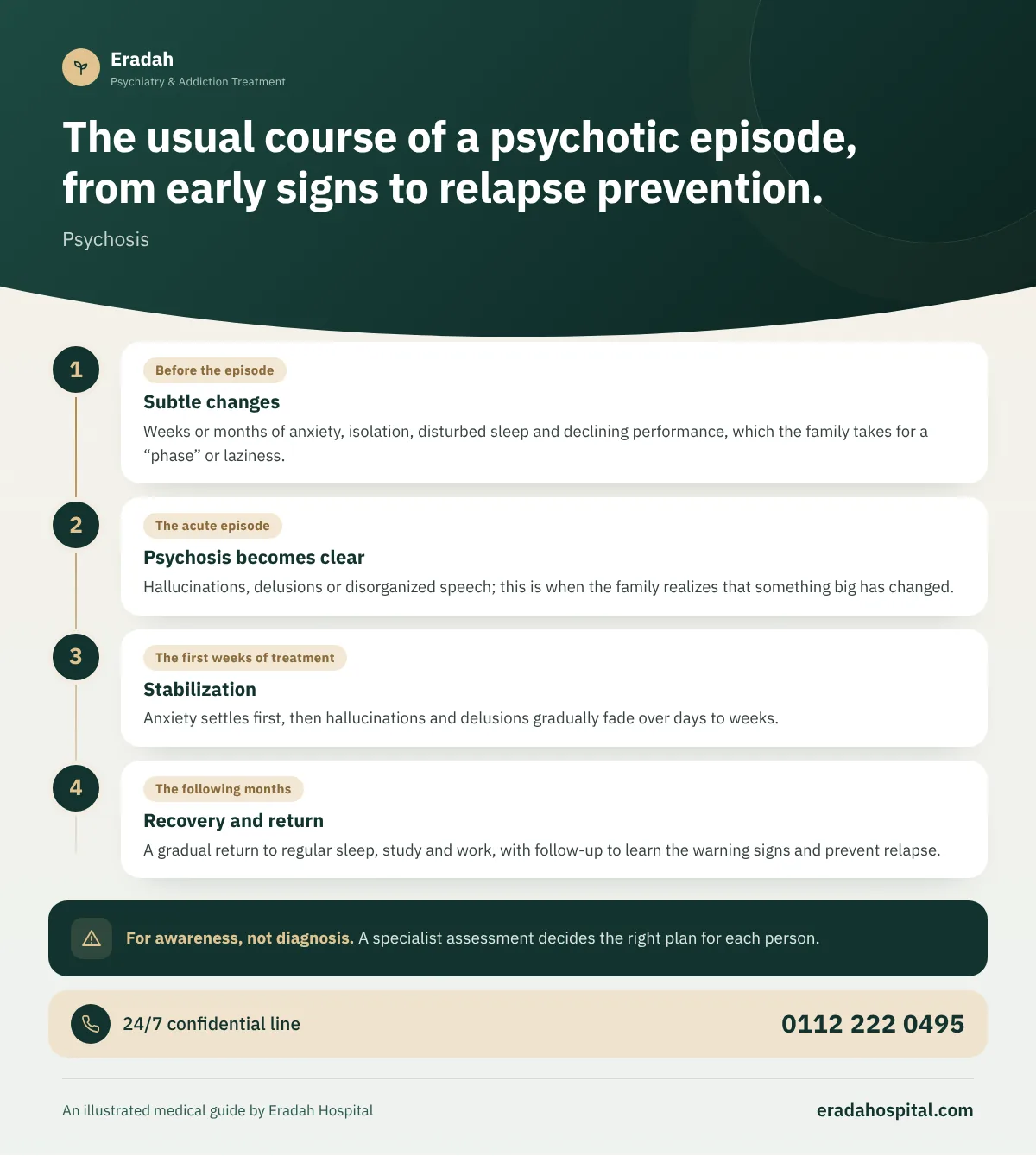
NIMH points out that shortening the duration of untreated psychosis is decisive, because early treatment often means a better recovery. Every month that passes without assessment prolongs suffering and delays the return to life.
Why does psychosis happen?
There is no single cause of psychosis; according to NIMH it results from a complex interaction between genetic predisposition, differences in brain development, and exposure to stress or trauma. It may be part of a mental illness such as schizophrenia, the effect of a substance or withdrawal from one, or a symptom of a physical illness, a medication or severe sleep deprivation. We explain these factors, and the role of hashish, trauma and lack of sleep, in detail on the page causes of psychosis; when a substance is the direct cause, the details are in the guide to drug-induced psychosis.
What is the difference between psychosis, schizophrenia and similar conditions?
Confusion among these terms is common even among educated people, and telling them apart matters because the treatment plan differs. The types of psychotic disorders themselves are covered in detail on the page psychotic disorders:
| The situation | Relationship to psychosis | What sets it apart |
|---|---|---|
| Schizophrenia | Psychosis is one of its main symptoms | A long-term disorder in which symptoms last a long time, with a decline in functioning |
| Psychotic depression | Psychosis within an episode of severe depression | Delusions that usually revolve around guilt, illness or poverty, and improve when the depression is treated |
| Delirium | It may resemble psychosis, with hallucinations and confusion | Clouded awareness and disorientation that fluctuate through the day; the cause is an acute physical problem that needs emergency care |
| Delusional disorder | A single fixed delusion | Usually without obvious hallucinations, and the person seems normal in the rest of their life |
The short rule: everyone with schizophrenia goes through psychosis, but not everyone who has a psychotic episode has schizophrenia. An episode may be brief and never recur, the effect of a substance, or part of a mood disorder, which is why a diagnosis is not made from a single episode.
Common myths about psychosis
| The myth | The truth |
|---|---|
| Psychosis means the person has “gone mad” forever | Many people recover fully from an episode, especially with early treatment, and for some it never returns. |
| A person with psychosis is violent by nature | Violence is not common, most patients are more likely to harm themselves than others, and the risk falls with treatment, according to NIMH. |
| It is a possession or the evil eye, not an illness | Psychosis is a medical condition with an explanation and a treatment, and delaying treatment while looking for other solutions prolongs suffering. |
| Hashish calms the nerves and has nothing to do with psychosis | Daily use of high-potency hashish is one of the strongest factors linked to first episodes in European studies. |
| Psychosis medications are addictive and leave the patient “drugged” all the time | Antipsychotics do not cause addiction, and they can be adjusted with the doctor if their side effects bother the patient. |
Can psychosis be treated? Do patients recover?
Yes. The NHS says psychosis is an acute condition that often ends in full recovery if treated. Treatment is usually based on antipsychotic medication together with cognitive behavioral therapy, family intervention and support in returning to study and work, and some patients may need a short stay in a psychiatric hospital during a severe episode. The course after that varies: some never have another episode, and some have occasional episodes with normal life in between. We explain the options, how long medication is needed and the family's role on the page treatment of psychosis.
When should you seek a psychological assessment?
Do not wait until you are sure that what is happening is “psychosis”. The purpose of early assessment is to understand what is going on before it gets worse, and it does not mean a verdict of chronic illness. Ask for a consultation if you notice:
- Talk of voices that no one else hears, or of being watched, a plot, or special messages.
- A lasting change in behavior or speech that is not in their nature, with growing isolation.
- Staying up for several nights in a row, or clearly neglecting hygiene and eating.
- Suspicions or hallucinations after using hashish or stimulants, even if they faded after a few days.
- Any talk of harming themselves or others; here help is urgent: ambulance (123) or the mental health support line 16328 (24 hours).
At Eradah, it starts with a confidential consultation with a psychiatrist, and the family can begin on their own if the patient refuses to attend, to learn how to persuade them and how to deal with them until they reach treatment.
Psychosis guide: everything you need to know
We have gathered everything about psychosis into 5 pages, each answering one question in detail. Choose what you are looking for:
Psychosis symptoms and signs
Learn about the symptoms of psychosis in detail: hallucinations, types of delusions, disorganized speech and negative symptoms, the early signs before a first episode, and when symptoms become an emergency.
Causes of psychosis
What causes psychosis? The role of schizophrenia, bipolar disorder and severe depression, high-potency hashish and stimulants, physical illnesses and medications, lack of sleep and trauma, and how the doctor identifies the cause.
Psychosis treatment
How is psychosis treated? Antipsychotics and when they start to work, cognitive behavioral therapy and family intervention, early intervention, and how the family can deal with a person with psychosis and prevent relapse.
Dealing with a person with psychosis: a family guide for before, during and after an episode
Dealing with a person with psychosis step by step: how to open the conversation at the first signs, how to act during an episode without arguing, how to persuade them to see a doctor, and how to support them after the episode ends to prevent it from returning.
The difference between psychosis and schizophrenia: are they the same thing?
What is the difference between psychosis and schizophrenia? Psychosis is a symptom that can come from many causes, while schizophrenia is a chronic illness that is one of them. Learn the differences in duration, symptoms and prevalence, and whether a first episode turns into schizophrenia.
An acute psychotic episode or danger to self? Get help now
- Hearing voices that command them to harm themselves or others, or talk of death or suicide
- Severe agitation or threats toward those around them, or behavior that puts them in danger in the street or at home
- Complete refusal to eat or drink, often out of fear of poisoning
- Psychosis that appeared suddenly with fever, confusion, severe headache or seizures
- Hallucinations and suspicion after using a drug or after suddenly stopping alcohol
Do not leave them alone. Speak calmly in short sentences without arguing with their ideas, and quietly keep sharp objects and medication out of their reach without confronting them. Call ambulance (123) or take them to the nearest emergency department, and you can call the mental health support line 16328 (24 hours) for advice. If they are aggressive, do not stay alone with them in a closed space, and tell the medical team about any substance they have used.
Ambulance 123 Mental health support line 16328