What is obsessive-compulsive personality?
“I can't leave anyone else to do the work; nobody will do it right except me.” This sounds like care and mastery, but when every project is delayed because the details never end, vacations are canceled because work can't wait, and everyone at home is worn out by rigid rules, these may be the features of obsessive-compulsive personality disorder.
Obsessive-compulsive personality disorder is one of the personality disorders, in the “anxious and fearful” cluster. The MSD Manual defines it as a pervasive preoccupation with orderliness, perfectionism and control, with no room for flexibility, in a way that slows or prevents the completion of tasks. The manual states that its average prevalence is about 4.7% and may reach 7.8%, that it is equal between men and women in population studies, and that traits of rigidity, perfectionism and restricted emotional expression in the family may contribute to its development.
Traits of obsessive-compulsive personality
The American diagnostic manual requires at least four of eight signs, beginning by early adulthood:
A preoccupation with rules, lists and schedules until the main point of the work is lost.
Reviews and corrects endlessly, so work is handed in late or is never completed.
Excessive devotion to work, not out of financial need, at the expense of rest and friends.
Strictness and inflexibility about values and rules, toward themselves and others.
Won't hand a task to anyone unless they do it exactly the person's way.
Holds on to their opinion, spends sparingly in preparation for the future, and may keep worn-out items of no value.
The MSD Manual adds that in people with this personality, expressions of affection are controlled and formal, they may not speak until they find the “perfect word,” they are uncomfortable with spontaneous emotional expression, and they criticize themselves harshly.
The difference between obsessive-compulsive personality and OCD
| Obsessive-compulsive personality disorder | Obsessive-compulsive disorder (OCD) | |
|---|---|---|
| Nature | A fixed pattern in the personality | Intrusive thoughts and compulsions |
| The person's own view | Sees their way as right and logical | Is distressed by their thoughts and usually knows they are exaggerated |
| Motive | Need for order and control | Easing the anxiety of obsessions |
| Who is more bothered | Usually the people around them | The person themselves |
| Can they occur together? | Yes, OCD may accompany it | Yes |
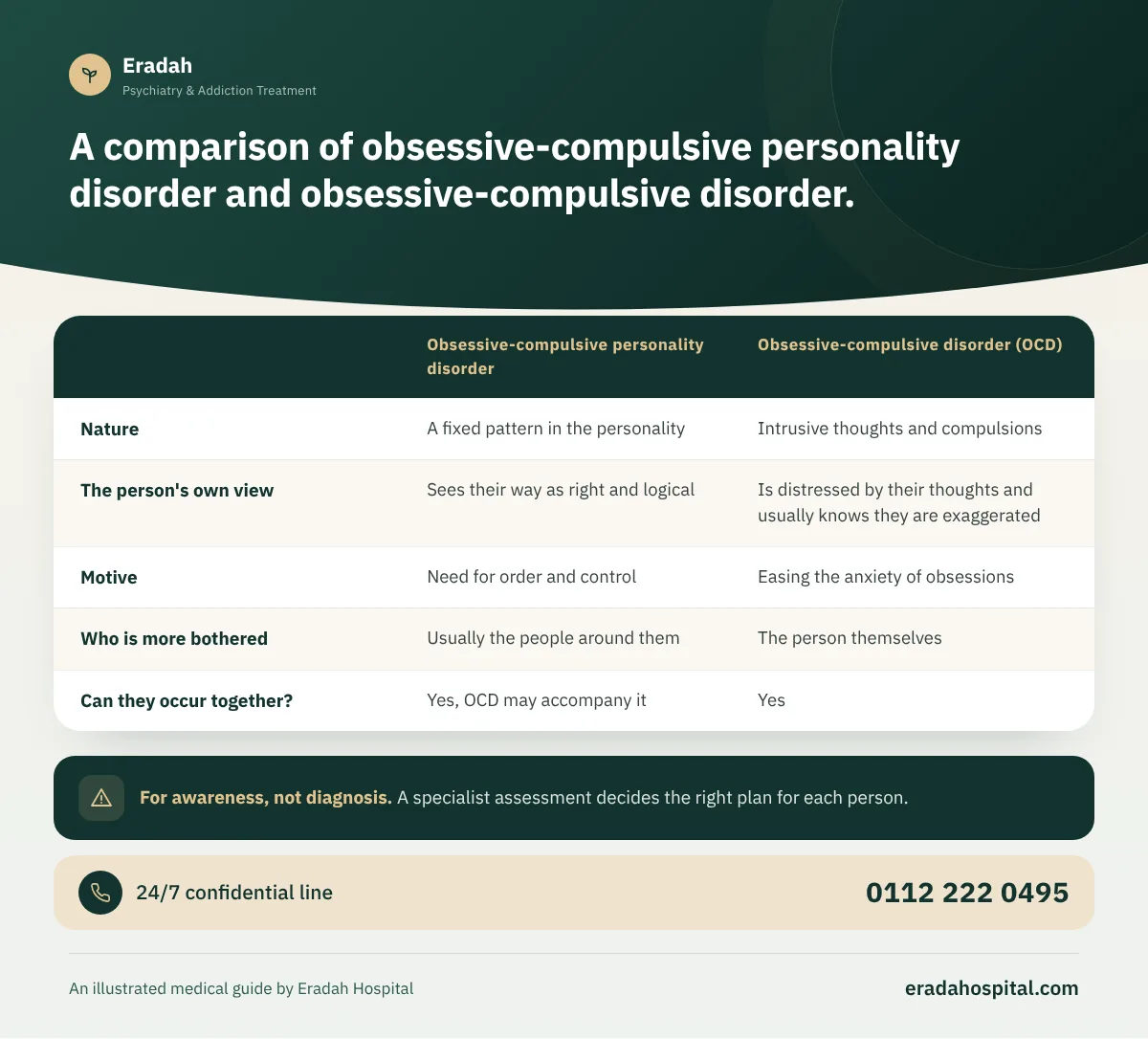
The MSD Manual explains that a person with OCD suffers from losing control over thoughts and actions they do not want, while a person with obsessive personality has a need for control that comes from a preoccupation with order, and their behavior fits their image of themselves. For that reason the first often comes for treatment on their own, while the second comes because of pressure from family, work problems or depression.
How does pathological perfectionism affect life?
- Delayed or stalled projects despite great effort.
- Tension at work from difficulty cooperating with colleagues and refusing help.
- Wearing out the family with strict rules and repeated criticism.
- Neglecting rest, vacations and hobbies, which paves the way to burnout.
- Depression and anxiety, which are common co-occurring disorders according to the MSD Manual.
How do you deal with an obsessive personality?
- Agree in advance on “good enough” and clear deadlines.
- Offer alternatives calmly and logically; they are persuaded more by argument than by emotion.
- Respect their need to plan, and tell them about changes early.
- Set boundaries when their rules extend into the details of your life.
- Encourage an assessment if depression appears or their relationships are badly affected.
Treatment of obsessive-compulsive personality disorder
According to the MSD Manual, psychodynamic psychotherapy and cognitive behavioral therapy can help; the latter challenges the thought “it must be perfect” and trains the person to accept mistakes and delegate tasks gradually. Limited data suggest that SSRI antidepressants may help, and the doctor decides whether they are needed and at what dose. The manual acknowledges that treatment can stall because of the patient's rigidity and need for control, so it takes patience and practical goals. Never start or stop any medication without a doctor.
When do you need a psychological consultation?
If perfectionism is costing you your job or your marriage, or you feel constantly exhausted and cannot rest, or signs of depression have appeared, an assessment can help you become more flexible without losing your high standards. You can start with sessions in Eradah's outpatient clinics, and the first consultation is free and confidential.
Severe depression or thoughts about death? Ask for help now
- Intense sadness and collapse after a failure at work or a mistake the person sees as “unforgivable”
- Harsh self-criticism with a feeling of worthlessness
- Insomnia, severe exhaustion and being unable to stop working
- Talking about death or life having no meaning
Do not leave the person alone. Ask them calmly and frankly what they are thinking, and listen without blame or mockery; asking does not plant the idea, it opens the door to help. Call an ambulance (123) or take them to the nearest emergency room, or call the mental health support line 16328 (24 hours), and keep medications and other things they could harm themselves with out of their reach.
Ambulance 123 Mental health support line 16328