What is hoarding disorder?
“We might need everything one day.” With this sentence, many people justify keeping old newspapers, bags, boxes and broken appliances. But when rooms fill up so much that no one can sit in them, and every conversation about getting rid of something turns into a fight, this is no longer a habit. It is a mental health disorder with a name and a treatment.
Hoarding disorder, or compulsive hoarding, was listed as a separate diagnosis in the American diagnostic manual DSM-5 in 2013, after previously being treated as part of obsessive-compulsive disorder. The American Psychiatric Association describes it by three features: a persistent difficulty discarding possessions, clutter that prevents the space from being used, and clear distress or impairment in daily life.
A systematic review published in 2019, covering 11 studies with more than 53,000 participants, estimated its prevalence at about 2.5%, with similar rates in men and women. The American Psychiatric Association notes that symptoms usually begin in adolescence, at around age 16, then become more severe with each decade of life, and that the condition is more common after age 60.
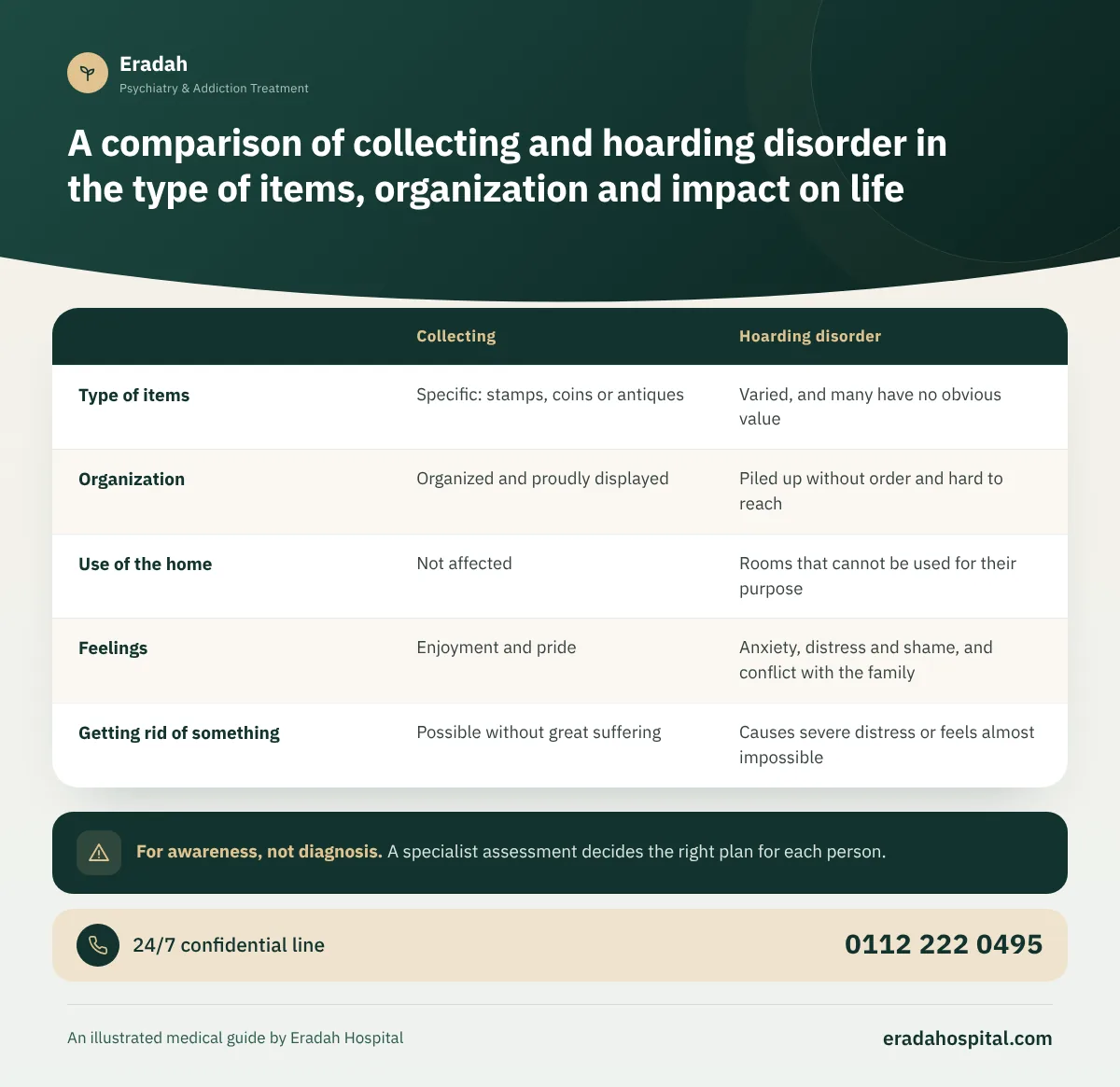
The difference between hoarding disorder and collecting
| Collecting | Hoarding disorder | |
|---|---|---|
| Type of items | Specific: stamps, coins or antiques | Varied, and many have no obvious value |
| Organization | Organized and proudly displayed | Piled up without order and hard to reach |
| Use of the home | Not affected | Rooms that cannot be used for their purpose |
| Feelings | Enjoyment and pride | Anxiety, distress and shame, and conflict with the family |
| Getting rid of something | Possible without great suffering | Causes severe distress or feels almost impossible |
Symptoms of hoarding disorder
- Great difficulty throwing away, selling or giving away items, even damaged ones.
- Buying or collecting free items that are not needed and have no place to go.
- Rooms, surfaces or hallways blocked by clutter.
- Difficulty organizing and making decisions, and constantly putting off sorting.
- Distress or anger if someone touches or moves the items without permission.
- Embarrassment about guests entering the home.
- Difficulty with daily tasks such as cooking, cleaning and paying bills, as the UK's National Health Service notes.
Why is it so hard for a person with the disorder to let go of things?
The item holds a memory or feels like part of the self, so throwing it away feels like a loss.
A strong fear of regretting it later if the item is needed and cannot be found.
Guilt about wasting something that could still be of use.
Great hesitation in sorting items and deciding what to let go of and what to keep.
The things around the person bring reassurance, and their absence raises anxiety.
Trouble planning and concentrating makes sorting an exhausting task.
Causes of hoarding disorder and risk factors
No single cause is known, and the American Psychiatric Association points out that genetics is part of the picture, alongside environment and traumatic events. The NHS lists related factors including having a relative who hoards, and going through a loss, a major change or a stressful event. It is also common with depression and anxiety, and it may overlap with compulsive buying, which adds to the buildup.
Risks of hoarding disorder
- Fires: Piled-up paper and fabric near electrical and gas sources is highly flammable fuel and makes escape difficult.
- Falls and injuries: especially for older adults moving through narrow pathways.
- Health problems: a buildup of dust, damp and insects, and difficulty cooking and keeping clean.
- Isolation and conflict: avoiding guests, and repeated clashes with family and neighbors.
- Animal hoarding: a particular form in which a person keeps large numbers of animals without being able to care for them, while denying their poor condition.
Treatment of hoarding disorder
The main treatment is cognitive behavioral therapy designed for hoarding. It includes understanding the beliefs attached to possessions, practicing sorting decisions, resisting bringing in new items, and gradually discarding at a pace the patient can tolerate, and it may include home visits. An analysis of 16 studies published in 2021 found a large improvement in symptoms after this treatment, which was maintained at follow-up.
Medication plays a supporting role: the NHS notes that a doctor may prescribe antidepressants to treat accompanying anxiety. The doctor chooses the appropriate medication, and no medication should be started or stopped without a doctor. Treatment can be delivered through outpatient clinics with regular sessions.
How can you help someone with hoarding disorder?
- Start with safety, not quantity: safe pathways, clear exits, and keeping clutter away from the stove and electricity.
- Talk about how the problem affects their own life, not about “filth” or “mess.”
- Do not touch or throw away their belongings without their permission.
- Celebrate small steps, such as clearing a single surface.
- Encourage them to have a psychological assessment, since many also have depression or anxiety that needs treatment.
When should you ask for help?
If clutter keeps the rooms of the home from being used, causes constant conflict, has become a safety threat, or comes with symptoms of depression, it is time for an assessment. If thoughts of hopelessness or self-harm appear, call the mental health support line 16328 or an ambulance (123).
A safety risk at home or severe hopelessness? Act now
- Paper or fabric piled near the stove, gas or electrical sources
- Blocked pathways or exits that would prevent escape in a fire or emergency
- An older person falling or being injured among piles and narrow pathways
- Many animals in the home in poor condition and without care
- Talk of hopelessness or thoughts of self-harm after an argument or a clean-out attempt
In immediate danger, such as a fire, collapse or injury, call an ambulance (123) or the relevant authorities right away, and coordinate with them instead of a sudden forced clean-out that destroys trust. If thoughts of hopelessness or self-harm appear, do not leave the person alone. Ask calmly, listen without blame, and call the mental health support line 16328 (24 hours) or an ambulance (123).
Ambulance 123 Mental health support line 16328