What is burnout?
You used to love your job, get excited about projects, and stay past closing time without complaint. Then the sound of an email notification began to weigh on your chest, you started counting the hours until the day ended, and you came home completely empty. This gradual shift is what specialists call burnout.
The World Health Organization included burnout in the International Classification of Diseases as an occupational phenomenon, not a medical condition, and defined it as a syndrome resulting from chronic workplace stress that has not been successfully managed. The definition is limited to the work context, but many people describe a similar state after years of caring for a sick relative, in motherhood without support, or in exhausting study.
Symptoms of burnout
Tiredness that does not go away with sleep or time off, and a feeling of being completely “empty” inside.
Indifference toward work, colleagues, and clients, and a cynicism and sarcasm that were not part of your nature.
Slowness, mistakes, forgetfulness, and a sense that your effort makes no difference.
Headaches, muscle pain, stomach upset, and catching colds often.
Irritability, tension, Sunday-night anxiety, and difficulty enjoying vacations.
More coffee and cigarettes, or relying on sedatives or alcohol to get through the days.
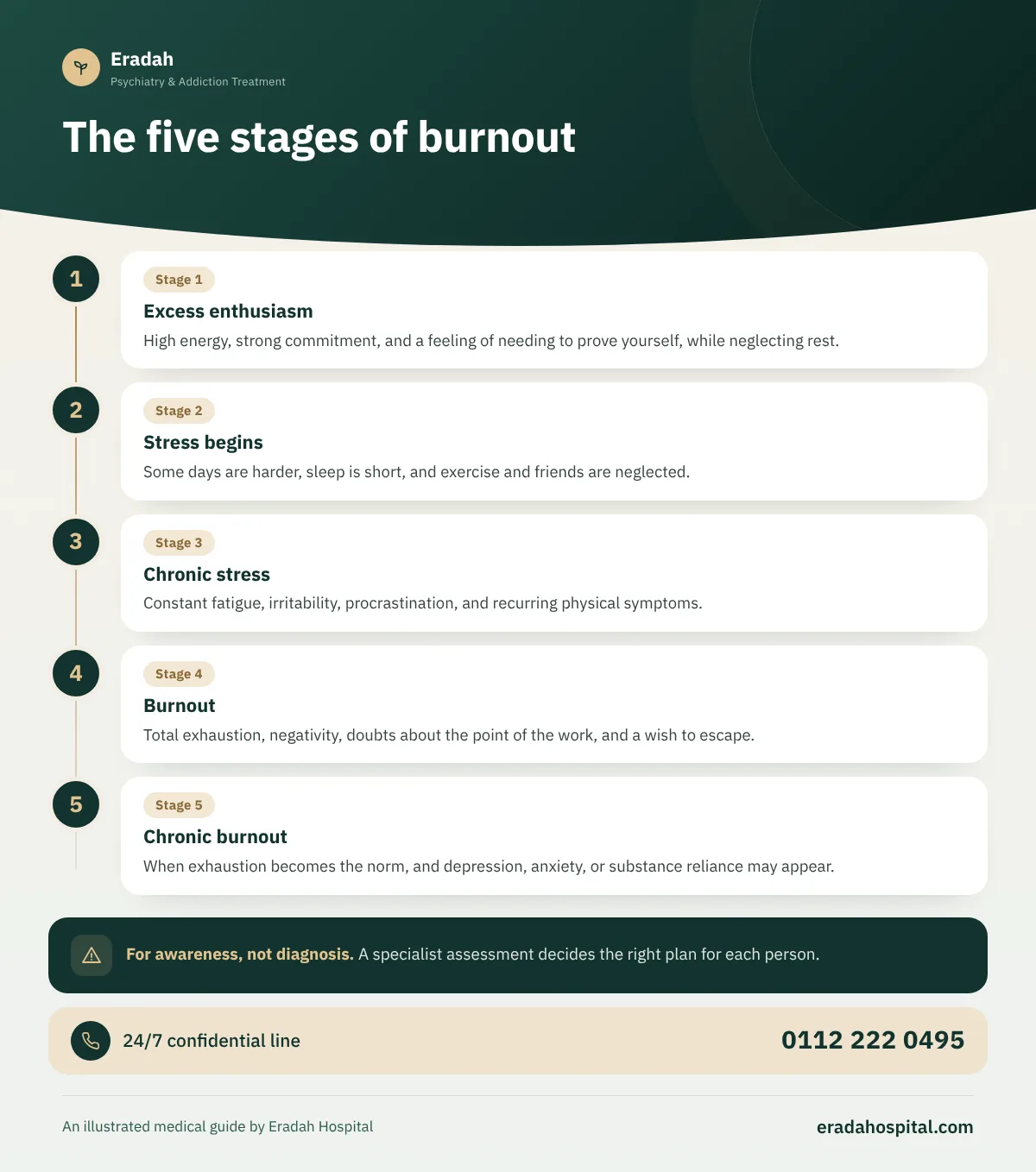
Stages of burnout
- Stage 1Excess enthusiasm
High energy, strong commitment, and a feeling of needing to prove yourself, while neglecting rest.
- Stage 2Stress begins
Some days are harder, sleep is short, and exercise and friends are neglected.
- Stage 3Chronic stress
Constant fatigue, irritability, procrastination, and recurring physical symptoms.
- Stage 4Burnout
Total exhaustion, negativity, doubts about the point of the work, and a wish to escape.
- Stage 5Chronic burnout
When exhaustion becomes the norm, and depression, anxiety, or substance reliance may appear.
Causes of burnout
The research of Christina Maslach, who created the best-known burnout measure, describes six main sources in the workplace: a workload beyond capacity, little control over decisions, lack of recognition, weak relationships and support, a sense of unfairness, and a conflict between the job and the person's values. The risk rises when this combines with traits such as perfectionism, difficulty saying “no,” and tying self-worth to achievement alone.
The difference between burnout and depression
| Burnout | Depression |
|---|---|
| Mainly work-related | Extends into every area of life |
| Often improves with a long vacation | Does not improve much with a change of setting |
| Enjoyment outside work is often still present | Loss of pleasure in all the things once enjoyed |
| Dominant feeling: exhaustion and negativity | Dominant feeling: sadness, hopelessness, and worthlessness |
| Occupational phenomenon | Mental health disorder that needs treatment |
But the line between them is not sharp, and prolonged burnout often develops into real depression. If you are not sure, you can start with the PHQ-9 depression test as a first step.
How do you recover from burnout?
- Acknowledge the problem: what you are going through is a sign that your energy has run out, and has nothing to do with weakness or laziness.
- Win back your sleep first: keep regular hours, and stop working at least an hour before bed.
- Set clear boundaries: a cut-off hour for email and phone, and real days of rest.
- Talk to your manager about workload and priorities instead of staying silent until you collapse.
- Rebuild what you neglected: daily movement, friends, and a hobby that has nothing to do with achievement.
- Review your relationship with work: what can be changed? And what deserves a bigger decision?
- Seek specialist help if you have not improved within weeks despite trying.
When do you need a psychiatrist?
If symptoms last more than two weeks despite rest, if loss of enjoyment has spread to everything, if chronic insomnia or panic attacks appear, if you have started relying on sedatives or substances, or if thoughts of death cross your mind, a psychiatric assessment is essential. It may be that things have gone beyond burnout into depression or an anxiety disorder that needs treatment.
Exhaustion turned into hopelessness or suicidal thoughts? Get help now
- Talking about wanting to die or that life is no longer worth it after prolonged work stress
- Loss of pleasure and interest in everything, not just work, for weeks
- Repeated panic attacks, or chest pain and palpitations with severe exhaustion
- Growing reliance on sedatives, sleeping pills, or alcohol to sleep and to cope
- Complete withdrawal from family and friends with a sense that there is no way out
Do not leave the person alone. Ask calmly and frankly how they are feeling and listen without blame or quick advice; asking about suicidal thoughts does not plant them but opens the door to help. Call ambulance (123) or go to the nearest emergency department if there is danger or chest pain, or call the mental health support line 16328, available around the clock, and keep medications and anything they could use to hurt themselves out of reach.
Ambulance 123 Mental health support line 16328