“I tried 3 antidepressants and nothing helped. Is there anything else?” This question is one of the most common reasons patients start looking into TMS. The answer is yes: there are options when medication is not enough, and this is one of them, but it has specific uses and limits you should know about.
What is transcranial magnetic stimulation?
Repetitive transcranial magnetic stimulation, abbreviated rTMS or TMS, belongs to the group of “brain stimulation therapies.” The US National Institute of Mental Health explains that the coil generates a magnetic field about as strong as an MRI machine’s, switched on and off very rapidly, which induces weak electrical currents in a specific brain area and activates the nerve cells and circuits connected to it. In depression, the target area is usually the left prefrontal cortex.
Uses of TMS
According to the US National Institute of Mental Health, the US Food and Drug Administration approved the first TMS device in 2008 to treat depression in people who have not responded to at least one antidepressant in the current episode. Approved uses have since expanded to include severe obsessive-compulsive disorder in 2018, migraine, anxiety accompanying depression, and helping people quit smoking. Cleveland Clinic notes that researchers are studying it in other conditions, including bipolar disorder, post-traumatic stress disorder, schizophrenia and substance use disorders, but these are still under investigation.
How does a TMS session work?
- The patient sits in a comfortable chair and removes any metal, such as metal-framed glasses and jewelry.
- They wear earplugs because the machine makes a loud clicking sound.
- The doctor sends test pulses to determine the right intensity, and the hand or thumb may twitch slightly.
- The repeated pulses begin, and the patient feels a light tapping on the scalp.
- The session lasts from a few minutes to about 40 minutes depending on the protocol, then the patient returns to their activities.
The US National Institute of Mental Health notes that the usual schedule is daily sessions, 5 days a week, for 4 to 6 weeks, and that there are “accelerated” protocols that give several sessions in a single day and often work within a week. The doctor determines the appropriate protocol.
Side effects of TMS
- Discomfort where the coil is placed on the head.
- Tightening or tingling in the scalp, jaw or facial muscles during the session.
- Mild headache or brief dizziness.
- Seizures are possible but very rare, and the risk is higher with a history of epilepsy or medications that lower the seizure threshold.
The institute stresses that most symptoms are mild and short-lived when guidelines are followed, and that its long-term effects still need more research.
Who is not suited to TMS?
Cleveland Clinic notes that it may not be safe for people with metal or electronic devices implanted in the head or neck, such as a cochlear implant, brain aneurysm clips, implanted brain stimulators, or shrapnel near the head, because the magnet could move them. People with a history of epilepsy or who take medications that raise seizure risk also need special evaluation. Dental fillings and artificial joints away from the head usually do not prevent treatment.
The difference between TMS and ECT
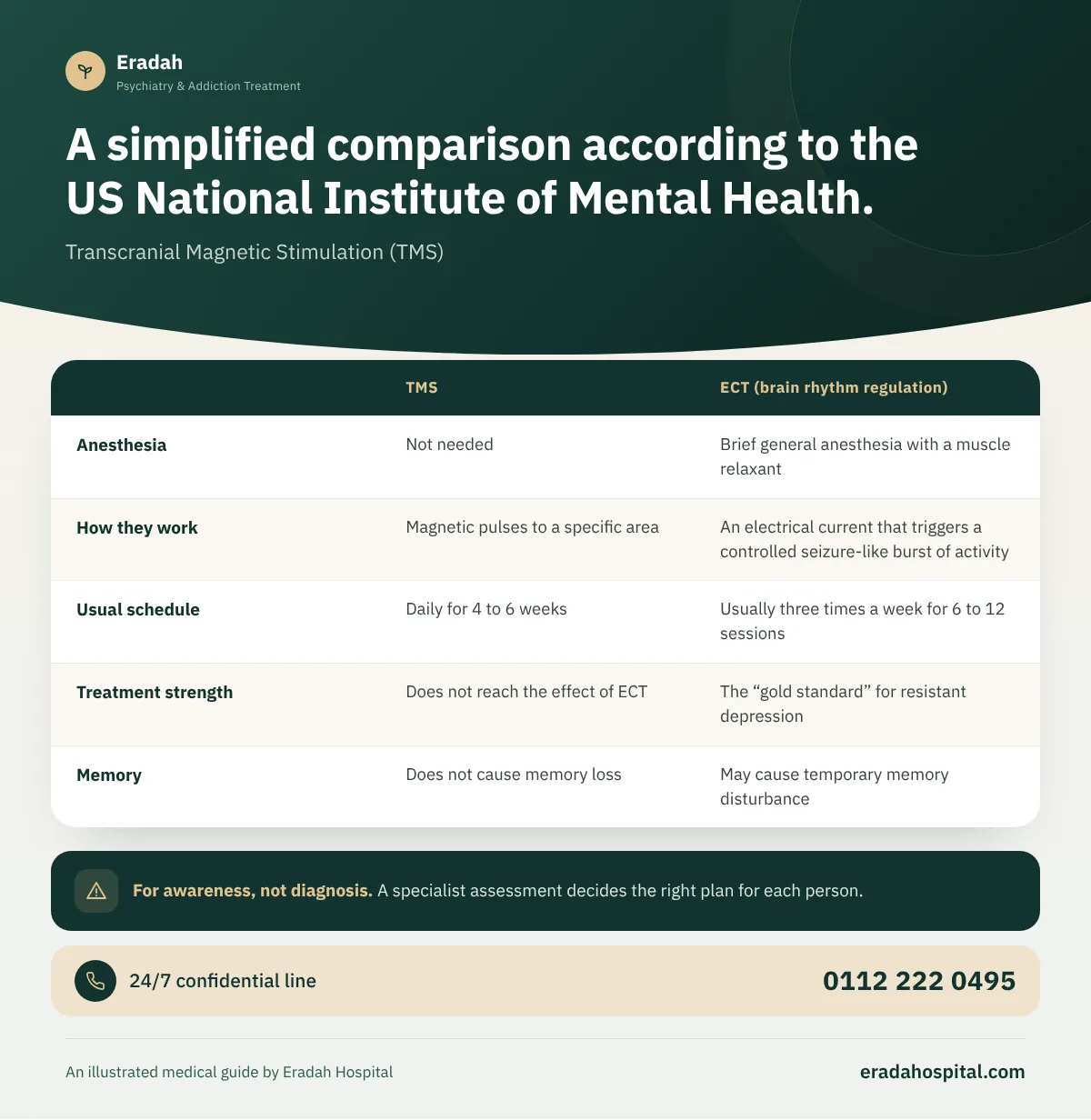
| TMS | ECT (brain rhythm regulation) | |
|---|---|---|
| Anesthesia | Not needed | Brief general anesthesia with a muscle relaxant |
| How they work | Magnetic pulses to a specific area | An electrical current that triggers a controlled seizure-like burst of activity |
| Usual schedule | Daily for 4 to 6 weeks | Usually three times a week for 6 to 12 sessions |
| Treatment strength | Does not reach the effect of ECT | The “gold standard” for resistant depression |
| Memory | Does not cause memory loss | May cause temporary memory disturbance |
Does TMS treat addiction?
The US National Institute on Drug Abuse notes that TMS is approved for quitting smoking and is currently being studied for treating other substance use disorders. An international consensus paper in 2019 concluded that early results are encouraging but the methods used in studies vary, and it has not yet become an approved treatment for alcohol or drug addiction. So beware of any provider that presents it as a miracle cure for addiction instead of a comprehensive addiction treatment program.
How do you know if it suits you?
It starts with the psychiatrist’s assessment of your history of depression, the medications you have tried and their doses, and any accompanying conditions such as substance use or post-traumatic stress disorder. Eradah does not offer TMS sessions, but the psychiatrist at the Eradah psychiatric hospital assesses your case and reviews the available options, including medication adjustment and psychotherapy. If they decide TMS is the best fit for you, they refer you to a specialist provider that offers it and continue to follow your treatment plan with you.