Where do you start the journey of quitting smoking?
Start with a clear decision and a written plan before you throw away the pack. People who prepare to quit and know what to expect succeed more often than those who stop suddenly in a moment of enthusiasm and are then caught off guard by the craving.
- Define your reason: Write down your personal reasons for quitting (children, health, money, fitness) and keep them in front of you.
- Choose a date within the next two weeks, preferably during a less stressful period.
- Know your triggers: For a few days, record when and why you smoke each cigarette.
- Prepare your environment: Get rid of cigarettes, lighters, shisha tobacco, and vape devices, and clear the smell from the car and clothes.
- Tell the people close to you and ask them not to offer you cigarettes or smoke in front of you.
- Consult a doctor to choose a suitable aid before the quit day, not after it.
What happens when you stop? Withdrawal symptoms and how long they last
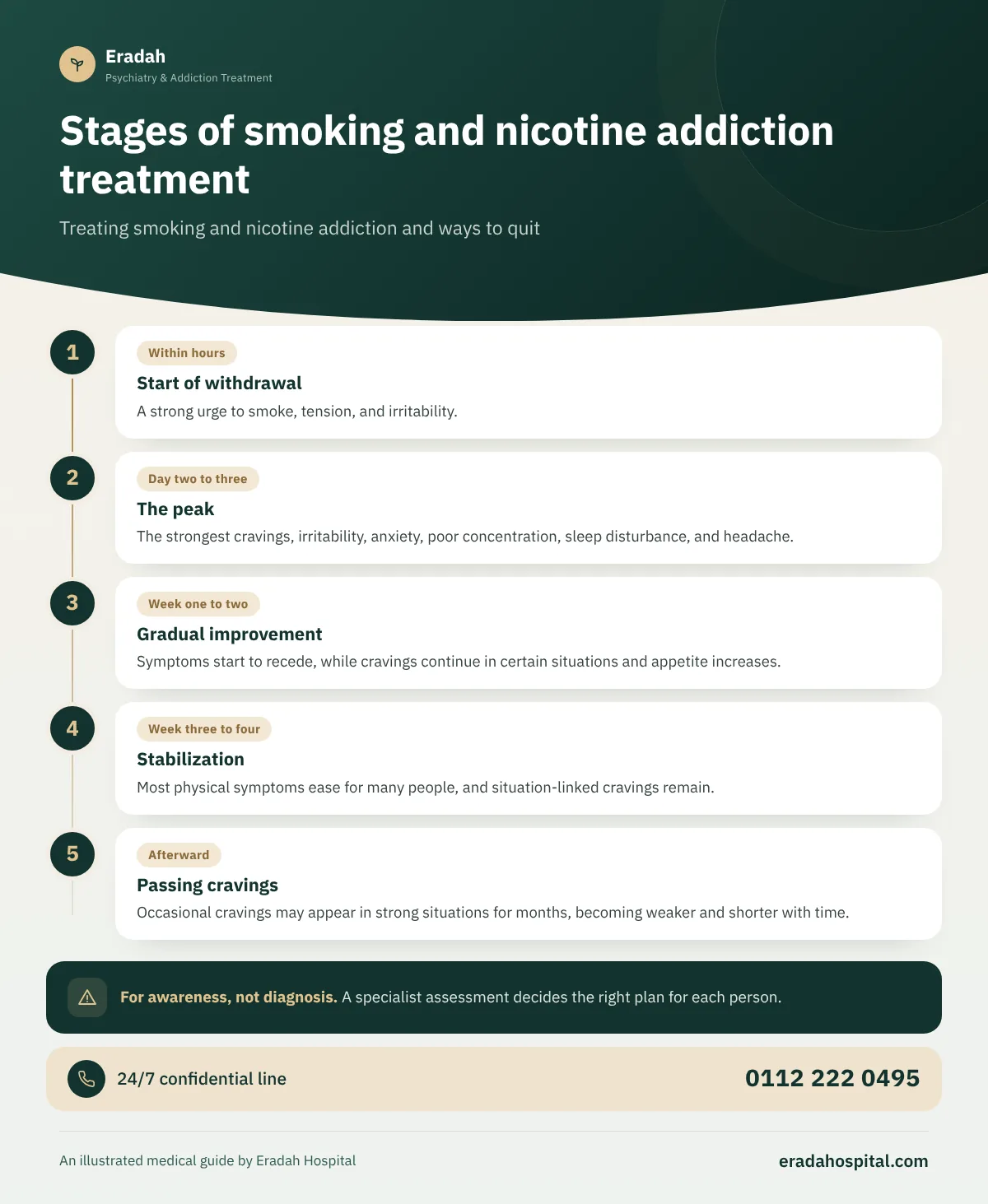
According to the US National Library of Medicine (MedlinePlus), nicotine withdrawal symptoms begin within two to three hours of last use, peak two to three days after stopping, and then ease gradually over weeks. This varies from person to person:
- Within hoursStart of withdrawal
A strong urge to smoke, tension, and irritability.
- Day two to threeThe peak
The strongest cravings, irritability, anxiety, poor concentration, sleep disturbance, and headache.
- Week one to twoGradual improvement
Symptoms start to recede, while cravings continue in certain situations and appetite increases.
- Week three to fourStabilization
Most physical symptoms ease for many people, and situation-linked cravings remain.
- AfterwardPassing cravings
Occasional cravings may appear in strong situations for months, becoming weaker and shorter with time.
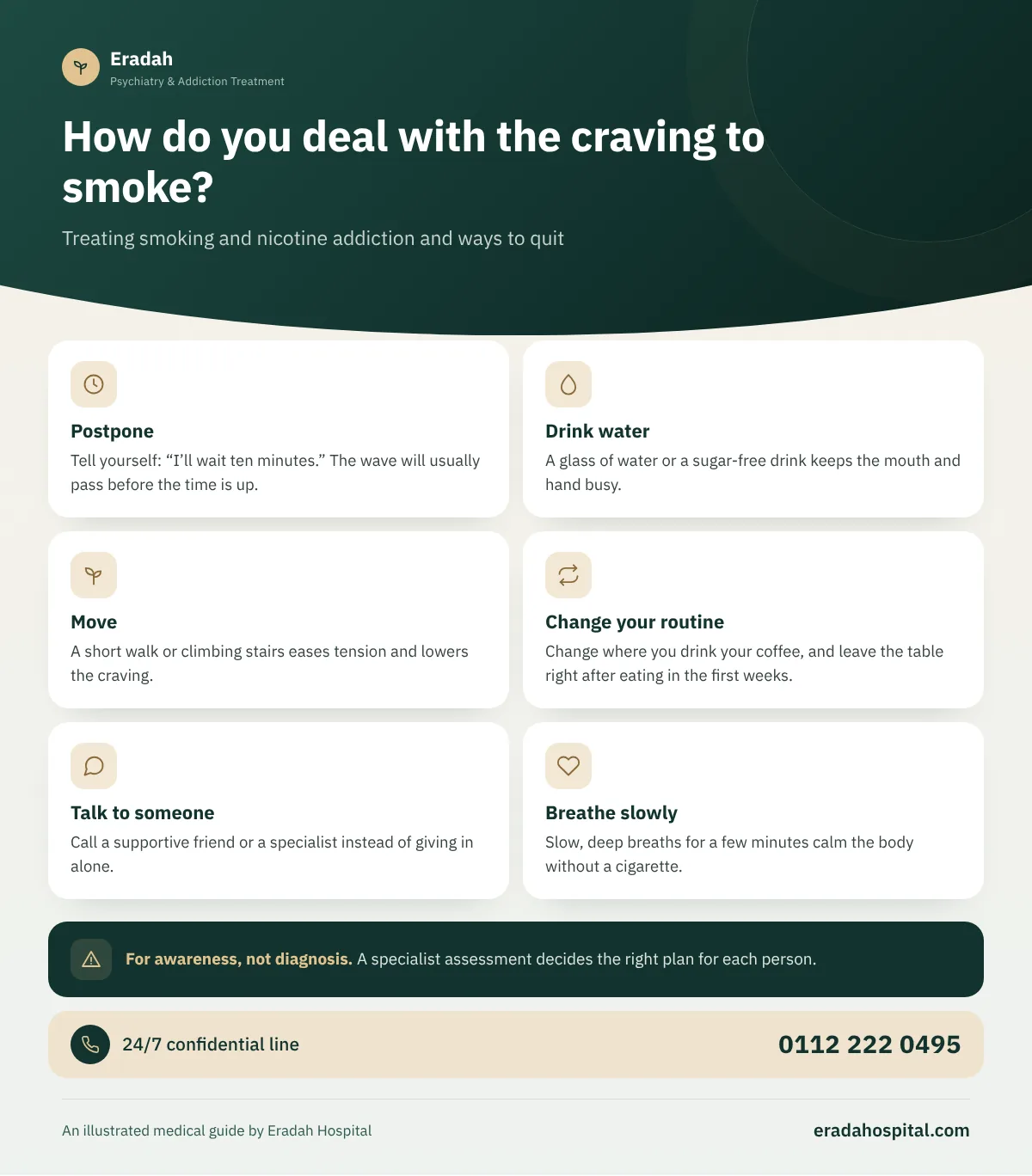
How do you deal with the craving to smoke?
Tell yourself: “I’ll wait ten minutes.” The wave will usually pass before the time is up.
A glass of water or a sugar-free drink keeps the mouth and hand busy.
A short walk or climbing stairs eases tension and lowers the craving.
Change where you drink your coffee, and leave the table right after eating in the first weeks.
Call a supportive friend or a specialist instead of giving in alone.
Slow, deep breaths for a few minutes calm the body without a cigarette.
Which medications and nicotine replacements help with quitting?
Helpful medications do not “create willpower,” but they ease withdrawal symptoms and cravings, allowing you to focus on changing your behavior. The World Health Organization and major health bodies recommend them together with behavioral support. We list them here by name and role only:
| Aid | How it helps | Important notes |
|---|---|---|
| Nicotine replacement (patches, gum, lozenges, spray) | Supplies the body with nicotine without smoke, easing withdrawal symptoms, then is tapered gradually | Combining a patch with a fast-acting form works better for many people, and the doctor or pharmacist sets the plan |
| Varenicline | Acts on nicotine receptors in the brain, reducing craving and the pleasure from a cigarette | A prescription drug, and the doctor monitors side effects such as nausea, vivid dreams, and mood changes |
| Bupropion | An antidepressant that eases craving and withdrawal symptoms | By prescription, and not suitable for people with a history of seizures or certain eating disorders |
| Cytisine | A plant-derived substance that works in a way similar to varenicline | Available in some countries only, and under medical supervision |
What is the role of behavioral therapy and psychological support?
Behavioral support is half of the treatment, and includes individual or group sessions that help you understand your triggers, learn alternatives, and plan for difficult situations. Approaches used include:
- Cognitive behavioral therapy: To change thoughts like “a cigarette relaxes me” and learn other ways to cope with stress.
- Motivational interviewing: For those who have not yet made up their mind, helping them discover their own reasons for change without pressure.
- Regular follow-up: Weekly meetings or calls in the first weeks, and the UK’s National Health Service (NHS) notes that support programs usually run for about 12 weeks.
- Family support: Involving a partner or family in the plan, especially if there are other smokers at home.
How do you quit shisha or vaping specifically?
Shisha is part of a social ritual, so quitting it needs a plan for the session itself: suggest meeting places that do not serve shisha, or order your drink without the “coal,” and tell your friends about your decision openly. Someone who smokes shisha daily is truly dependent on nicotine and may benefit from the same quit aids.
As for vaping, quitting it is similar to quitting cigarettes, with the added difficulty that it is available all day without restrictions on place. Health bodies differ on using it as a quit aid: some, such as the UK’s NHS, believe it may help adult smokers leave cigarettes, while the World Health Organization warns of its harms and does not recommend it. What is agreed is that it is not suitable for nonsmokers and teenagers, and that the ultimate goal is freedom from nicotine altogether.
What happens to your body after you quit smoking?
According to the World Health Organization, the benefits begin faster than most smokers expect:
| After | What improves |
|---|---|
| 20 minutes | Heart rate and blood pressure drop |
| 12 hours | Blood carbon monoxide returns to normal |
| 2 – 12 weeks | Circulation improves and lung efficiency increases |
| 1 – 9 months | Coughing and shortness of breath decrease |
| 1 year | The risk of coronary heart disease falls to about half that of a smoker |
| 5 – 15 years | The risk of stroke becomes the same as a nonsmoker’s |
| 10 years | The risk of lung cancer falls to about half, and the risk of cancers of the mouth, throat, esophagus, bladder, cervix, and pancreas decreases |
| 15 years | The risk of coronary heart disease becomes the same as a nonsmoker’s |
What do you do if you go back to smoking?
Going back after a quit attempt is very common, and most of those who eventually succeeded went through earlier attempts. What matters is to treat the “slip” cigarette as information, not a final verdict:
- Don’t say “that’s it, I’ve ruined everything”; one cigarette does not erase the days you succeeded.
- Ask yourself: What situation came before the return? Stress? A gathering? Alcohol?
- Add to your plan a way to handle that specific situation.
- See your doctor if you were not using a quit aid, or if your current aid was not enough.
- Set a new quit date soon instead of postponing it indefinitely.
Where can you find help to quit in Egypt?
According to the Egyptian Cabinet’s Information and Decision Support Center, the Ministry of Health and Population provides quit-assistance clinics in a number of governorates and hotlines for inquiries, including hotline 105, in addition to the mental health support line 16328. Numbers and services may change, so confirm them through the ministry’s official channels. You can also start with your doctor or pharmacist to discuss the available options.
A hospital for smoking addiction treatment
Most smokers quit successfully without spending a single night in a hospital; what they need is a doctor to choose the right medication, behavioral support to face triggers, and close follow-up in the first weeks. But the picture changes when smoking is part of a wider addiction or comes with depression or schizophrenia, where a specialized psychiatric setting becomes the better fit. Here is a table to help you assess any provider before you begin:
| What to ask about | Why it deserves attention |
|---|---|
| Is your nicotine dependence measured before choosing an aid? | The severity of dependence determines the type and duration of medication support. |
| Does the doctor review your mental health and current medications? | Stopping may change mood and affect the level of some psychiatric medications. |
| Does the program cover shisha, vapes, and chewing tobacco? | Many people switch between them without counting that as smoking. |
| Is there follow-up after the quit day? | The first days are the hardest, and an early slip needs quick intervention, not blame. |
| Is smoking treated as part of recovery from drugs or alcohol? | Leaving it in place keeps a door open to old triggers. |
At Eradah, the doctor sets the medication plan and the specialists work on triggers and habits, mostly through outpatient follow-up. If quitting is part of treatment for another addiction, it is integrated into the same inpatient program. And learn the truth about vaping before you consider it a safe alternative.
How does Eradah Center help you quit?
At Eradah we treat smoking as a real addiction, especially in people with anxiety or depression or those recovering from addiction to other substances. We begin by assessing the degree of dependence, general health, and mental state, then build a plan that combines behavioral therapy, the right medication aid, and regular follow-up, involving the family when needed. All of this is in complete confidentiality and without judgment.