Is OCD treatable?
Yes. OCD is one of the disorders with a specific, strongly proven psychological treatment, alongside effective medications. The goal is not for intrusive thoughts to disappear completely, since they pass through every human mind, but for them to lose their control over the patient’s life.
The British NICE guidelines use a “stepped care” model: mild cases start with low-intensity psychological therapy, moderate and severe cases need more intensive treatment or a combination of psychological therapy and medication, and treatment-resistant cases are referred to specialist services.
What is exposure and response prevention therapy?
It is the heart of OCD treatment, and the International OCD Foundation describes it as the first and most effective psychological treatment. It has two elements:
The patient gradually faces the thoughts, situations or objects that trigger the obsession, starting with the easiest.
Refraining from the usual ritual, such as washing, checking or seeking reassurance, and tolerating the anxiety until it settles on its own.
The brain discovers that anxiety falls without rituals and that the feared disaster does not happen.
The patient is not forced into anything. Instead, with the therapist, they build a “ladder” of situations ranked by difficulty, and move up step by step when ready:
| Level | Exercise | Required abstention |
|---|---|---|
| 1 | Touching the handle of their bedroom door | Not washing hands for a period agreed with the therapist |
| 2 | Touching the outside handle of the apartment door | Not using disinfectant afterward |
| 3 | Sitting on a chair in a public place | Not changing clothes right after getting home |
| 4 | Shaking hands with people at an event | Not asking for reassurance |
| 5 | Touching the floor of the house and then touching their belongings | Not cleaning the belongings again |
At first anxiety rises, which is expected and part of the treatment. With repetition, the patient learns that they can tolerate doubt without rituals, and the cycle gradually weakens. A distinguishing feature of this treatment is that its effect often lasts after the sessions end, because the patient has learned a skill that does not depend on anything external.
What other psychological treatments are there for OCD?
- Cognitive therapy: works on the beliefs that feed OCD, such as exaggerated responsibility and confusing thought with action, and is often combined with exposure.
- Acceptance and commitment therapy: helps the person let thoughts pass without struggling with them, and move toward what matters to them even when the thoughts are present.
- Inference-based cognitive behavioral therapy: a newer approach that focuses on the way of thinking that generates obsessive doubt.
- Group therapy and remote therapy: the British guidelines mention group formats and telephone-based formats as part of low-intensity treatment for milder cases.
What medications are used to treat OCD?
| Group | Examples | Role and notes |
|---|---|---|
| SSRI antidepressants | Fluoxetine, fluvoxamine, sertraline, paroxetine, citalopram | The first medication option; its effect may take up to 12 weeks, and doses decided by the doctor are often higher than those used for depression |
| Clomipramine | A tricyclic antidepressant | Used when more than one SSRI has not worked well enough, or by the patient’s preference; it needs heart monitoring because it is more dangerous in overdose |
| Add-on medications | Low doses of some antipsychotics, decided by the specialist | Sometimes added for treatment-resistant cases, and not used alone to treat uncomplicated OCD |
The British guidelines recommend against using certain medications for uncomplicated OCD, such as antipsychotics alone, tricyclic antidepressants other than clomipramine, or other classes of antidepressants not proven effective for it. Sedatives from the benzodiazepine group are not a treatment for OCD; they may ease anxiety briefly but do not break the cycle and can cause dependence.
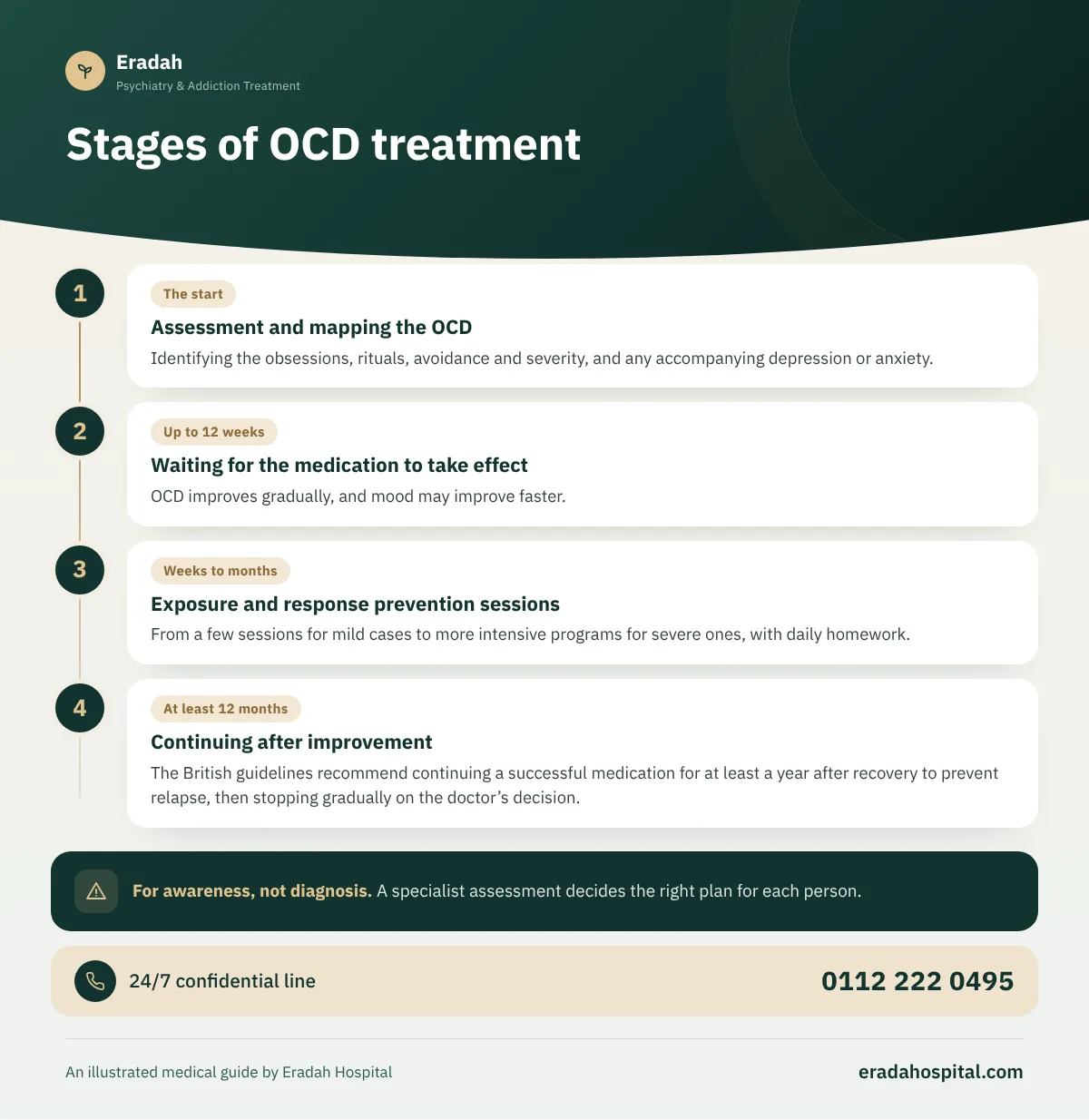
How long does OCD treatment take?
- The startAssessment and mapping the OCD
Identifying the obsessions, rituals, avoidance and severity, and any accompanying depression or anxiety.
- Up to 12 weeksWaiting for the medication to take effect
OCD improves gradually, and mood may improve faster.
- Weeks to monthsExposure and response prevention sessions
From a few sessions for mild cases to more intensive programs for severe ones, with daily homework.
- At least 12 monthsContinuing after improvement
The British guidelines recommend continuing a successful medication for at least a year after recovery to prevent relapse, then stopping gradually on the doctor’s decision.
What if OCD does not respond to treatment?
Medical reviews indicate that a proportion of patients, estimated at about a quarter to more than a third, do not improve enough with the first treatment. This does not mean the case is hopeless; it means the plan needs adjusting:
- Making sure exposure therapy was applied correctly and with enough intensity.
- Trying another SSRI, or switching to clomipramine.
- Combining medication with intensive psychological therapy if they were not already combined.
- Adding an add-on medication chosen by the specialist doctor.
- For severe treatment-resistant cases, specialized centers around the world offer options such as intensive treatment programs or magnetic brain stimulation, after careful assessment.
How is OCD treated in children and teenagers?
The British guidelines recommend that treatment of children and teenagers start with cognitive behavioral therapy that includes exposure and response prevention, with the family involved. A medication, such as sertraline or fluvoxamine, is added only if psychological therapy is not enough, and under close follow-up by a child psychiatrist.
Treatment is delivered in a way that suits the child’s age. The OCD is sometimes given a name or character that the child learns to “stand up to,” and the parents are partners in encouraging the child with the exercises at home.
How does the family stop accommodating OCD rituals?
Family accommodation, meaning taking part in rituals, answering reassurance questions or changing home life to avoid upsetting the patient, comes from love but feeds the OCD. That is why reducing it is part of the treatment itself. The International OCD Foundation advises doing so deliberately and gradually:
- Agree on a plan with the patient and the therapist, and do not withdraw accommodation suddenly without preparation.
- Start by reducing one form of accommodation, such as how many times you answer the same reassurance question.
- Replace reassurance with supportive phrases such as: “I know you’re anxious, and I’m sure you can bear this anxiety.”
- Do not take part in washing or checking on their behalf, while staying calm and empathetic.
- Praise every time they resist a ritual, even briefly.
- Seek support for yourselves too; caring for someone with OCD is exhausting.
How is religious OCD treated while respecting religion?
Treatment of religious OCD does not ask the patient to give up worship; it helps them perform worship as most believers do, without the excess that the OCD imposes. For example, they practice being content with a single ablution despite doubt, or finishing the prayer without repeating it. The therapist may involve a trusted religious scholar to explain the religious limits to the patient, so they are reassured that giving up the excessive ritual is not neglecting their faith.
Does a person with OCD need inpatient treatment?
Most patients are treated in outpatient clinics with regular sessions. Inpatient treatment or intensive programs are suggested when the OCD is very severe and takes up most of the day, when it comes with severe depression or thoughts of self-harm, when the patient cannot care for themselves, or when there is substance use that needs safe detox.
How do you prevent OCD from coming back after improvement?
- Keep to the principle of “no to rituals” even after improvement, and deal quickly with any small ritual that returns.
- Expect some thoughts to return in times of stress, and treat them as a chance to practice, not a sign of failure.
- Do not stop the medication on your own when you feel better; continuing lowers the risk of relapse.
- Keep regular follow-up sessions, especially at times such as exams, pregnancy or a job change.
Choosing a hospital for OCD treatment
OCD treatment depends on one skill above all others: the therapist knows how to build an exposure ladder and prevent rituals step by step, without the sessions turning into repeated reassurance that feeds the OCD. Many patients spend years in comforting conversations that never come near exposure, or switch between medications that were not given enough time. So focus your questions on the details:
| Question | A reassuring answer |
|---|---|
| Do you actually apply exposure and response prevention? | Yes, with a written plan and home exercises between sessions |
| When do you judge whether a medication has worked? | After it has had enough time, and the decision belongs to the doctor, not a quick trial |
| What about the family? | Sessions that teach them to stop taking part in rituals and answering reassurance questions |
| And if the OCD is religious? | Full respect for belief, while distinguishing between worship and a compulsive ritual |
| And if the patient does not improve? | Reassessment and a more intensive program instead of closing the file |
At Eradah the psychiatrist and the specialist work together on the plan, and accompanying depression or substance use is treated in the dual diagnosis track. Children and teenagers are seen for assessment and follow-up. Most cases are followed as outpatients; residential treatment, which is for men only, is considered when OCD consumes the whole day. To learn about its different forms, see types of OCD. Call or WhatsApp 01122220495 any time for a free, confidential first consultation, or leave us a message and we will call you back.
OCD treatment at Eradah
At Eradah, treatment starts with a careful psychological assessment that maps the obsessions and rituals and uncovers any accompanying depression, anxiety or substance use. The psychiatrist and therapist then set a plan combining exposure and response prevention therapy with suitable medication, with sessions for the family to learn to stop accommodating rituals, and full respect for the patient’s beliefs in cases of religious OCD. All of this is done in complete confidentiality, in the outpatient clinic or within an intensive program depending on the severity of the case.