“He's been like this since he was little; anything he likes, he gets addicted to.” Many mothers say this about their sons, and some patients say it about themselves: “I have an addictive personality.” The sentence explains something real, but it also carries a measure of resignation. So what does science say about the addictive personality?
Does the addictive personality really exist?
Psychiatry does not recognize a diagnosis called “addictive personality,” and there are no fixed traits shared by everyone with addiction. Addiction affects the shy and the sociable, the calm and the impulsive, the successful and the struggling. But research has found that some traits make a person more vulnerable, which is what the popular term tries, imprecisely, to express.
In a review published in the journal Trends in Cognitive Sciences in 2014, with the participation of the director of the US National Institute on Drug Abuse, the researchers proposed focusing on three major personality traits linked to specific brain systems and genes, which interact dynamically with the environment and with drugs themselves to determine a person's susceptibility to addiction or resistance to it.
Traits that raise the risk of addiction
Acting before thinking and difficulty delaying a desire; the trait most strongly linked to addiction.
Quick boredom and a taste for new experiences and risk.
Fear of the sensations of anxiety themselves, so the person looks for something to quiet them quickly.
A bleak view of the future and a tendency toward sadness, so the substance becomes an escape.
Emotional instability and heightened sensitivity to stress.
Repeated clashes with others and difficulty following rules.
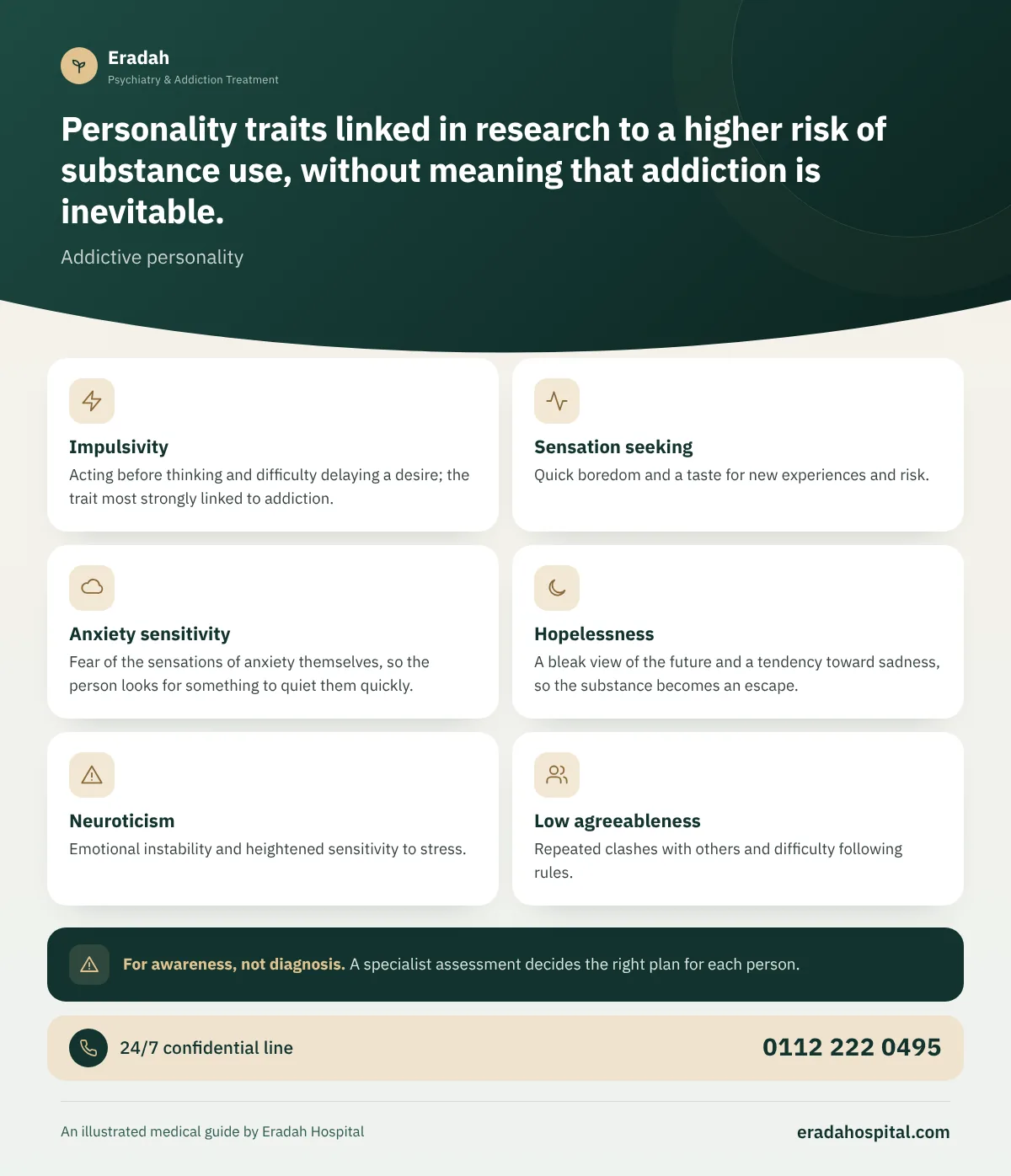
The first four traits are those targeted by the PreVenture prevention program developed by researcher Patricia Conrod. The link of addiction to neuroticism, low agreeableness and low inhibition comes from the pooled analysis by Kotov and colleagues in 2010.
What does research say about personality and addiction?
Kotov and colleagues analyzed 175 studies published between 1980 and 2007 and found that all the common psychiatric disorders are linked to high neuroticism and low conscientiousness. But substance use disorders stood out from the others: they were less linked to neuroticism and more linked to low inhibition, meaning impulsivity, and to disagreeableness with others.
What matters is that these are statistical associations between groups, not a written fate for an individual. Many people have these traits and never go near drugs, and many become addicted without showing them clearly. The guide to the causes of addiction explains the other factors: genetics, environment, trauma and age of onset.
Addictive personality and personality disorders
Some people confuse “addictive personality” with the medically recognized personality disorders. What is true is that some of these disorders overlap heavily with addiction, such as borderline personality disorder and antisocial personality disorder, and when the two occur together, treatment needs a plan that addresses both within dual diagnosis. But having an addiction does not mean having a personality disorder, and the reverse is true too.
Does addiction change personality?
Much of what looks like “personality” during addiction is really the effect of the substance and of the life around it: lying to hide use, irritability in withdrawal, impulsiveness under the influence. That is why many parents are surprised that their son, after months of recovery, seems calmer and closer to who he used to be. Personality should not be judged at the height of addiction.
Why can the label “addictive personality” be harmful?
Can it be prevented if these traits appear early?
Yes, and this is among the most hopeful findings. In a randomized trial in 31 high schools in Montreal, whose five-year results were published in the American Journal of Psychiatry in 2025, students with high scores on one of the four traits received two group sessions based on cognitive behavioral therapy and tailored to each student's trait. The rise in substance use disorder rates over the years was slower in the program schools than in the other schools.
- Get to know your child's traits without turning them into a label.
- Teach them early how to cope with anxiety, boredom and impulsivity.
- Provide healthy alternatives for excitement, such as sport and group activities.
- Follow up with a specialist if anxiety, depression or marked impulsivity appears, since early treatment is prevention, as in the guide to preventing drug use.
How does treatment take personality traits into account?
Good treatment does not treat “the addict” as a single mold. An impulsive person needs skills for delay and control, a person with anxiety sensitivity needs treatment for the anxiety itself, and a person with hopelessness needs a depression assessment. That is why treatment at Eradah begins with a comprehensive psychological assessment that identifies these aspects, and the plan is then built on them.