What is antisocial personality disorder?
Antisocial personality disorder (ASPD) is one of the ten personality disorders in the American DSM-5. Its core is a persistent pattern of disregard for and violation of the rights of others, which begins in childhood or adolescence, continues into adulthood, and appears across many areas of life rather than in a single situation.
The American Psychiatric Association describes it as selfish, irresponsible, law-breaking, and impulsive behavior, with disregard for the rights of others and, in most cases, a lack of remorse. It is important to note that the word “antisocial” in psychiatry does not mean “introverted” or someone who dislikes socializing, as it is understood in everyday speech, but someone who breaks society's rules and harms others.
Diagnosis requires that the person be at least 18 years old, that there be evidence of conduct disorder before age 15, and that the behaviors not be limited to episodes of schizophrenia or bipolar disorder. The international ICD-11 classification, by contrast, describes personality disorders by severity and uses the trait of “dissociality” to describe this pattern.
How common is antisocial personality disorder?
Scientific reviews estimate that the disorder affects about 2–3% of the general population, and it is several times more common in men. The rate rises considerably in prisons and among people attending addiction treatment centers, which makes these settings an important opportunity for diagnosis and intervention.
Is antisocial personality the same as “psychopathy”?
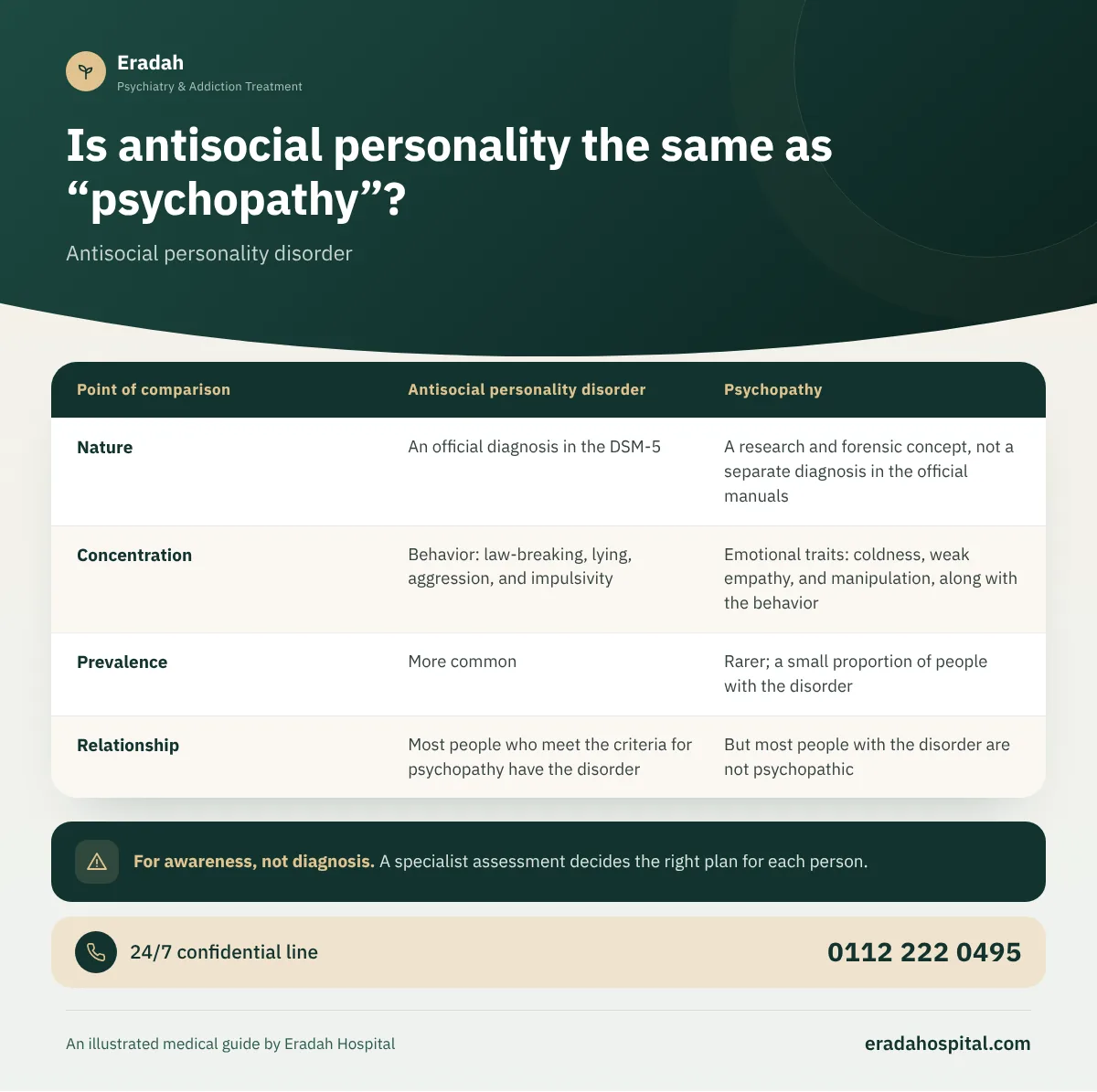
Not exactly. “Psychopathy” is a research and forensic concept that specialists measure with dedicated tools such as the “Hare Psychopathy Checklist,” and it focuses on emotional traits such as emotional coldness, weak empathy, superficial charm, and manipulation, in addition to antisocial behavior. Antisocial personality disorder, by contrast, is a medical diagnosis based mainly on behaviors.
| Point of comparison | Antisocial personality disorder | Psychopathy |
|---|---|---|
| Nature | An official diagnosis in the DSM-5 | A research and forensic concept, not a separate diagnosis in the official manuals |
| Concentration | Behavior: law-breaking, lying, aggression, and impulsivity | Emotional traits: coldness, weak empathy, and manipulation, along with the behavior |
| Prevalence | More common | Rarer; a small proportion of people with the disorder |
| Relationship | Most people who meet the criteria for psychopathy have the disorder | But most people with the disorder are not psychopathic |
As for the word “sociopath,” it is a term common in the media and not a medical diagnosis. For this reason we prefer to use the medical name, and we advise against using these labels on people in family disputes or on social media.
How is childhood conduct disorder related to this disorder?
Conduct disorder is a repeated pattern in a child or adolescent of aggression toward people or animals, destruction of property, lying and theft, or serious violation of rules such as running away from home or school. It is an essential condition for diagnosing antisocial personality disorder later on.
But not every child with conduct disorder will become an adult with the disorder. Reviews indicate that about 40% of boys and about 25% of girls diagnosed with conduct disorder go on to develop it later. That means most of them do not reach it, which is why early intervention with the family and school helps.
What happens in the brain, briefly?
Research points to differences in some people with the disorder in the brain areas responsible for impulse control, planning, and decision-making in the frontal cortex, and in the amygdala's response to fear and to other people's emotions. This may explain weak learning from punishment and difficulty feeling other people's pain. The details of genetic and environmental factors are on the causes page.
How does it differ from similar disorders?
- Narcissistic personality: it shares weak empathy with antisocial personality, but its main driver is the need for admiration, and it is less tied to aggression and law-breaking. See narcissistic personality disorder.
- Borderline personality: it may resemble antisocial personality in impulsivity and anger, but borderline personality revolves around fear of abandonment and emotional pain, with strong guilt after a crisis. See borderline personality disorder.
- Behavior resulting from addiction: lying and theft to fund substance use may disappear with recovery, whereas a personality disorder begins before substance use and appears in other areas of life.
- Attention-deficit/hyperactivity disorder (ADHD): impulsivity in ADHD does not mean disregard for the rights of others, although the two can occur together.
Does antisocial personality change with age?
Some behaviors, especially law-breaking and impulsive violence, tend to decline in a proportion of people with the disorder as they get older, particularly after 40, although some traits remain. The UK's National Health Service notes that many people with personality disorders improve over time.
Treatment here is difficult but not impossible, and it focuses on harm reduction, treating co-occurring addiction and depression, and learning problem-solving and anger-control skills. The details are on the treatment page.
When should you seek a psychological assessment?
- When a child or adolescent repeatedly shows aggression, theft, or cruelty despite the efforts of the family and school.
- When a young adult has repeated lying, fraud, and legal problems over a period of years.
- When rule-breaking behavior goes together with alcohol or drug use.
- Immediately if there is a threat of violence or danger to a family member or to the person themselves.
The assessment is not meant to “stigmatize” the person. It is an opportunity to discover what can genuinely be treated, such as addiction, depression, or ADHD, and to set up a realistic plan that protects everyone. Often the easier route to getting the person to a doctor is treating the substance use, rather than talking directly about personality.
How can the family cope and protect itself?
Violence or threats are never justified. A clear safety plan for the children, women, and older people in the home is a priority.
Keep important papers, money, and cards out of their reach, and do not guarantee debts under pressure.
Speak in short, consistent sentences, and set realistic consequences that you actually carry out, without shouting.
Ask for support from trusted people and from a specialist, and do not hide abuse out of a wish to “keep it private.”
A family's love for their son does not mean accepting abuse. The family can keep supporting his treatment while firmly protecting its members. In Egypt, you can call the police on 122 if there is a threat, and the Child Helpline on 16000 if a child is at risk.
Antisocial Personality Disorder Guide: Everything You Need to Know
We have gathered everything about antisocial personality disorder into 5 pages, each answering one question in detail. Choose what you are looking for:
Antisocial personality disorder symptoms and signs
The seven traits the diagnosis relies on, the signs of conduct disorder in childhood, and what the picture looks like from inside the home.
Causes of antisocial personality disorder
The role of heredity and the brain, the effects of abuse, neglect, and violence in childhood, and risk and protective factors.
Harms and complications of antisocial personality disorder
What the disorder causes for the person themselves, including injuries, imprisonment, poverty, and addiction, and what it causes for the family, children, and society.
Antisocial personality disorder treatment: medication and psychotherapy
Cognitive behavioral programs, early intervention with children, the limited role of medication, and treatment of co-occurring disorders.
Antisocial personality disorder and addiction: dual diagnosis
Why the disorder is so strongly linked to addiction, how each raises the risk of the other, and how to design suitable treatment for both.
Risk of violence or self-harm? Get help now
- An explicit threat to harm a family member or others, or violence that has already begun
- Severe agitation and aggression, especially under the influence of alcohol or drugs
- Recklessness that endangers their life or the lives of others, such as driving under the influence
- Talk of wanting to die or of severe hopelessness after a crisis or major loss
- Immediate danger to children or older people in the home
Your safety and the children's safety come first: do not get into an argument or a physical confrontation, move to a safe place, and call the police on 122 if violence is threatened or the ambulance on 123 if someone is injured or life is in danger. If the danger is to the person themselves, stay close if it is safe to do so, and call the mental health support line 16328 or go to the nearest emergency department.
Ambulance 123 Mental health support line 16328