“My son is well-behaved and could never do that.” Many parents say this. It comes from love, but it can delay attention. Drug prevention does not mean doubting your children; it means preparing them for a moment when something will be offered to them, because that moment comes for most of them.
What does drug prevention mean?
Drug prevention is a set of approaches, not a single lecture, that reduce the chance that a child or teenager will try drugs, or that stop experimentation from turning into regular use and addiction. The international prevention standards issued by the United Nations Office on Drugs and Crime together with the World Health Organization stress that evidence-based prevention, working with families, schools and communities, saves at least ten dollars in health and social costs for every dollar spent on it.
Why does prevention start early?
The US National Institute of Mental Health explains that the brain keeps maturing until the mid-to-late twenties, that the part responsible for planning and decision-making is among the last to mature, and that teenagers’ interest in their friends grows, so they lean toward taking risks. This is why every year that first use is delayed is a real gain: in a large US study published in 1998, the likelihood of misuse and dependence fell by about 4% to 5% with each year of delay.
The family’s role in drug prevention
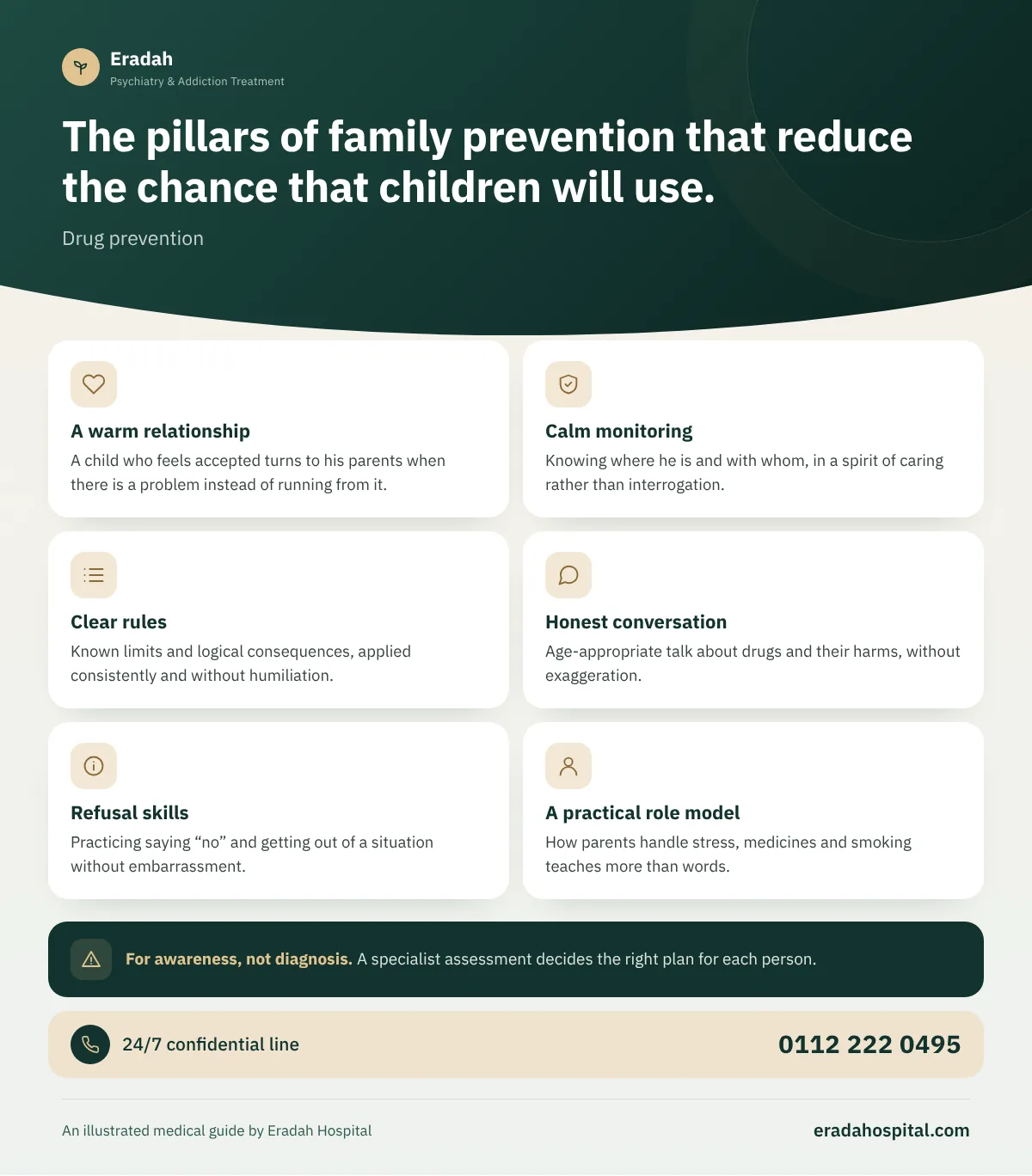
A child who feels accepted turns to his parents when there is a problem instead of running from it.
Knowing where he is and with whom, in a spirit of caring rather than interrogation.
Known limits and logical consequences, applied consistently and without humiliation.
Age-appropriate talk about drugs and their harms, without exaggeration.
Practicing saying “no” and getting out of a situation without embarrassment.
How parents handle stress, medicines and smoking teaches more than words.
A 2016 analysis of family prevention programs found that these programs reduce adolescent substance use, and that what most increases their effect is strengthening positive relationships within the family and building an optimistic outlook on the future in the child, alongside supervision and behavior management.
How do you talk to your child about drugs at each age?
| Age | What to say and do |
|---|---|
| Before school | Medicine is taken only by adults and with a doctor’s permission, and if we don’t know something, we ask before touching or eating it. |
| Ages 6 to 10 | Simple facts about the harms of cigarettes and drugs, and encouraging him to tell you what he sees and hears. |
| Ages 11 to 14 | Talking about peer pressure, practicing refusal, and getting to know his friends and their parents. |
| Ages 15 to 18 | A deeper conversation about decisions and consequences, “natural” hashish and painkillers, with trust and agreed rules for going out. |
| University and beyond | Keep supporting without controlling, and watch for study pressure, late nights and the use of stimulants. |
The school’s role in drug prevention
In a 2014 Cochrane review covering 51 studies and more than 127,000 students, school programs that combined building social competence (problem-solving, stress management and communication skills) with resisting social influence (spotting peer pressure and advertising, and correcting the belief that “everyone tries it”) showed a small but consistent protective effect. The only study that evaluated a program based on information alone found no effect on substance use. This is why researchers advise that the school be part of a broader plan that includes the family and community.
What doesn’t work in prevention?
- Relying on information and warnings alone without building skills.
- Exaggeration and scare tactics, which a child sees through and then stops trusting anything you say.
- Secret searches and constant spying instead of conversation.
- Harsh punishment or humiliation at the first mistake, which teaches the child to hide things.
- Smoking or misusing medicines in front of children.
Medicines at home: the forgotten prevention
Not every addiction story begins with a dealer. Sometimes it begins with a strip of tramadol after an operation, or pregabalin or a sedative in the medicine drawer. Keep these medicines locked away, know how many there are, dispose of leftovers when treatment ends, and never give anyone a medicine prescribed for someone else.
When should you ask for help?
If you notice lasting changes in sleep, friends, school or money, or you find signs of use, ask for advice early instead of an angry confrontation. Anxiety, depression and hyperactivity in children are risk factors, and treating them is part of prevention. The page on persuading a person with addiction to accept treatment helps you start the difficult conversation, and the family program offers support for parents themselves. At Eradah you can start with a free, confidential first consultation.