What is borderline personality disorder?
Borderline personality disorder (BPD) is a long-standing pattern of instability in three core areas: emotions, relationships, and a person's sense of who they are, often accompanied by impulsive behavior. This pattern continues for years if untreated and shows up in many situations, so it goes well beyond a passing episode.
The US National Institute of Mental Health describes the condition as a mental illness that severely affects a person's ability to regulate their emotions, which increases impulsivity, makes relationships difficult, and affects how they see themselves. It is classed as a personality disorder, meaning an enduring pattern of thinking, feeling, and relating that differs from what those around the person expect and causes distress or disruption in life.
The word “borderline” comes from an old idea that the condition sat “on the border” between neurotic and psychotic disorders. That idea is no longer used scientifically, but the name stuck. In some countries it is also called “emotionally unstable personality disorder,” and in the international classification ICD-11, personality disorder is diagnosed by severity, with the option of adding a “borderline pattern” specifier.
How common is borderline personality disorder?
Population studies estimate that borderline personality disorder affects anywhere from under 1% to about 3% of the general population. The rate is much higher in treatment settings: scientific reviews suggest that about one in five patients admitted to psychiatric units may meet the criteria for this diagnosis.
It is diagnosed more often in women in clinics, but community studies show a much smaller difference between the sexes. Researchers believe men are diagnosed less often because their distress sometimes shows up as anger or substance use, so they receive a different diagnosis or never seek help at all.
What does borderline personality feel like from the inside?
Many patients describe their lives as an “emotional roller coaster.” A simple event, such as a message that goes unanswered, can set off a wave of fear, anger, or sadness that looks far out of proportion to others, but for the person it is completely real and painful, and it takes longer to settle.
“I feel everything twice as strongly: joy, fear, anger. When someone I love pulls away, I feel as if I’m going to disappear.” This is how many patients describe what they go through in the clinic; the sentence is not a quotation from any particular patient.
This heightened sensitivity is not something the person chooses, and it is not meant to get attention. It is the core of the disorder itself. Because the pain is so intense, a person sometimes turns to quick ways of relieving it, such as acting impulsively, self-harm, or substance use. These bring relief in the moment and then deepen the suffering later. The details of these signs are on the symptoms page.
What happens in the brain, briefly?
Imaging research suggests that the brain's emotional alarm regions, such as the amygdala, may respond more strongly in people with the disorder, while the control and calming regions of the frontal cortex are less able to dampen that response in moments of stress. The result is an emotional system that is “quick to ignite and slow to settle.”
These differences are not a fixed destiny. The brain can learn, and therapies that train emotion regulation help build new pathways of response. The factors that contribute to the disorder, from genetics to childhood experiences, are explained on the causes page.
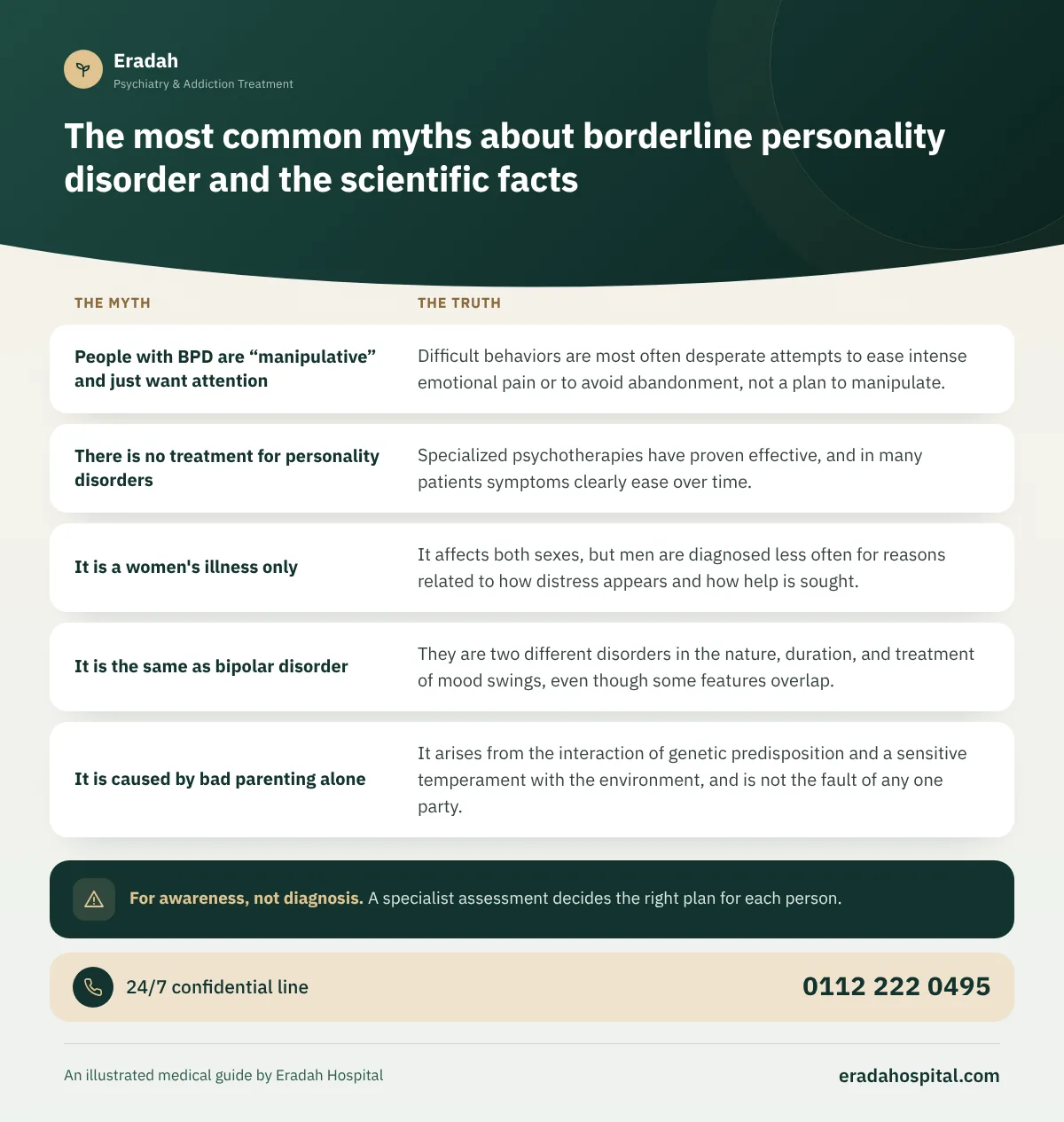
Common myths about borderline personality
| The myth | The truth |
|---|---|
| People with BPD are “manipulative” and just want attention | Difficult behaviors are most often desperate attempts to ease intense emotional pain or to avoid abandonment, not a plan to manipulate. |
| There is no treatment for personality disorders | Specialized psychotherapies have proven effective, and in many patients symptoms clearly ease over time. |
| It is a women's illness only | It affects both sexes, but men are diagnosed less often for reasons related to how distress appears and how help is sought. |
| It is the same as bipolar disorder | They are two different disorders in the nature, duration, and treatment of mood swings, even though some features overlap. |
| It is caused by bad parenting alone | It arises from the interaction of genetic predisposition and a sensitive temperament with the environment, and is not the fault of any one party. |
How does borderline personality differ from bipolar disorder and PTSD?
In bipolar disorder, an episode of elevated or low mood lasts days or weeks, often comes without a clear outside trigger, and is accompanied by obvious changes in sleep and energy. In borderline personality disorder, mood shifts are rapid, can happen several times a day, and are usually set off by a relationship event such as feeling rejected.
The disorder sometimes overlaps with post-traumatic stress disorder, especially in people who experienced repeated trauma in childhood, and the two can occur together. It can also look similar on the surface to narcissistic personality disorder in anger at criticism, but the core driver in borderline personality is fear of abandonment and an unstable sense of self, not a need for admiration. That is why a careful assessment by a psychiatrist is the deciding factor.
When should you see a psychiatrist?
- When turbulent relationships and abrupt breakups keep repeating in a pattern that wears you and those around you out.
- When bouts of anger, sadness, or fear take over, out of proportion to the situation and hard to calm.
- When you find yourself turning to impulsive acts, alcohol, or substances to calm your feelings.
- Right away if thoughts of self-harm or suicide appear, without waiting for an appointment.
A diagnosis is made by a psychiatrist or a qualified specialist after a detailed interview and a review of personal history, not through an online test. The assessment itself is a step in treatment: many patients feel relief when they find a name for what they are going through and a clear plan for dealing with it.
Can you recover from borderline personality disorder?
Yes, and this is one of the most important messages. Studies that followed patients for many years found that symptoms ease in a large share of them: a review of long-term studies found an average remission rate of about 60% over follow-up periods of five to fifteen years. The UK's National Health Service states that many people with the condition overcome their symptoms and recover over time.
Difficulties at work or in relationships may remain even after the acute symptoms settle, which is why good treatment aims to build a stable, meaningful life, not just put out crises. The treatment options are covered on the treatment page.
How can a family help their son, daughter, or partner?
Understanding the illness turns anger from “why is he doing this to us?” into “what is hurting him right now?”
A phrase like “I understand you’re deeply hurt” calms more than arguing over whether the situation deserves such a reaction.
Love does not mean accepting insults or threats; clear, consistent boundaries help everyone feel safe.
Caring for someone with a severe disorder is exhausting, and psychological support for the family is part of the plan, not a luxury.
In Egyptian society, families may fear “what people will say” and put off seeing a psychiatrist, or explain the disorder as “bad manners” that needs strictness. Harshness and punishment usually deepen the patient's sense of rejection and fuel crises, while warmth combined with clear boundaries and specialized treatment helps bring stability.
Borderline Personality Disorder Guide: Everything You Need to Know
We have gathered everything about borderline personality disorder into 5 pages, each answering one question in detail. Choose what you are looking for:
Borderline personality disorder symptoms and signs
The nine criteria doctors rely on, how they show up in emotions, relationships, and behavior, and how they differ in teens, men, and women.
Causes of borderline personality disorder
How genetics and a sensitive temperament interact with trauma and an unsafe environment to produce the disorder, and what the protective factors are.
Harms and complications of borderline personality disorder
What the disorder does if left without care: to health, studies, work, relationships, and family, and the risk of self-harm.
Borderline personality disorder treatment: medication and psychotherapy
Dialectical behavior therapy, mentalization-based therapy, and schema therapy, the limited role of medication, and how long treatment takes.
Borderline personality disorder and addiction: dual diagnosis
Why people with the disorder turn to alcohol and substances, how these make the disorder worse, and why both must be treated together.
Suicidal thoughts or risk of self-harm? Get help now
- Talking about wanting to die, that “nothing is worth it,” or that they are a burden on others
- Self-harm or hints of it, especially if it is becoming more frequent or more dangerous
- Severe emotional collapse after a breakup, a quarrel, or a feeling of rejection and abandonment
- Sudden withdrawal from people, saying goodbye to them, or getting rid of important belongings
- Heavy use of alcohol or substances in the middle of an emotional crisis, with intense agitation or a feeling of being detached from reality
Stay with the person and do not leave them alone. Listen calmly, without blame or lectures, and ask them directly about suicidal thoughts; asking does not plant the idea. Keep anything they could use to hurt themselves out of reach as far as you can, and call ambulance (123) or go to the nearest emergency department, or call the mental health support line 16328, available around the clock.
Ambulance 123 Mental health support line 16328