“Two friends tried the same thing on the same night. One forgot about it, and the other couldn’t stop.” This puzzling question is the heart of research into the causes of addiction: why does an experience pass without a trace for one person, while for another it turns into an illness that swallows their life?
What are the causes of addiction in brief?
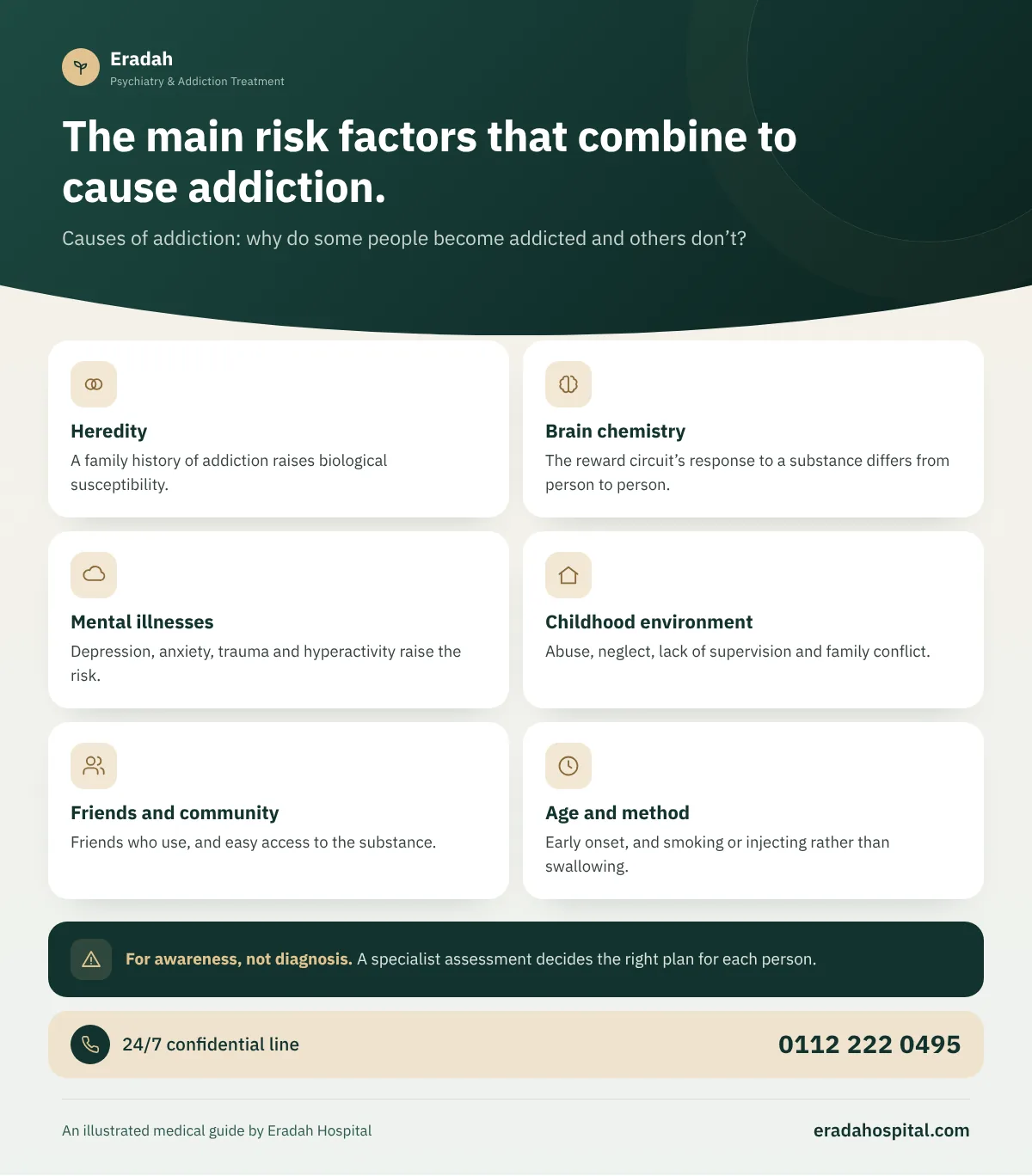
The US National Institute on Drug Abuse stresses that no single factor determines who will develop addiction. There are risk factors that raise the likelihood and protective factors that lower it, and the more risk factors come together, the more likely it is that substance use leads to addiction. The most important causes can be summarized in six groups:
A family history of addiction raises biological susceptibility.
The reward circuit’s response to a substance differs from person to person.
Depression, anxiety, trauma and hyperactivity raise the risk.
Abuse, neglect, lack of supervision and family conflict.
Friends who use, and easy access to the substance.
Early onset, and smoking or injecting rather than swallowing.
How do the causes of addiction begin inside the brain?
Addictive substances release dopamine in the reward circuit with a force beyond natural pleasures, so the brain learns that this substance is “important for survival.” With repetition it feels ordinary pleasure less, the areas of judgment and impulse control weaken, and craving becomes stronger than willpower. But this mechanism is the same in everyone, and what differs between people is the strength of the response and the speed of adaptation, and this is where genes, experiences and environment come in.
Is addiction hereditary?
The more precise answer: the vulnerability to addiction is partly inherited, but addiction itself is not inherited. According to the US National Institute on Drug Abuse, genes, together with the environment’s effect on how those genes work, account for between 40% and 60% of a person’s vulnerability to addiction. A scientific review published in 2012 indicates that twin studies estimated heritability between 0.39 for hallucinogens and 0.72 for cocaine, and that addiction is ultimately the product of genes interacting with environment.
This means the son of a father with addiction is not “doomed” to addiction, but he needs more caution: delaying any experimentation, watching for signs of anxiety and depression early, and not taking “just once” lightly. Knowing the family history also helps the doctor assess the patient.
Mental illness as a cause of addiction
Many people start using in an attempt to ease psychological pain: relentless anxiety, depression, traumatic memories, or insomnia. The drug may relieve this pain temporarily, then makes it worse and adds addiction on top. The National Institute on Drug Abuse notes that people with mental disorders are more likely to use substances and develop addiction. Well-known examples are post-traumatic stress disorder (PTSD), ADHD and depression. This is why such people need treatment for both conditions together under dual diagnosis care.
Childhood trauma and the family environment
In the “Adverse Childhood Experiences” study, which included more than 8,600 adults and was published in 2003, each adverse experience, such as abuse, neglect, or having a person with addiction or mental illness in the home, was linked to a two- to four-fold increase in the likelihood of early onset of substance use. People who had gone through five or more experiences were seven to ten times more likely to have substance use problems and addiction than those who had gone through none.
The National Institute on Drug Abuse adds other family factors: weak parental supervision, use by a parent or older siblings, and constant conflict. By contrast, a warm relationship, calm monitoring and clear rules are protective.
Age of onset and method of use
- Early onset: in a large US study published in 1998, the likelihood of drug abuse and dependence fell by about 4% to 5% with each year that the first use was delayed. This is linked to the fact that the brain, according to the US National Institute of Mental Health, does not finish maturing until the mid-to-late twenties.
- Method of use: the National Institute on Drug Abuse explains that smoking and injecting raise a substance’s addictiveness, because they deliver it to the brain within seconds.
- Type of substance: some substances cause dependence faster, such as opioids and crystal meth (shabu).
Is addiction a choice or an illness?
The first experiment is often a decision, but what happens afterward is not purely a decision. With repetition, the brain’s circuits change in a way that makes stopping hard even with a sincere wish to stop. Understanding the causes of addiction does not excuse a person from responsibility, but blame alone does not treat, and treatment must deal with the causes: the body, the mind and the family together.
What should you do if risk factors come together for you or someone you love?
If your family has a history of addiction, or you struggle with anxiety or depression, do not wait for experimenting to turn into a problem. Treating mental illness early is real prevention. If use has already begun, an assessment by a psychiatrist determines whether outpatient treatment is enough or residential treatment is needed. At Eradah, the first consultation is free and confidential.
6Friends, community and easy access to the substance
In adolescence and early adulthood the influence of friends is strong, and the first experience often happens in a gathering with friends. The risk is also raised by easy access to the substance, a permissive view of it such as “hashish isn’t a drug,” poverty and unemployment, and the pressures of work and late nights. Some addictions also begin with a painkiller or sedative taken the first time for a medical reason and then continued without follow-up.