Why is ADHD linked to addiction?
The relationship between the disorder and addiction is among the most consistent in psychiatry, and it has more than one explanation, working together in the same person.
Difficulty stopping and thinking about consequences makes the first try easier and repeating it faster.
Intense boredom and the need for quick reward make substances especially attractive.
Some turn to substances they believe will calm restlessness or improve focus or sleep.
Years of failure and criticism push people to look for an escape or for acceptance among groups that use substances.
The two conditions share part of their genetic predisposition and recur in the same families.
Dropping out of school, idle time and unsafe company increase the chances of exposure to substances.
How big is this link?
Studies show that teenagers and adults with untreated ADHD start smoking earlier and reach dependence on substances at higher rates than their peers. Conversely, reviews of people with addiction find that a notable share of them have the disorder, estimated in some reviews at close to one fifth, and many of them were never diagnosed before.
StatPearls notes that the disorder increases susceptibility to substance use, while treatment with stimulants is associated with lower lifetime risk. The figures are approximate and vary by study and country.
Which substances are most often used with ADHD?
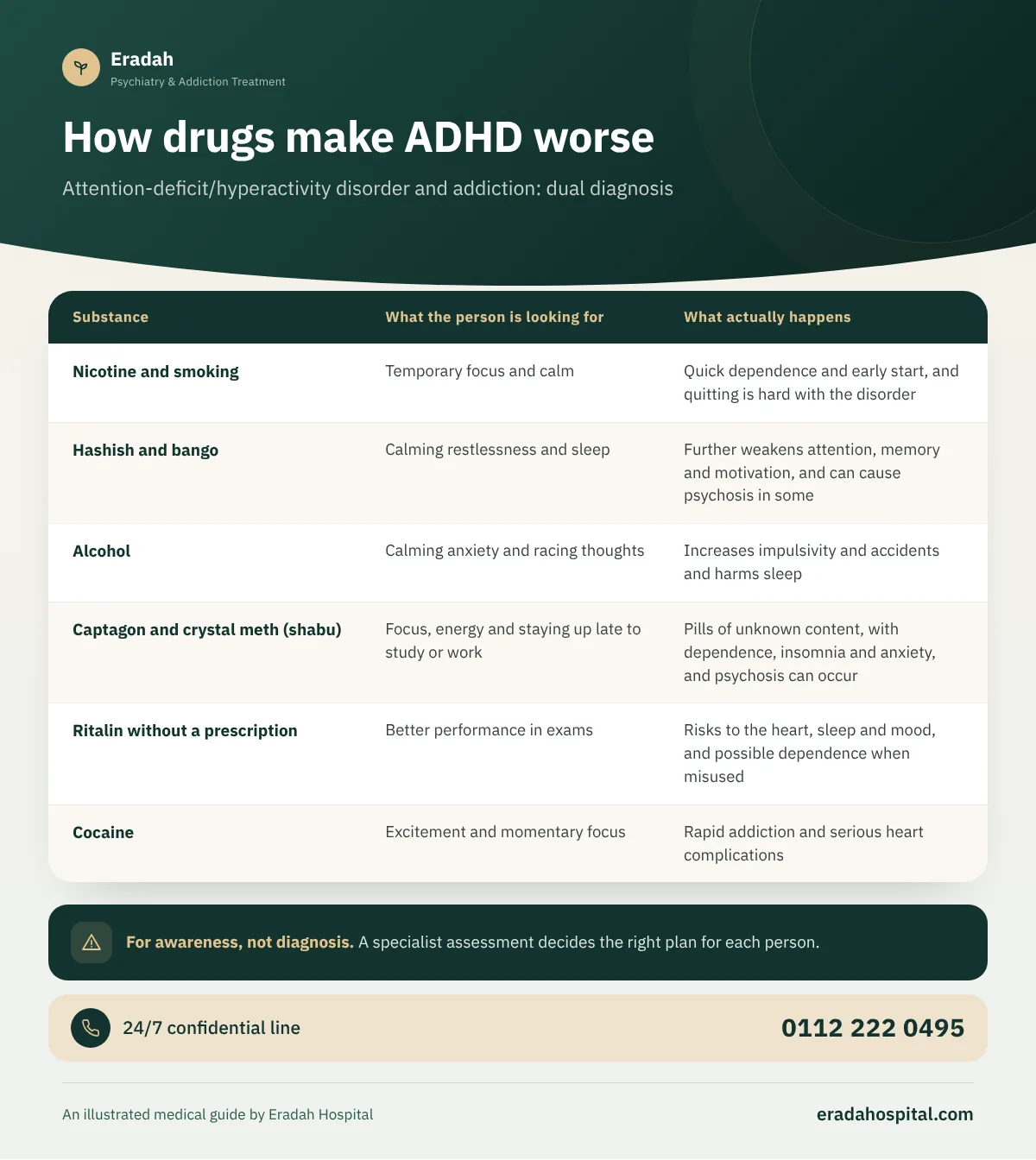
| Substance | What the person is looking for | What actually happens |
|---|---|---|
| Nicotine and smoking | Temporary focus and calm | Quick dependence and early start, and quitting is hard with the disorder |
| Hashish and bango | Calming restlessness and sleep | Further weakens attention, memory and motivation, and can cause psychosis in some |
| Alcohol | Calming anxiety and racing thoughts | Increases impulsivity and accidents and harms sleep |
| Captagon and crystal meth (shabu) | Focus, energy and staying up late to study or work | Pills of unknown content, with dependence, insomnia and anxiety, and psychosis can occur |
| Ritalin without a prescription | Better performance in exams | Risks to the heart, sleep and mood, and possible dependence when misused |
| Cocaine | Excitement and momentary focus | Rapid addiction and serious heart complications |
Do ADHD medications cause addiction?
This is what worries families most, and the answer supported by research is reassuring: stimulant medications used by prescription and under medical supervision do not raise the risk of later addiction. Two follow-up studies from the US National Institutes of Health found that children treated with stimulants were not more likely to use alcohol, drugs or nicotine later.
But the same studies caution that treatment does not automatically protect against substance use, which is why periodic screening and asking about substances remain part of follow-up. The essential difference between therapeutic use and misuse is: the prescription, the dose set by the doctor, often the long-acting form, and regular follow-up.
| Aspect | Therapeutic use | Misuse |
|---|---|---|
| Source | Doctor’s prescription after a diagnosis | A friend, a colleague or an illegal source |
| Goal | Treating diagnosed symptoms | Staying up late, euphoria, weight loss or “excelling” in an exam |
| Follow-up | Monitoring pulse, blood pressure, growth and mood | No follow-up |
| Method | Exactly as the doctor prescribed | Taking more, changing the way it is taken, or mixing with other substances |
Why do some students misuse stimulants?
A belief is common among some high school and university students that Ritalin or Captagon “boosts studying.” In fact, a person without the disorder gains little real benefit in learning, while facing risks such as insomnia, anxiety, palpitations and high blood pressure, and with excess or mixing, seizures or psychosis may occur, along with the risk of dependence.
How do substances make ADHD symptoms worse?
- Hashish: weakens working memory and motivation, increasing procrastination and falling behind.
- Alcohol: increases impulsivity and harms the sleep that people with ADHD badly need.
- Illicit stimulants: cause a crash, insomnia and anxiety after their effect wears off, so distractibility seems worse than before.
- Withdrawal itself: causes distractibility and irritability that may be mistaken for symptoms of the disorder.
- Substance use complicates diagnosis: which is why the doctor may need a period of abstinence before a final judgment.
What signs should the family watch for?
- A sudden decline in school or work after a period of stability.
- New friends, excessive secrecy and unexplained absence from home.
- ADHD medication running out faster than expected, or constant requests for more.
- Staying up for days followed by long sleep and irritability, or a change in appetite and weight.
- The smell of smoke or hashish, or repeated need for money without explanation.
If these signs appear, start a calm conversation free of accusation and contact the treating doctor; substance use is often an attempt to treat symptoms that have not been well controlled.
How are ADHD and addiction treated together?
The rule in dual diagnosis is that treating one condition and leaving the other raises the chance of relapse. That is why integrated treatment is built on:
- A comprehensive assessment of both conditions and of other accompanying conditions such as depression and anxiety.
- Detox under medical supervision if the substance requires it, such as alcohol or sedatives.
- Confirming the ADHD diagnosis after a period of stability or abstinence, as the doctor judges.
- Choosing the ADHD medication carefully: the doctor may prefer non-stimulant medications or long-acting forms that are less prone to misuse, with close follow-up.
- Psychotherapy that combines relapse prevention skills with organization and impulse management skills.
- Involving the family and long follow-up after the intensive phase ends.
Does treating ADHD protect against addiction?
Early, integrated treatment greatly reduces the factors that push toward substance use: academic failure, frustration, uncontrolled impulsivity and unsafe company. This does not mean guaranteed protection, but a child who is understood, supported and followed up is clearly less at risk than a child left with their symptoms and blame. Early drug education, especially at the start of adolescence, is a core part of the plan.
How can the family help their child with ADHD avoid drugs?
- Talk with them early and openly about drugs and the stimulants passed around among students.
- Explain that their impulsivity makes them more likely to experiment, without scaring or stigmatizing them.
- Provide alternatives for excitement: sports, activities, responsibilities that suit their energy.
- Keep track of their company and allowance in a way that respects their privacy as far as possible.
- Do not leave the disorder untreated out of fear of medication; the greater risk is in leaving it untreated.
How does Eradah treat dual diagnosis?
Dual diagnosis is the core of Eradah’s expertise. The program begins with a comprehensive psychiatric and medical assessment, then safe detox when needed, then integrated treatment of the disorder and the addiction together by one team, with careful medication choices, family follow-up and a relapse prevention program, all in complete confidentiality. Learn more about the dual diagnosis program.
Suicidal thoughts or danger to self? Get help now
- Talk of wanting to die or of the family being better off without them
- Severe hopelessness after failing, being dismissed, a breakup or harsh punishment
- Sudden dangerous impulsiveness: reckless driving, heavy substance use or self-harm
- Sudden withdrawal from friends and family and saying goodbye to them
- Severe agitation or sleeplessness for days, or strange symptoms after taking stimulants without a prescription
Do not leave the person alone. Listen calmly without blame or lectures, and keep dangerous objects out of their reach in general. Call an ambulance (123) or go to the nearest emergency room, or call the mental health support line 16328 around the clock, and inform their treating doctor.
Ambulance 123 Mental health support line 16328