“There’s an herbalist who says he has a mixture that removes addiction in a week, with no rehab and no medication.” A tempting offer for a tired family, and for a patient who fears treatment. We fully understand why people look for herbal addiction treatment: it seems natural, private and cheap. But the question that deserves an answer is: does it work? And is it safe?
Is there an herbal treatment for addiction?
No herb or mixture has so far been shown in good studies to treat addiction. Addiction, as the US National Institute on Drug Abuse explains, is a chronic disease that changes brain circuits and needs treatment that usually combines behavioral therapy with medications approved for some substances, plus long follow-up. A drink or a capsule cannot shortcut this.
Some herbs have indeed been studied seriously by scientists, but their results so far are modest or conflicting, as we will see. You will also find an overview of where herbs fit in treatment in the guide to addiction treatment.
Why are addiction “mixtures” so widespread?
- Fear of rehab and of stigma, which makes a mixture look like a private solution.
- The promise of speed: “a week and you’re done.”
- The word “natural,” which suggests safety.
- Earlier bad experiences with unlicensed treatment places.
- Sometimes the mixture itself contains a hidden sedative or painkiller, so the person feels a temporary improvement.
The best-known herbs for addiction treatment: the claim and the evidence
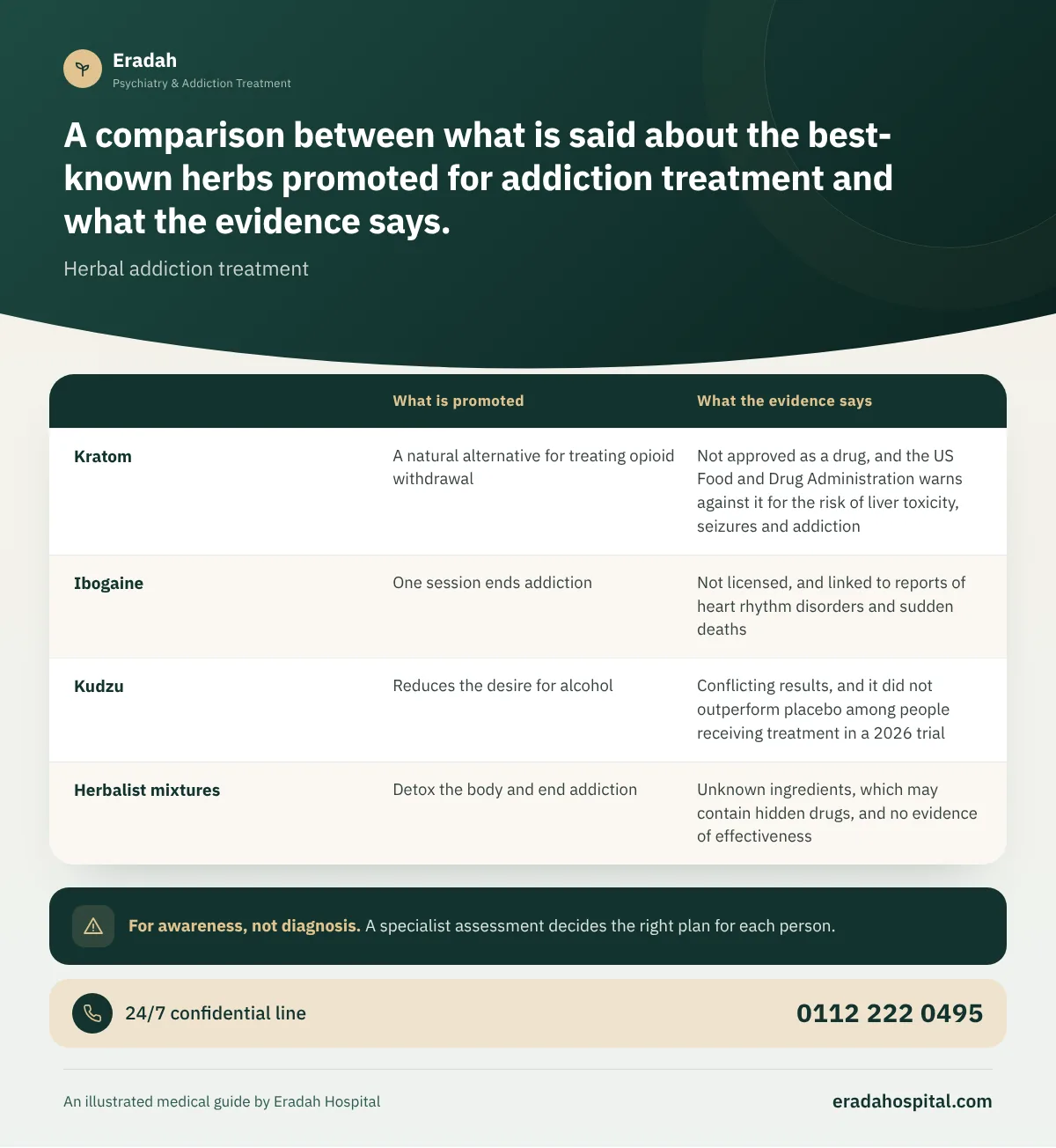
| What is promoted | What the evidence says | |
|---|---|---|
| Kratom | A natural alternative for treating opioid withdrawal | Not approved as a drug, and the US Food and Drug Administration warns against it for the risk of liver toxicity, seizures and addiction |
| Ibogaine | One session ends addiction | Not licensed, and linked to reports of heart rhythm disorders and sudden deaths |
| Kudzu | Reduces the desire for alcohol | Conflicting results, and it did not outperform placebo among people receiving treatment in a 2026 trial |
| Herbalist mixtures | Detox the body and end addiction | Unknown ingredients, which may contain hidden drugs, and no evidence of effectiveness |
Kratom: an herb that treats addiction or causes it?
Kratom is a tree from Southeast Asia, and the US Food and Drug Administration notes that many people use it to treat themselves for pain, anxiety, and opioid use disorder and its withdrawal. But the agency stresses that it is not approved as a drug or as a supplement, and warns against using it because of the risk of serious adverse events including liver toxicity, seizures and substance use disorder. The agency also cites cases of users who developed craving, tolerance and withdrawal symptoms on stopping, and cases of newborns who suffered withdrawal symptoms after exposure to it in the womb.
In other words, someone who uses kratom to treat opioid addiction may swap one dependence for another, with no supervision and no known dose.
Ibogaine: why do doctors warn against it?
Ibogaine is a substance extracted from an African plant, and it showed anti-addiction effects in animal studies. But a review published in the journal Molecules in 2015 notes that it is not licensed as a drug, yet is used in dozens of clinics around the world, and that worrying reports have accumulated of life-threatening complications and sudden deaths that were closely timed to taking it, which the researchers considered likely to be linked to its ability to cause heart rhythm disorders.
Kudzu and alcohol: what have studies found?
Kudzu is among the herbs most seriously studied in this field. In earlier studies its extract reduced drinking in men who drink heavily and are not seeking treatment. But a trial published in 2026 on men and women seeking treatment for alcohol use disorder found that kudzu did not outperform placebo: heavy drinking days fell by about 30% with it and 44% with placebo over eight weeks, with weekly counseling sessions for everyone. The researchers concluded that it may add no benefit for people receiving effective treatment.
“Natural” products claiming to treat addiction
In January 2018 the US Food and Drug Administration and the Federal Trade Commission sent warnings to 11 companies marketing unapproved products that claim to treat opioid addiction and withdrawal, with phrases such as “safe and effective natural supplements to relieve withdrawal symptoms.” The commission said these products had not been shown to be safe or effective, and that they may steer patients away from approved treatments.
The real danger in herbal addiction treatment
- Delaying effective treatment for weeks or months while the addiction advances.
- Stopping alcohol or sedatives suddenly “because the mixture is enough,” which can cause seizures.
- Unknown ingredients that may interact with other medications or harm the liver.
- A false sense of safety that makes a relapse harder to deal with.
- Spending money on promises instead of treatment.
What actually helps?
The treatments with evidence are well known: medically supervised detox, medications approved for some substances such as opioids and alcohol, which you will find in addiction treatment medications, cognitive behavioral therapy, family therapy, and follow-up. Good nutrition, sleep and exercise are important supports for recovery, and spiritual support has its place, as the guide to spiritual support in addiction treatment explains, but all of these work alongside treatment, not in place of it.
Questions to ask before any mixture
- What exactly is in it, and in what amounts?
- Is there a published study showing it helps for this particular addiction?
- Does it conflict with my medications or with a liver or heart condition?
- What will happen if I stop the substance suddenly because I rely on it?
- Have I consulted a doctor before starting?