“I have a test in two days, what should I drink so it comes out negative?” This question is asked again and again online, and ads for drinks, herbs and “guaranteed recipes” compete to answer it. This page does not offer a method. It honestly explains why these methods don’t work and what harm they can cause.
What determines whether drugs show up in urine?
When a substance enters the body, the liver usually breaks it down into byproducts, which then leave gradually in the urine. The test looks for the substance or its byproducts. How long they stay detectable depends on:
- The type of substance: some leave within a day or two, while others, such as hashish, are stored in fat and leave slowly, as we explain in how long hashish stays in the body.
- Amount and frequency: long-term daily use extends the detection time far more than a single occasion.
- The person’s body: liver and kidney function, age, weight and body fat percentage.
- The type of test: urine, blood, saliva and hair have different detection windows, as the guide to drug testing explains.
No drink or herb has the power to speed up the liver or to remove a substance stored in fat in a way that guarantees a negative result.
How do labs detect attempts to cleanse urine of drugs?
Two recent scientific reviews explain that labs, especially for workplace and official testing, do not simply look for the substance; they first verify that the sample is real, untampered urine by:
- Measuring the sample temperature as soon as it is handed in, and visually checking its color.
- Measuring the pH.
- Measuring creatinine and specific gravity to detect abnormally diluted samples.
- Special tests to detect substances added to the sample, such as oxidizing agents and some known chemicals.
According to a review published in the journal Therapeutic Drug Monitoring, a sample proven to be tampered with is treated as a refusal to submit to testing, meaning the person fails the test. They may also be asked to give another sample under direct observation.
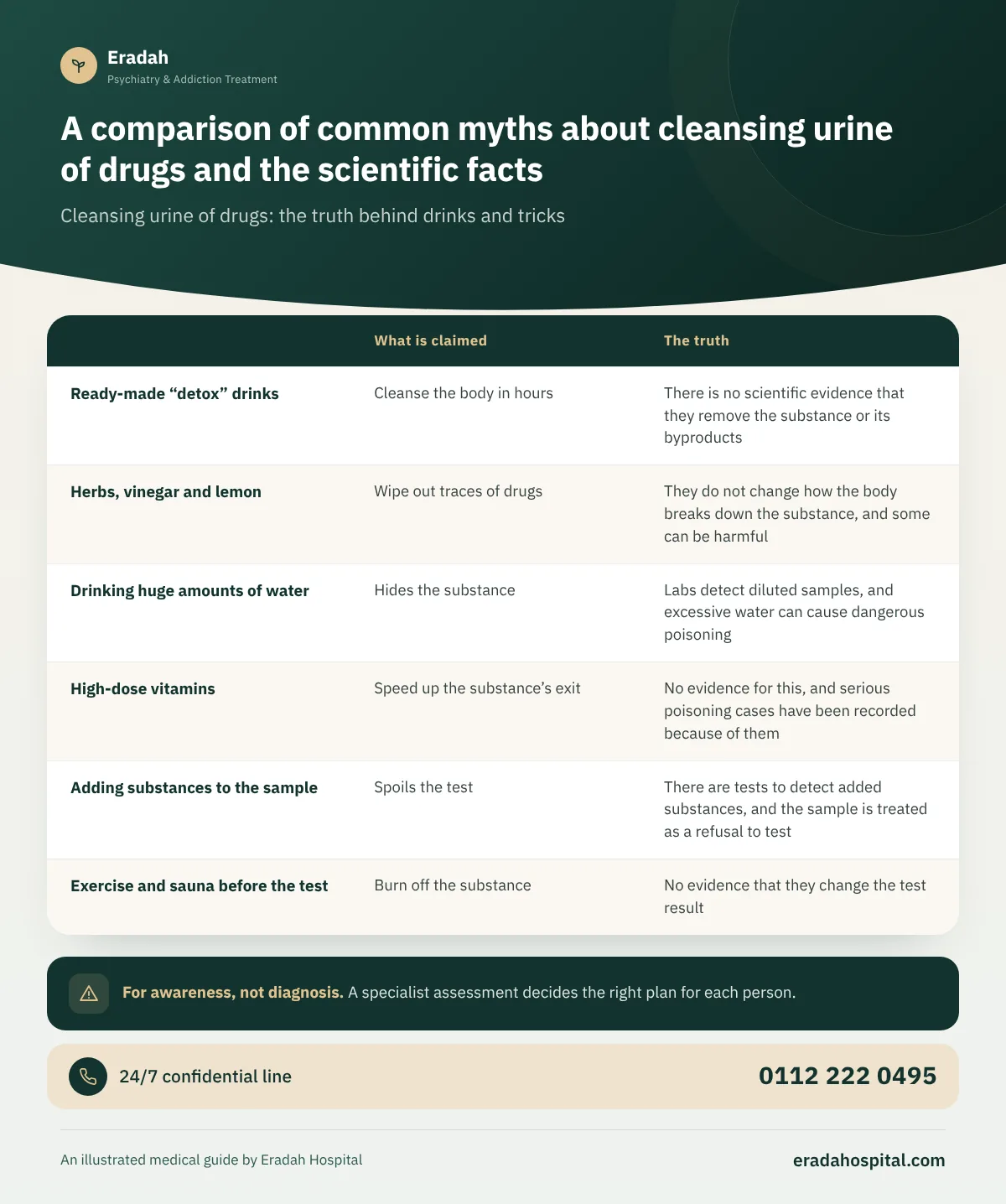
Common myths about cleansing urine, and the truth
| What is claimed | The truth | |
|---|---|---|
| Ready-made “detox” drinks | Cleanse the body in hours | There is no scientific evidence that they remove the substance or its byproducts |
| Herbs, vinegar and lemon | Wipe out traces of drugs | They do not change how the body breaks down the substance, and some can be harmful |
| Drinking huge amounts of water | Hides the substance | Labs detect diluted samples, and excessive water can cause dangerous poisoning |
| High-dose vitamins | Speed up the substance’s exit | No evidence for this, and serious poisoning cases have been recorded because of them |
| Adding substances to the sample | Spoils the test | There are tests to detect added substances, and the sample is treated as a refusal to test |
| Exercise and sauna before the test | Burn off the substance | No evidence that they change the test result |
Harms of body-cleansing tricks for drugs
The danger here is not theoretical. A medical report published in 2011 in the Journal of Emergency Medicine described a 23-year-old man who took a large amount of vitamin niacin after reading online that it helps pass a drug test. He developed acute kidney failure and severe disturbances of clotting and consciousness, and needed a ventilator and kidney dialysis before he recovered. The report stresses that there are no data supporting the use of niacin for this purpose.
A US military trainee also died in 2002 from water intoxication and brain swelling after drinking excessive amounts of water so he could give a urine sample. Drinking far too much water in a short time lowers blood sodium and can cause headache, vomiting, confusion and seizures.
If you don’t use drugs and fear a wrong result
Some medicines can give a positive result on the initial test, such as certain cold medicines, painkillers and antidepressants. It is more useful to tell the lab about every medicine you take and to ask for a confirmatory test when needed, rather than trying to “cleanse” the body. You can find the details in medications that show up in drug tests.
The most honest path: openness and treatment
If you are looking for a way to cleanse urine of drugs because you really are using, first ask yourself “Can I stop?” before “How do I pass the test?” If the answer is hard, that is a sign worth paying attention to. The practical steps:
- Talk openly with a doctor; the consultation is confidential, and its purpose is to help you, not to judge you.
- Do not suddenly stop certain substances on your own, such as sedatives, alcohol and opioids, because their withdrawal can be dangerous.
- Know that real “detox” is a medical procedure to get through withdrawal safely, not a drink, as we explain in medically supervised detox.
- Start a real treatment plan, because sustained abstinence is the only way to make the test negative every time; the details are in addiction treatment.
A message to the family
If you find “cleansing” drinks in your son’s room or read a search on his phone about cheating a drug test, this is a sign of real worry on his part, not mere stubbornness. Start a calm conversation, avoid humiliating surprise tests, and ask for specialist advice. The guide to signs of drug use offers practical steps to begin.