"I want an injection that makes him hate drugs." Addiction doctors hear this request from families often. The truth is that medications play an important role, even a lifesaving one in some types of addiction, but it is a specific role that differs from one substance to another, and understanding it protects the family from false promises.
What is the role of addiction medications?
The US National Institute on Drug Abuse explains that medications are used for three purposes: easing withdrawal symptoms at the start, reducing cravings and preventing relapse afterward, and treating co-occurring mental and physical illnesses. Some medications act on the same receptors the drug acts on, but without the high; some block the drug's effect; and some make using a repellent experience. This is why the phrase "the addiction medication" on its own means nothing without specifying the substance and the stage.
Addiction medications by substance
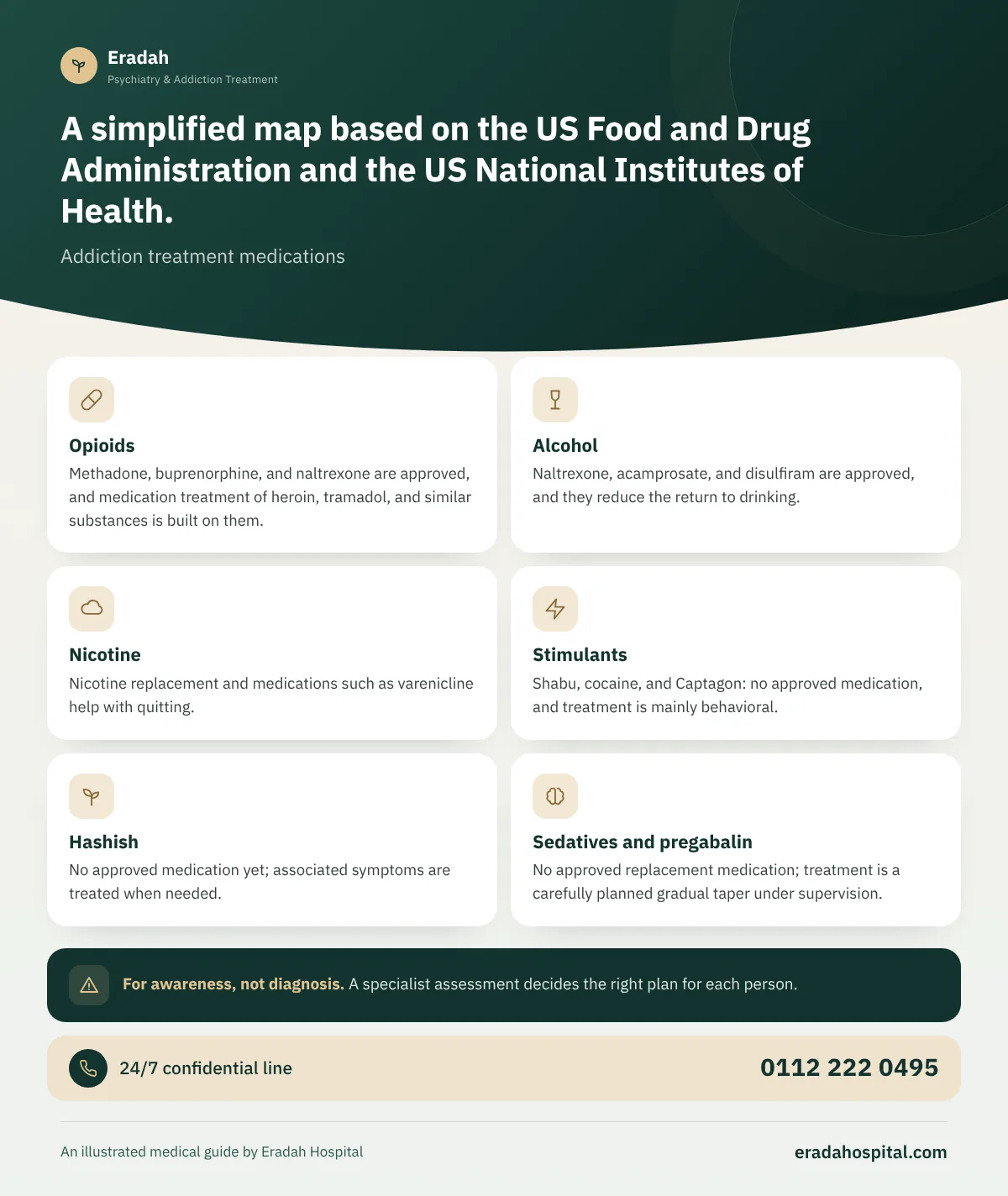
Methadone, buprenorphine, and naltrexone are approved, and medication treatment of heroin, tramadol, and similar substances is built on them.
Naltrexone, acamprosate, and disulfiram are approved, and they reduce the return to drinking.
Nicotine replacement and medications such as varenicline help with quitting.
Shabu, cocaine, and Captagon: no approved medication, and treatment is mainly behavioral.
No approved medication yet; associated symptoms are treated when needed.
No approved replacement medication; treatment is a carefully planned gradual taper under supervision.
Medications for opioid addiction
The US Food and Drug Administration says there are three approved medications for opioid use disorder, all safe and effective: methadone, a full agonist dispensed in accredited programs; buprenorphine, a partial agonist that reduces withdrawal and cravings; and naltrexone, which blocks the receptors so the person feels no effect from the opioid. The US National Institute on Drug Abuse adds that these medications are the standard of care for opioid addiction, and that lofexidine is approved to ease withdrawal symptoms. The choice among them depends on the severity of dependence, the patient's history, and his preference, and it is a medical decision.
Medications for alcohol addiction
The US National Institute on Alcohol Abuse and Alcoholism states that there are three approved medications, and that none of them causes addiction:
- Naltrexone: reduces craving and the pleasure associated with drinking.
- Acamprosate: helps someone who has stopped drinking to keep going, and is believed to restore chemical balance in the brain.
- Disulfiram: causes a very unpleasant reaction when any amount of alcohol is drunk, such as facial flushing, nausea, and palpitations. MedlinePlus warns against giving it to a patient without his full knowledge, so it must never be put secretly in food or drink.
In an analysis of 122 randomized trials published in JAMA in 2014, doctors needed to treat 12 patients with acamprosate to prevent one from returning to drinking, and 12 patients with oral naltrexone to prevent one from returning to heavy drinking; the analysis found no clear difference between the two drugs. These numbers mean the benefit is real but modest, so it does not replace comprehensive alcohol addiction treatment. Alcohol withdrawal itself can be dangerous and needs different medications under medical supervision.
Why is there no medication for shabu and cannabis?
The US National Institute on Drug Abuse confirms that no medication is approved for methamphetamine use disorder or any other stimulant, and that researchers are still working on medications for stimulants and cannabis. The most effective treatment for shabu and cocaine addiction is behavioral, and its strongest method is positive reinforcement with tangible rewards for abstinence, together with cognitive behavioral therapy and motivational interviewing. Even so, a doctor may prescribe medication for what accompanies withdrawal, such as insomnia, depression, or psychosis; this treats the symptoms, not the addiction itself.
Do addiction medications cause addiction?
The US National Institute on Drug Abuse explains that methadone, buprenorphine, and nicotine replacement act on the same receptors but in a way that does not produce a high, and that when taken as prescribed they control withdrawal and cravings and are not considered addiction. They can, however, cause physical dependence, which is why stopping them is done gradually under a medical plan. Naltrexone and acamprosate do not cause dependence at all.
The limits of medication treatment
- Medication does not treat the psychological and social causes of substance use.
- Adherence to medication weakens without follow-up and support.
- No medication protects against all substances at once when they are mixed.
- Do not start or stop any medication without a doctor, and do not buy it anywhere other than a pharmacy with a prescription.
How are medications chosen at Eradah?
The doctor begins by assessing the substance, the duration of use, and physical and mental health, then builds a plan that combines the right medication with psychological therapy, whether in residential treatment or outpatient treatment. When depression, anxiety, or psychosis is present, it is treated within dual diagnosis, avoiding, as far as possible, medications that could cause a new dependence.