Stages of alcohol addiction treatment
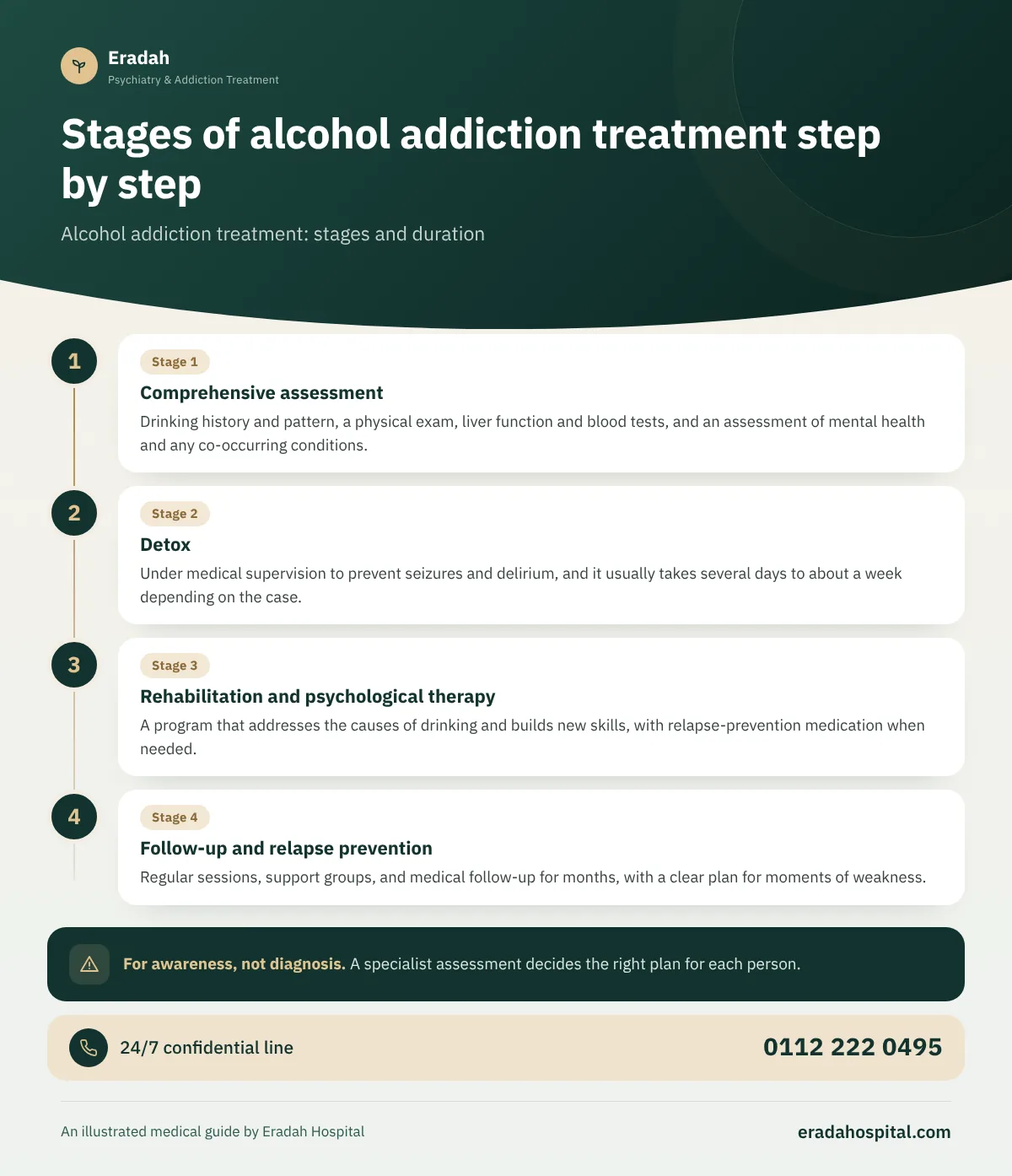
- Stage 1Comprehensive assessment
Drinking history and pattern, a physical exam, liver function and blood tests, and an assessment of mental health and any co-occurring conditions.
- Stage 2Detox
Under medical supervision to prevent seizures and delirium, and it usually takes several days to about a week depending on the case.
- Stage 3Rehabilitation and psychological therapy
A program that addresses the causes of drinking and builds new skills, with relapse-prevention medication when needed.
- Stage 4Follow-up and relapse prevention
Regular sessions, support groups, and medical follow-up for months, with a clear plan for moments of weakness.
Alcohol detox: why must it be medical?
Detox is the stage in which the body clears the alcohol and goes through withdrawal symptoms safely. Because alcohol withdrawal can cause seizures and delirium tremens, this stage needs a medical team that assesses severity with validated scales, prescribes suitable sedative medication and then tapers it gradually, and monitors vital signs, fluids, and electrolytes.
You will find details of withdrawal symptoms and their timing on the page on alcohol withdrawal symptoms and their duration. Detox is the safe start of treatment, and it is not enough on its own to treat addiction.
What medications are used in alcohol addiction treatment?
After withdrawal ends, the doctor may prescribe one of the approved medications that help maintain abstinence, choosing the most suitable according to liver and kidney condition, other illnesses, and the patient’s goals:
| Medicine | Its role | Note |
|---|---|---|
| Naltrexone | Reduces the urgent craving to drink and weakens the sense of reward from it | Not used with opioid painkillers, and needs monitoring of liver function |
| Acamprosate | Eases the troublesome symptoms that continue after stopping, making it easier to keep going | The doctor needs to check kidney function before it |
| Disulfiram | Causes very unpleasant symptoms if the patient drinks alcohol, so it acts as a deterrent | Used only with the patient’s full consent and under medical supervision |
These medications are mentioned only to raise awareness of their roles; choosing them and how long to use them is the decision of the treating doctor alone, and they must not be used or stopped without follow-up.
Psychological therapy for alcohol addiction
Helps identify the thoughts and situations that drive drinking and learn alternative ways to cope with them.
Strengthens the patient’s inner motivation to change, especially if he is hesitant.
Repairs patterns of communication within the family, and teaches the family how to support without enabling drinking.
Treats co-occurring anxiety, depression, or trauma within the same plan.
Do support groups help with recovery from alcohol?
Yes. Mutual-support groups such as Alcoholics Anonymous give the person in recovery a safe space to share with people who have been through the same experience, and break isolation and shame. The US National Institute on Alcohol Abuse and Alcoholism stresses that they complement specialized treatment and do not replace it, and many people benefit from them for years after treatment.
Residential treatment or outpatient treatment?
| Residential treatment | Outpatient treatment | |
|---|---|---|
| Suitable for | Severe dependence, a history of seizures or delirium, or co-occurring illnesses | Mild, stable cases, or after residential treatment |
| Supervision | around the clock | Regular visits and appointments |
| Distance from triggers | Complete during the stay | Needs strong family support |
| Daily life | A temporary break from work | Can continue |
How long does alcohol addiction treatment take?
Detox usually takes days to about a week, then rehabilitation runs from weeks to a few months depending on the case, and follow-up and support groups continue for longer. Research indicates that staying in treatment for long enough is one of the most important success factors, and that very short programs are linked to higher relapse rates.
What is the family’s role in alcohol addiction treatment?
The family is part of treatment, not a spectator. Programs that involve the family are linked to better outcomes, because they address patterns of communication that may unintentionally feed drinking, such as covering for the patient or constant blame. The family learns how to set clear boundaries without harshness, how to notice early signs of relapse, and how to protect itself from emotional exhaustion during recovery.
Relapse prevention after alcohol treatment
- Identify personal triggers: places, people, occasions, feelings.
- Remove alcohol from the home and avoid places associated with drinking in the first months.
- A written plan for moments of weakness: whom to call and what to do.
- Stick with medication and medical follow-up without stopping on your own.
- Build a healthy routine of sleep, exercise, work, and supportive relationships.
- Attend support groups regularly.
How do you choose a center for alcohol addiction treatment?
- Officially licensed, with psychiatrists who specialize in addiction treatment.
- Provides medically supervised detox around the clock, with the ability to manage seizures and delirium.
- Assesses the liver and physical condition and works with internal medicine doctors when needed.
- Treats dual diagnosis, and has a family program and a clear follow-up plan.
- Respects confidentiality and dignity, and does not promise a miracle cure in days.
What to look for in a hospital for alcohol addiction treatment
Alcohol is one of the few substances whose withdrawal itself can be life-threatening: seizures, or delirium tremens with confusion, hallucinations, and disturbances in pulse and temperature. So the place you choose for a father or brother who has been drinking for years should be judged first by its ability to manage the first days after the last drink, not by how nice the rooms are or how long the program is.
- Who examines the patient in the middle of the night if severe shaking or confusion appears? Is the doctor in the building, or only on the phone?
- Is thiamine given early to protect the brain and memory from the complications of this vitamin deficiency?
- Are liver function and electrolytes checked before the plan, and who follows internal medical complications?
- What is the established arrangement for transfer to a general hospital if the condition worsens?
- Does the place have experience with people who combine drinking with sedatives, a mix that raises the risk?
At Eradah, a doctor and nursing staff are on site around the clock throughout medically supervised detox, and if the condition needs general hospital care the patient is transferred by ambulance to the nearest hospital. Once the body has stabilized, the rehabilitation stage begins with individual and group psychological therapy and a medication plan set by the doctor. For details of what happens in those days, see alcohol withdrawal symptoms and their stages.
Alcohol addiction treatment at Eradah
At Eradah we start with a comprehensive medical and psychological assessment, then safe detox under round-the-clock medical supervision with thiamine and liver monitoring, followed by a rehabilitation program combining medication, psychological, and family therapy, then regular follow-up after discharge. We treat co-occurring anxiety or depression within the same plan, with complete confidentiality and full respect from the first call.