"They told us, let him pray and read Quran and he'll quit on his own." This is said by families who trust in their Lord, and their trust is well placed. But addiction is an illness that changes brain chemistry, which is why the question about treating drug addiction with the Quran keeps coming up, and whether it is enough on its own. We answer with what the religion says, then what research says, then steps that combine faith and medicine.
Islam's position on drugs: a clear prohibition
The Holy Quran settled the matter of intoxicants in Surat Al-Ma'idah, where God Almighty said: "O you who believe! Intoxicants, gambling, idolatrous altars, and divining arrows are an abomination of Satan's handiwork, so avoid it, that you may prosper. Satan only wishes to stir up enmity and hatred among you through intoxicants and gambling, and to hinder you from the remembrance of God and from prayer. Will you not then desist?" [Al-Ma'idah: 90, 91].
And in Sahih Muslim, on the authority of Ibn Umar, the Prophet (peace be upon him) said: "Every intoxicant is khamr, and every intoxicant is forbidden." What counts is the intoxicating effect, not the name, so the ruling includes what is used today of hashish, pills, and powders.
Is seeking treatment for addiction required by religion?
Yes. The religion that prohibited the substance also commanded seeking treatment. In the hadith narrated by Usama ibn Sharik, the Prophet (peace be upon him) said: "O servants of God, seek treatment, for God has not made a disease except that He made a cure for it, except for one disease: old age." Narrated by Abu Dawud (3855), al-Tirmidhi (2038), and Ibn Majah (3436), and authenticated by al-Albani.
In fatwa No. 6843 issued by Egypt's Dar al-Ifta, titled "Seeking the help of experts in addiction treatment," it is stated that turning to specialists in addiction treatment is required by Islamic law, and that prescribing medication is the responsibility of the treating doctor and no one else may presume to do so. In this understanding, the person with addiction is a patient whose place is with medical professionals.
What do the Quran and prayer add to addiction treatment?
Faith does not remove the substance from the body, but it strengthens motivation, meaning, and companionship. God Almighty said: "Truly, in the remembrance of God do hearts find rest" [Ar-Ra'd: 28], and tranquility is a real weapon against anxiety and cravings. What spiritual support offers includes:
The sense that stopping has a value greater than oneself strengthens motivation on hard days.
The five prayer times divide the day and fill the free hours that substance use used to occupy.
Believing that repentance is accepted eases the weight of guilt that pushes many back to the substance.
The mosque or the church offers fellowship away from the friends and places of substance use.
Remembrance of God, reciting the Quran, and supplication help calm tension before sleep and in moments of craving.
What does research say about faith and recovery from addiction?
In a pooled analysis published in JAMA Psychiatry in 2026, researchers combined 55 longitudinal studies with more than 540,000 participants and found that spirituality was associated with about a 13% lower risk of harmful alcohol and drug use, rising to about 18% among those active in a religious community who attend its services often.
These are correlational findings; they do not prove that religiosity alone treats someone who already has an addiction. In a systematic review published in 2019 of twenty randomized trials with about 3,700 participants, the effect of spiritual interventions was positive but modest, and most of what was compared were twelve-step programs. So faith is a protective factor added to proven treatment.
Is treating addiction with the Quran alone enough?
In most cases it is not, for two reasons. First, addiction changes the brain's reward and self-control circuits, so the patient needs psychological and behavioral treatment and sometimes medication. Second, suddenly stopping alcohol or sedatives from the benzodiazepine group can cause life-threatening seizures and delirium, and the US Food and Drug Administration warns against abruptly stopping benzodiazepines for this reason. Pregabalin withdrawal can also cause seizures in some patients.
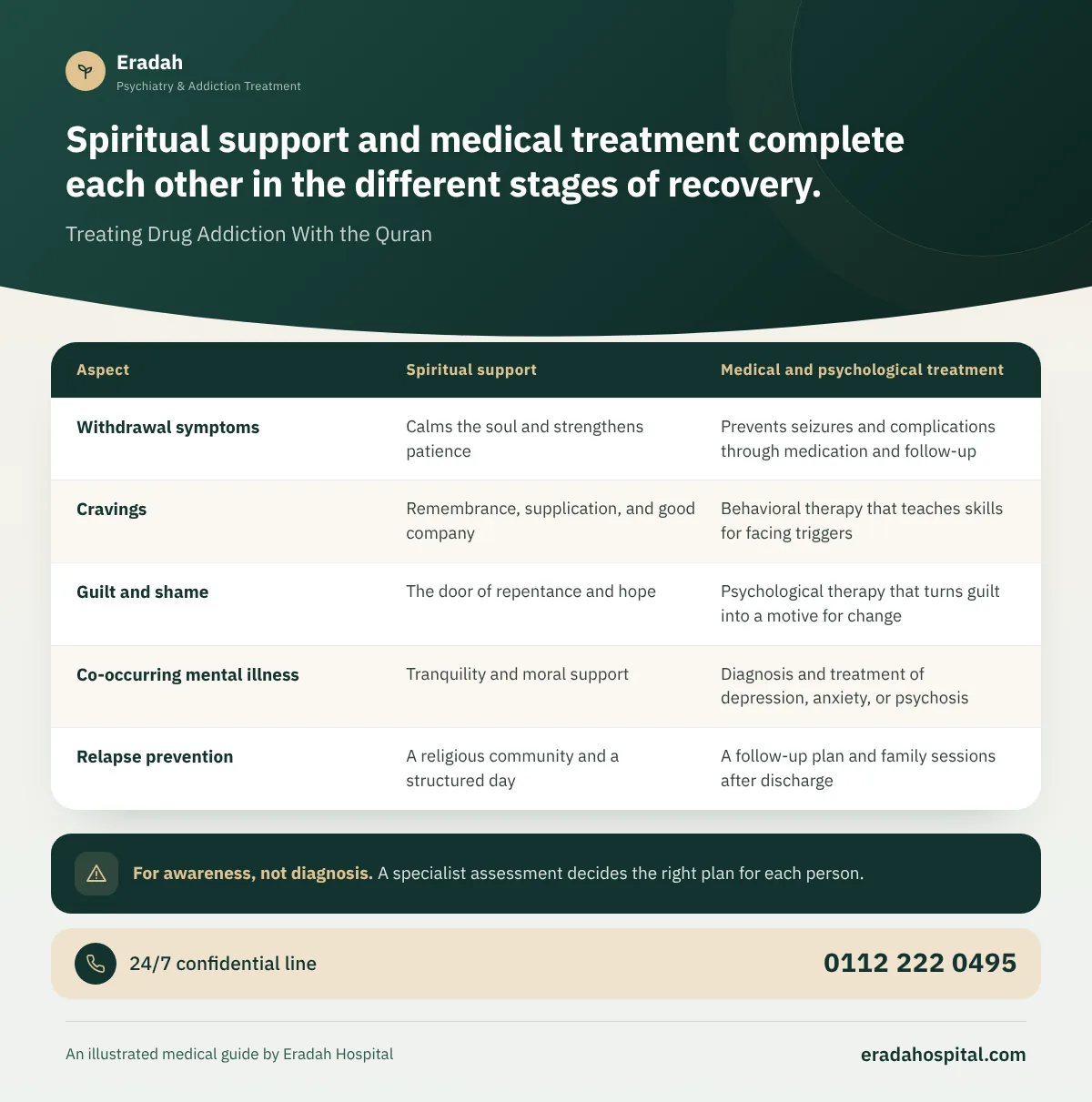
| Aspect | Spiritual support | Medical and psychological treatment |
|---|---|---|
| Withdrawal symptoms | Calms the soul and strengthens patience | Prevents seizures and complications through medication and follow-up |
| Cravings | Remembrance, supplication, and good company | Behavioral therapy that teaches skills for facing triggers |
| Guilt and shame | The door of repentance and hope | Psychological therapy that turns guilt into a motive for change |
| Co-occurring mental illness | Tranquility and moral support | Diagnosis and treatment of depression, anxiety, or psychosis |
| Relapse prevention | A religious community and a structured day | A follow-up plan and family sessions after discharge |
Treating addiction with ruqyah: what it can and cannot do
Ruqyah with the Quran and reported supplications is permissible, and the believer sees in it healing and mercy, as in God's words: "And We send down of the Quran that which is healing and mercy for the believers" [Al-Isra: 82]. There is no objection to the patient reciting for himself or his family reciting over him while he receives his treatment. The danger comes from those who trade in it, and their signs include:
- Promising a guaranteed cure of addiction in a few sessions.
- Asking for large sums, or selling "recited-over" water and oils at high prices.
- Telling the patient to stop psychiatric medication or not to see a doctor.
- Beating, locking up, or any physical harm under the pretext of driving something out of the patient.
The Dar al-Ifta fatwa mentioned above cites the hadith: "Whoever practices medicine without being known for medical knowledge before that is liable," so whoever treats without knowledge bears responsibility for any harm to the patient.
How do you combine faith and medical treatment in practice?
- Start with a medical assessment that identifies the type of substance and the danger of withdrawal, then medically supervised detox if needed.
- Give prayer and a portion of Quran reading a fixed place in the daily schedule, even a single page.
- If the patient has an imam or sheikh he trusts, let him be a source of support in coordination with the doctor.
- Tell the doctor about any herbs, water, or oils the patient takes.
- Join 12-step program groups if they suit you; many Muslim members understand the "higher power" in them to be God, glory be to Him.
The language of faith at home: support without blame
Phrases like "you're far from God" or "this is a punishment from God" increase the patient's sense of shame, and shame is one of the strongest drivers back to the substance. It helps more for him to hear about mercy and repentance, and to see his family pray with him and accompany him to treatment appointments.
And if a relapse happens, it does not mean his faith has weakened or that prayer did not help. Addiction is a chronic illness prone to relapse, and what is needed is a quick return to the plan. Read our guide to relapse in addiction.
For Christian patients: prayer and church support
All of the above applies to Christian patients as well. Prayer, reading the Bible, and the company of a priest or a servant he trusts are all real support, provided they go alongside medical treatment. The church can be part of the support network after discharge.
When should treatment begin? And how is the patient's faith respected?
Start now, and don't wait for God to "guide him" before he goes to the doctor; going to the doctor is part of taking the means. If his condition is stable, addiction treatment at home with outpatient follow-up may suit him, but alcohol, sedatives, and mixing substances need closer supervision. You can find the stages and programs of drug addiction treatment in our comprehensive guide.
At Eradah, the treatment team respects each patient's faith and worship, and the family can arrange spiritual support that suits the patient in coordination with the treating doctor. The first consultation is free and confidential at 01122220495.