"My son refuses treatment. Can I put him in a treatment center against his will?" By the time a family reaches this question, they have usually tried talking, pleading, and threats, and nothing has changed. Here we explain precisely what Egyptian law allows and does not allow, and why coercion is usually neither the first solution nor the most effective one.
Is it legal to treat a person with addiction against his will in Egypt?
Yes, but only through two formal routes, each with its own conditions and the body that decides: one route is in the Narcotics Control Law No. 182 of 1960 and its amendments, which concerns the person who uses drugs or has an addiction; the other is in the Mental Health Patient Care Law No. 71 of 2009, as amended by Law 210 of 2020, which concerns severe mental illness. Neither gives a family or a treatment center the right to "bring" a person from his home by force without a decision from the competent authority.
Route one: a family request under the drug law
Article 37 bis (b) of the drug law, as published, provides that no criminal case is brought against a person proven to have an addiction or to use drugs if his spouse, one of his parents or grandparents, or one of his children or grandchildren asks for his treatment. The request is submitted to the Addiction Treatment Committee formed in each governorate, chaired by a judge of the Court of Appeal and including a representative of the prosecution and representatives of the ministries of health, interior, defense, and social solidarity. The procedure runs as follows:
- The committee examines the request and hears the parties concerned, and it may ask the prosecution to investigate.
- If the person agrees, the committee decides to admit him to a treatment center or to require him to attend treatment facilities.
- If he refuses, the committee refers the matter through the prosecution to the criminal court covering his place of residence, sitting in chambers, to order his admission or require him to attend treatment.
- In cases of necessity, before a decision is made, the committee may place him under medical observation for no more than two weeks. He may file a grievance, and the prosecution must refer it to the court within three days.
The great advantage of this route is that it treats the person as a patient, not as a defendant. But in practice it varies from one governorate to another, so ask a lawyer or the Fund for Drug Control and Treatment of Addiction hotline, 16023, about the first step in your governorate before you begin.
Route two: compulsory admission under the Mental Health Patient Care Law
Article 13, after the 2020 amendment, provides that no one may be admitted compulsorily except with the approval of a psychiatrist, when there are clear signs of a severe mental illness whose treatment requires admission to a psychiatric facility, and in one of two situations: a likely severe and imminent deterioration in his condition, or symptoms that pose a serious and imminent threat to his safety or life or the lives of others, together with his refusal of treatment. Article 14 specifies who may submit a written request: a relative up to the second degree, the competent police officer, the social worker in the area, a health inspector, the consul of a foreign patient's country, or a psychiatrist from outside the facility who is not related to the patient.
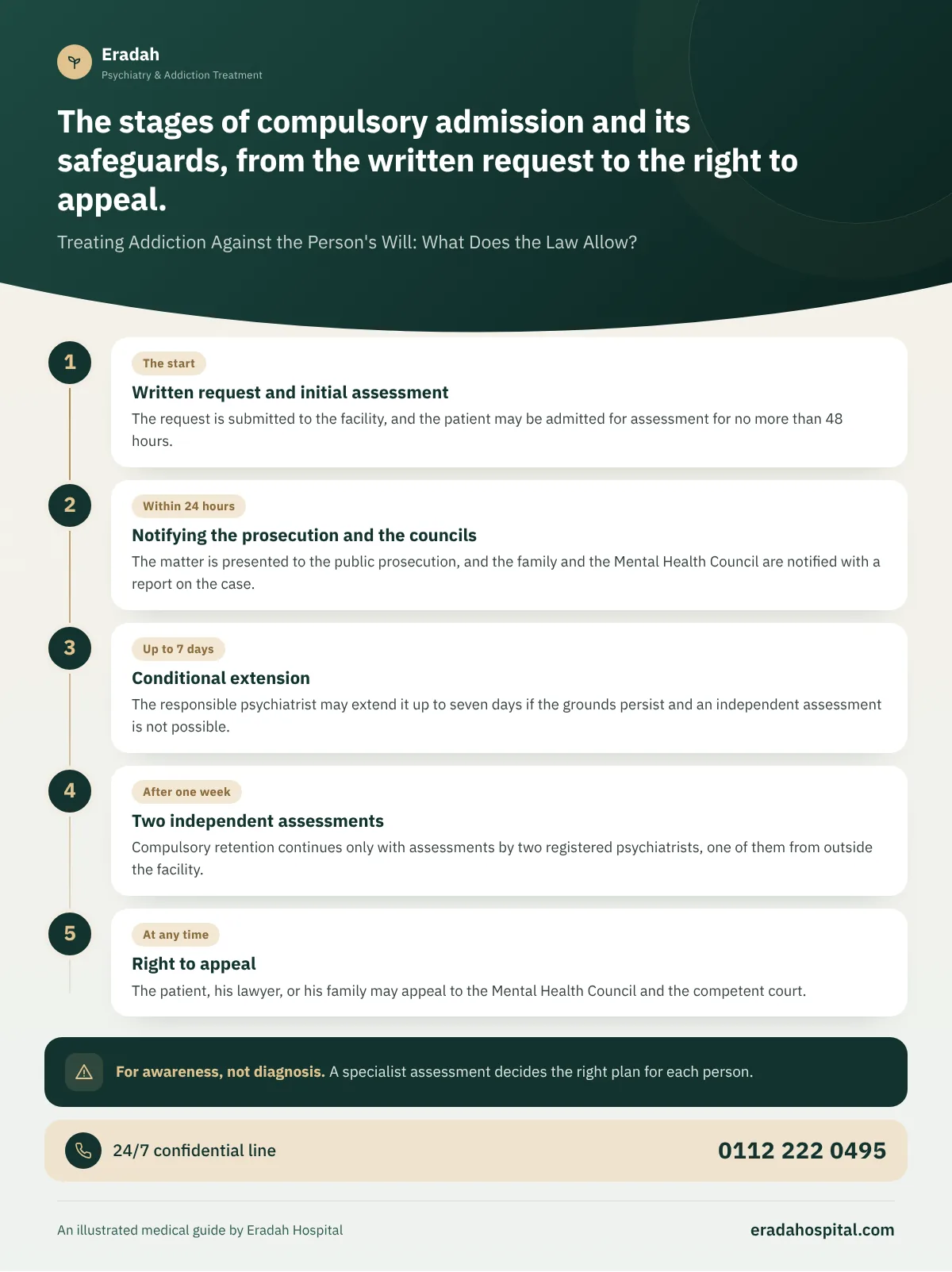
- The startWritten request and initial assessment
The request is submitted to the facility, and the patient may be admitted for assessment for no more than 48 hours.
- Within 24 hoursNotifying the prosecution and the councils
The matter is presented to the public prosecution, and the family and the Mental Health Council are notified with a report on the case.
- Up to 7 daysConditional extension
The responsible psychiatrist may extend it up to seven days if the grounds persist and an independent assessment is not possible.
- After one weekTwo independent assessments
Compulsory retention continues only with assessments by two registered psychiatrists, one of them from outside the facility.
- At any timeRight to appeal
The patient, his lawyer, or his family may appeal to the Mental Health Council and the competent court.
A point many people overlook is that the law defines mental disorder as not including behavioral disorders without a clear mental or psychiatric illness. So substance use alone is usually not enough for compulsory admission. When it is accompanied by psychosis, severe depression with suicide risk, or agitation that threatens others, the psychiatrist assesses whether the conditions apply. You can find the difference between voluntary and involuntary admission on the psychiatric hospital page.
Why is forced transport outside the law dangerous?
Some unlicensed places offer families a service of "bringing" the patient by force. This is dangerous for more than one reason. Article 45 of the Mental Health Patient Care Law punishes with imprisonment of up to two years anyone who detains a person, or deliberately causes his detention, as a mental health patient in places and circumstances other than those the law specifies. The patient may also suffer injuries or withdrawal complications without medical supervision, and violent coercion destroys the trust that any later treatment needs.
More effective alternatives to try before considering coercion
Among its principles of effective treatment, the US National Institute on Drug Abuse (NIDA) notes that treatment does not have to be voluntary to work, and that pressure from family or employers can increase entry into treatment and staying in it. What is meant here is thoughtful pressure and clear boundaries, not violence or abduction:
- Learn the CRAFT approach, explained in the guide to persuading a person with addiction to accept treatment. It changes how the family responds instead of confronting the person.
- Call the 16023 hotline or a licensed center yourself to understand the options, even before the patient agrees.
- Offer one small, specific step: "just an assessment," or a visit to a psychiatrist for sleep problems or irritability.
- Set firm boundaries, such as stopping cash, and state them calmly and follow through.
- Attend the family treatment program yourself. Family support can change the whole situation.
When should you act immediately without waiting for his consent?
If he loses consciousness or his breathing slows after using, has seizures, has hallucinations with threats of harm, or talks seriously about death, this is an emergency in which there is no room for persuasion or procedures. Call the ambulance at 123 or go to the nearest emergency room, and read what to do in an overdose. You can also call the mental health support line, 16328.
At Eradah, our free first consultation welcomes many families whose son is not yet convinced, and we explain which options suit their situation. This is a general educational overview of published texts, not legal advice; how the law applies varies with the details of each case, and the right decision needs a lawyer.