"I sleep eight hours and wake up as if I hadn't slept, and my wife says I snore and breathe with difficulty." Not everyone who complains about sleep has insomnia. Some sleep enough hours but their sleep is broken, some are overcome by sleepiness at work, and others move or shout in their sleep. These are all different forms of what are called sleep disorders.
What Are Sleep Disorders?
The MedlinePlus encyclopedia describes sleep disorders as conditions that affect your ability to sleep well on a regular basis, whether through difficulty falling asleep, sleeping at the wrong times, sleeping too much, or abnormal behaviors during sleep. The Cleveland Clinic says the International Classification of Sleep Disorders (ICSD) includes more than 80 types, and that more than 50 million people in the United States alone have a sleep disorder.
The US National Heart, Lung, and Blood Institute (NHLBI) recommends that adults sleep 7 to 8 hours a day, while children and teenagers need more. But the number of hours alone is not enough; broken or unrefreshing sleep can leave the same effect as deprivation.
Types of Sleep Disorders
Difficulty falling asleep or staying asleep on most nights for at least three months.
Snoring and episodes in which breathing stops during sleep, breaking it up.
An urgent need to move the legs at rest that prevents sleep.
Sleep timing delayed by two hours or more, or disrupted sleep because of shift work.
Inability to control when you sleep, with sudden, intense daytime sleepiness.
Such as acting out dreams with movement during REM (rapid eye movement) sleep, and sleepwalking.
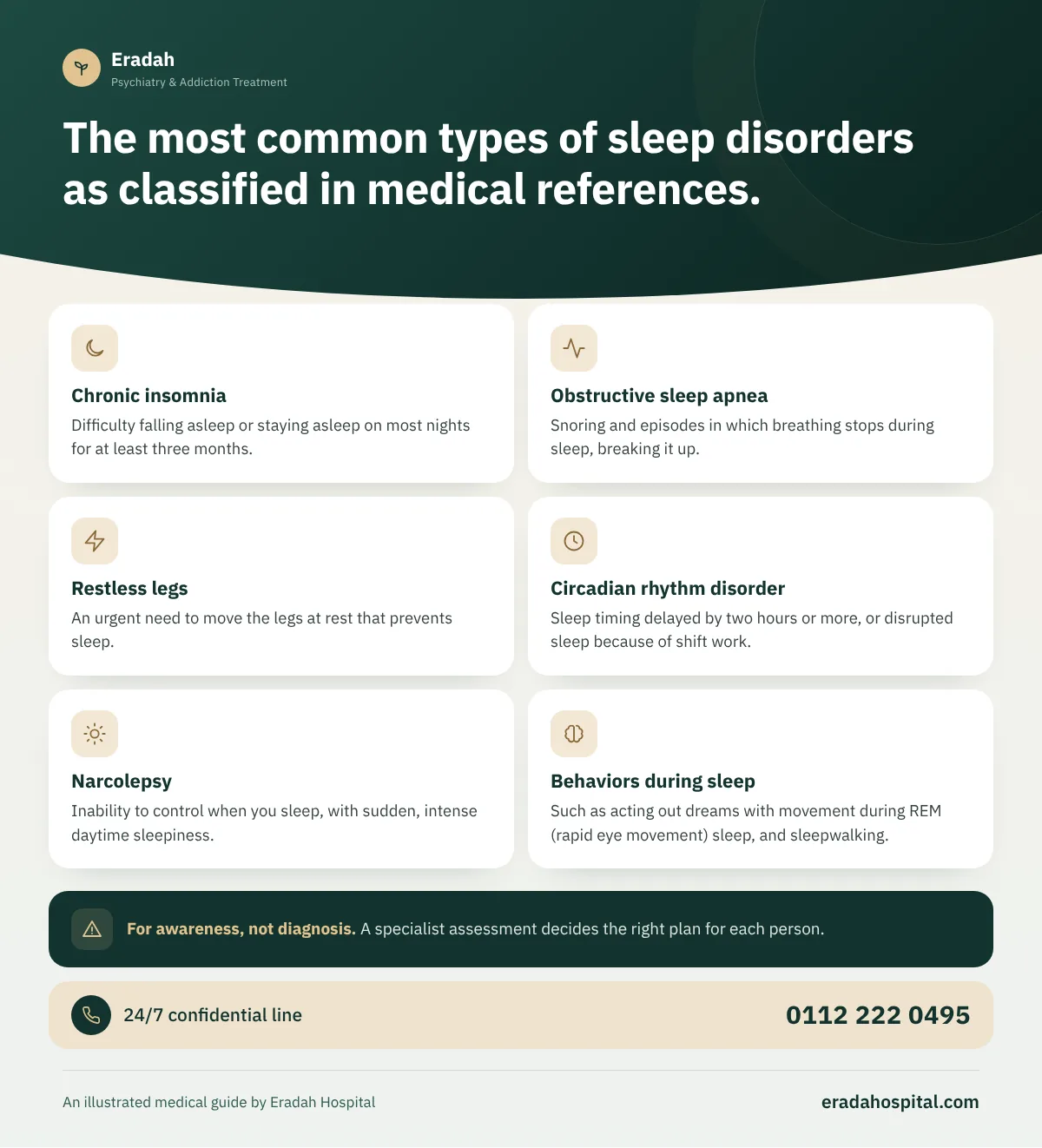
The best known of these types is chronic insomnia, which has its own page explaining its symptoms and treatment in detail.
Symptoms of Sleep Disorders
Symptoms vary by type, and signs mentioned by the Cleveland Clinic and the UK's National Health Service (NHS) include:
- Regularly taking more than 30 minutes to fall asleep.
- Waking often in the night and being unable to go back to sleep.
- Loud snoring, or gasping and choking during sleep that the person sleeping beside you notices.
- A feeling that you need to move your legs when you relax.
- Severe daytime sleepiness despite sleeping enough hours.
- Headache on waking, poor concentration and mood swings.
Sleep Apnea: The Disorder Many People Miss
According to the NHS, most symptoms of sleep apnea happen while the person is asleep, so only the person sleeping next to them may know: breathing stops and restarts, gasping or choking sounds, loud snoring, and frequent waking. During the day the patient feels severe tiredness, has difficulty concentrating, and suffers mood swings and morning headaches. The NHS stresses that it needs treatment because it can lead to more serious health problems.
Sleep Disorders and Mental Health
The relationship between sleep and the mind runs in both directions. Anxiety and depression are among the best-known causes of disrupted sleep, and repeated nightmares are a well-known sign in post-traumatic stress disorder (PTSD). In turn, sleep deprivation increases nervousness, poor concentration and mood swings. That is why a sleep disorder may be the first sign of a mental health problem that needs assessment.
Sleeping Pills, Drugs and Sleep Disorders
Many people turn to sleeping pills without a prescription, or to hashish and alcohol in order to sleep, and discover that their sleep has become dependent on the substance, and that stopping it brings back insomnia worse than before. Some common sleeping pills such as Z-drug sleep medications carry a risk of dependence if used for long periods without supervision. The page on insomnia and addiction explains this cycle and how to break it.
Habits That Improve Sleep
- Keep a fixed bedtime and wake time, even on days off.
- Avoid tea, coffee, soft drinks and smoking for three to four hours before bed, as the Cleveland Clinic advises.
- Cut down on long afternoon naps.
- Keep your phone and screens away from the bed.
- Make the bedroom quiet, dark and at a moderate temperature.
- If you don't fall asleep within a reasonable time, get up, do something calm, then go back.
When Should You See a Doctor About Sleep Disorders?
See a doctor if the sleep problem lasts for weeks despite improving your habits, if someone notices you stop breathing during sleep, if sleepiness overcomes you while driving or at work, or if you depend on a sleeping pill or a substance to sleep. You may need a chest physician, a neurologist or a sleep study, but if the sleep disorder is linked to anxiety, depression or substance use, a psychiatric assessment is essential. You can start with an assessment in Eradah's outpatient clinics, and the first consultation is free and confidential.