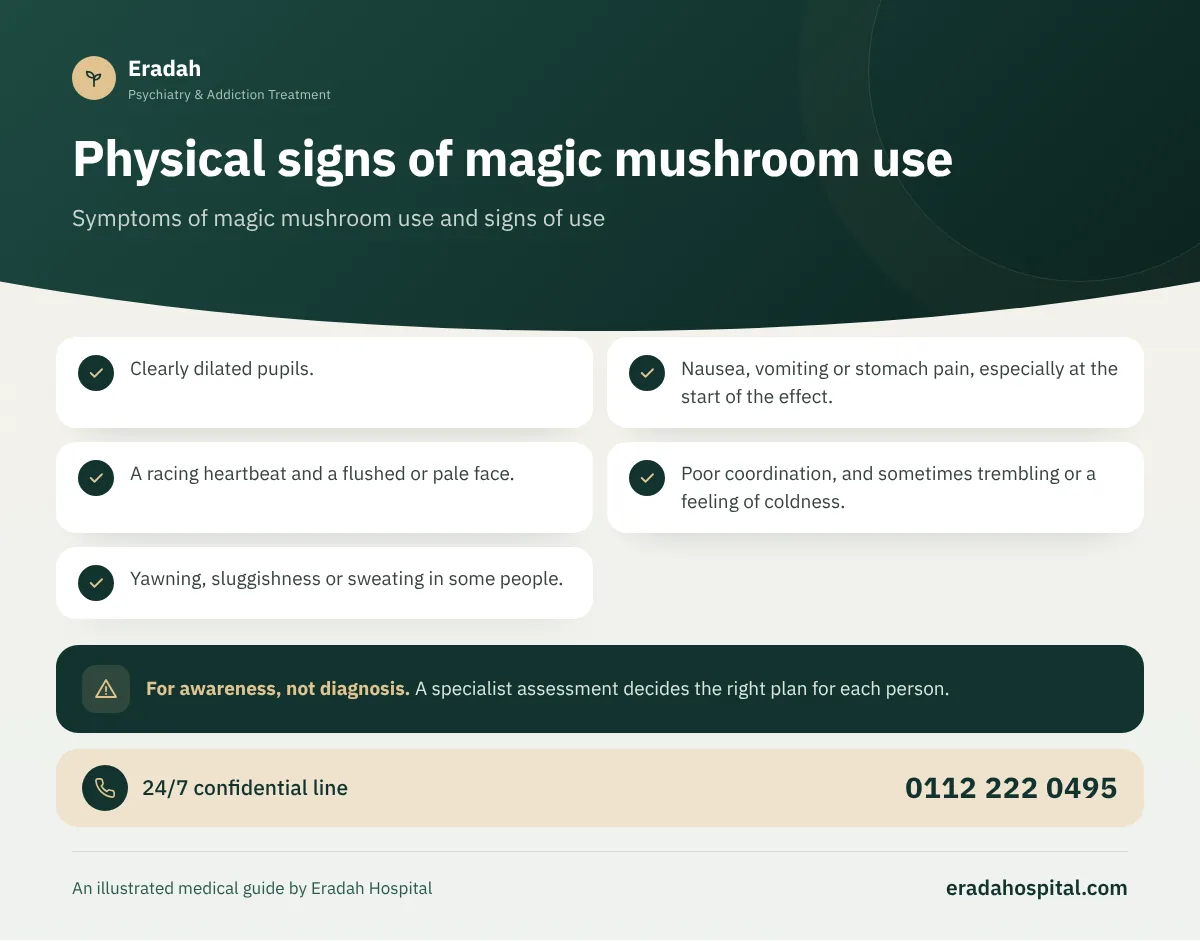
Physical signs during magic mushroom use
- Clearly dilated pupils.
- Nausea, vomiting or stomach pain, especially at the start of the effect.
- A racing heartbeat and a flushed or pale face.
- Poor coordination, and sometimes trembling or a feeling of coldness.
- Yawning, sluggishness or sweating in some people.
Signs of altered perception and thinking
These signs are the clearest, because magic mushrooms change the way a person sees the world around him:
Describing intense colors, moving shapes, walls that "breathe," or faces in objects.
Repeatedly asking about the time, or a feeling that minutes are hours.
Difficulty finishing sentences or following a conversation, and ideas that seem deep or strange.
A feeling of being outside his body or that his surroundings are not real.
Behavioral and emotional signs
- Excessive unexplained laughter, or crying, or rapid emotional swings.
- Long staring at ordinary objects or into space.
- Anxiety, fear or suspicion of those around him for no reason.
- A wish to isolate in a dark room or a sudden urge to go out into nature.
- Impulsive or unsafe behavior, such as wandering aimlessly or going near dangerous places.
How long do the signs of use last?
The signs usually appear within about half an hour, peak in the first hours, and last about four to six hours, after which the person remains tired or distracted for the rest of the day. Because the effect is relatively short, a family may not notice it unless it happens at home or is repeated. Magic mushrooms are not usually associated with physical symptoms after stopping, but some people experience anxiety or visual disturbances that return later.
Indirect signs at home
- Dried mushrooms, an unknown brown powder, or non-medicinal capsules.
- Candy, chocolate or "special" drinks that he hides or warns others about.
- A sudden interest in online content about "spiritual experiences" or hallucinogens.
- New friends and trips or gatherings he does not like to talk about.
- Lasting changes in thinking or perception after a trip or party.
Signs that the situation is dangerous right now
Some signs go beyond being evidence of use and call for an immediate ambulance call (123):
- Severe panic that does not settle with reassurance, or an attempt to flee or harm himself.
- Complete detachment from reality, or not recognizing family members.
- Severe diarrhea and vomiting starting hours after eating the mushrooms.
- Seizures, loss of consciousness, or injury after a fall.
When does use become a disorder? Diagnostic criteria
The DSM-5 diagnostic manual classifies magic mushroom problems under hallucinogen use disorder. Its criteria are similar to those for other substances, with one important difference: it does not include a withdrawal criterion, because hallucinogens do not usually cause clear withdrawal symptoms. In brief, the criteria include the following, and the disorder is usually diagnosed when two or more are present within a year:
- Using more, or for longer, than the person intends.
- A wish to stop, or failed attempts to cut down.
- Spending a lot of time obtaining the substance, using it or recovering from its effects.
- Strong cravings to use.
- Failing to meet obligations at school, work or home.
- Continuing despite relationship problems caused by use.
- Giving up important activities in favor of use.
- Using in physically dangerous situations, such as driving.
- Continuing despite knowing it causes or worsens a psychological or physical problem.
- Tolerance: needing more to get the same effect.
How do you tell magic mushrooms from other substances?
| The sign | Magic mushrooms | Ecstasy | Hashish |
|---|---|---|---|
| Pupils | Dilated | Dilated | Usually normal with red eyes |
| Most notable behavior | Hallucinations, distorted time, and wonder or fear | Warmth, hugging and energy | Sluggishness, laughter and hunger |
| The body | Nausea at the start | Jaw clenching, sweating and heat | Dry mouth and racing heart |
| Approximate duration of effect | 4 to 6 hours | About 3 hours, then a low lasting days | A few hours |
What do you notice in the days after the experience?
Most people return to their normal state after the effect ends, but there are changes worth noting, and a psychological assessment should be sought if they continue:
- Persistent anxiety or panic attacks that were not there before.
- Strange thoughts, suspicion of those around him, or a constant feeling that reality is not real.
- Recurrent visual disturbances such as halos around objects or trails behind moving objects.
- Disturbed sleep or recurrent nightmares linked to the experience.
- Withdrawal from family and friends and a clear decline in interests.
These signs do not necessarily mean addiction, but they may point to a psychological complication that needs treatment, and early intervention greatly improves outcomes.
After you notice the signs: what is the next step?
- Note down calmly what you have observed: the changes, their timing and duration.
- Agree with a trusted family member on a single approach to the conversation.
- Choose a calm time to talk, away from the time of the effect.
- Ask for a specialist psychological assessment if symptoms persist or use is repeated.
How do you talk to someone you suspect is using magic mushrooms?
Many young people defend magic mushrooms with arguments like "natural" and "research uses it," and direct argument closes the conversation. Try alternatives that open the door:
| Instead of saying | Try saying |
|---|---|
| "You're a drug addict" | "I'm worried about you, and I want to understand what drew you to this experience" |
| "All this talk about research is a lie" | "Research uses a known substance with doctors, and that's different from an unknown mushroom" |
| "If you do it again, you'll see" | "If you feel anything strange afterward, I'm here and I won't punish you for telling me" |
The goal is to keep the conversation open, so that if he goes through a frightening experience or psychological symptoms appear later, he comes back to you instead of hiding them.
Emergency signs with magic mushrooms: call an ambulance (123) immediately
- Severe vomiting, diarrhea, and abdominal cramps starting hours after eating the mushroom, a possible sign of a toxic mushroom
- Yellowing of the skin or eyes, reduced urine, or drowsiness and confusion in the following days
- Severe panic that does not settle, or behavior that puts the person or others in danger
- Complete detachment from reality, or talk of self-harm
- Injury or a fall, seizures, or loss of consciousness
Call an ambulance on 123 immediately. Do not try to make the person vomit, and do not give them food or drink. Keep any leftover mushroom or its packaging to show the doctors, and do not be reassured if symptoms improve temporarily, because poisoning from some toxic species can seem to improve and then get worse. Stay with them in a quiet, safe place, and if they lose consciousness but are breathing, place them on their side in the recovery position.
Call the ambulance 123