What is a panic attack?
A panic attack is a false fire alarm in the body: the “fight or flight” system fires at full strength suddenly, with no real danger, so the heart races, breathing tightens and the hands sweat, and the person feels they are dying or losing their mind.
The attack begins suddenly and peaks within minutes, and the NHS notes that most attacks last roughly 5 to 20 minutes, and may last longer in some people. An attack may come in a crowded place, while driving, or even during sleep, and the person remembers it afterward as one of the worst moments of their life.
What matters is that a panic attack, however terrifying, does not cause direct harm to the heart or brain in a healthy person. But this is known only after the doctor has ruled out physical causes, which is why chest pain comes first on the list of things worth checking.
What is the difference between a panic attack and panic disorder?
This is the most important distinction in the whole subject. Passing panic attacks are common, and many people have one or two in a lifetime under intense stress, and they are not by themselves a mental disorder. Panic disorder is diagnosed when:
- Panic attacks recur unexpectedly, that is, mostly without a clear trigger.
- At least one attack is followed by a month or more of persistent worry about having another attack or about its consequences (a heart attack, losing control, “going crazy”).
- Or the person changes their behavior to avoid them: gives up exercise, avoids crowded places, or won't go out without a companion.
- And the attacks are not explained by a substance, a medication, a medical condition or another mental disorder.
In other words, the problem in panic disorder goes beyond the attack itself to fear of fear: anticipating the next attack, which turns life into a state of constant guard.
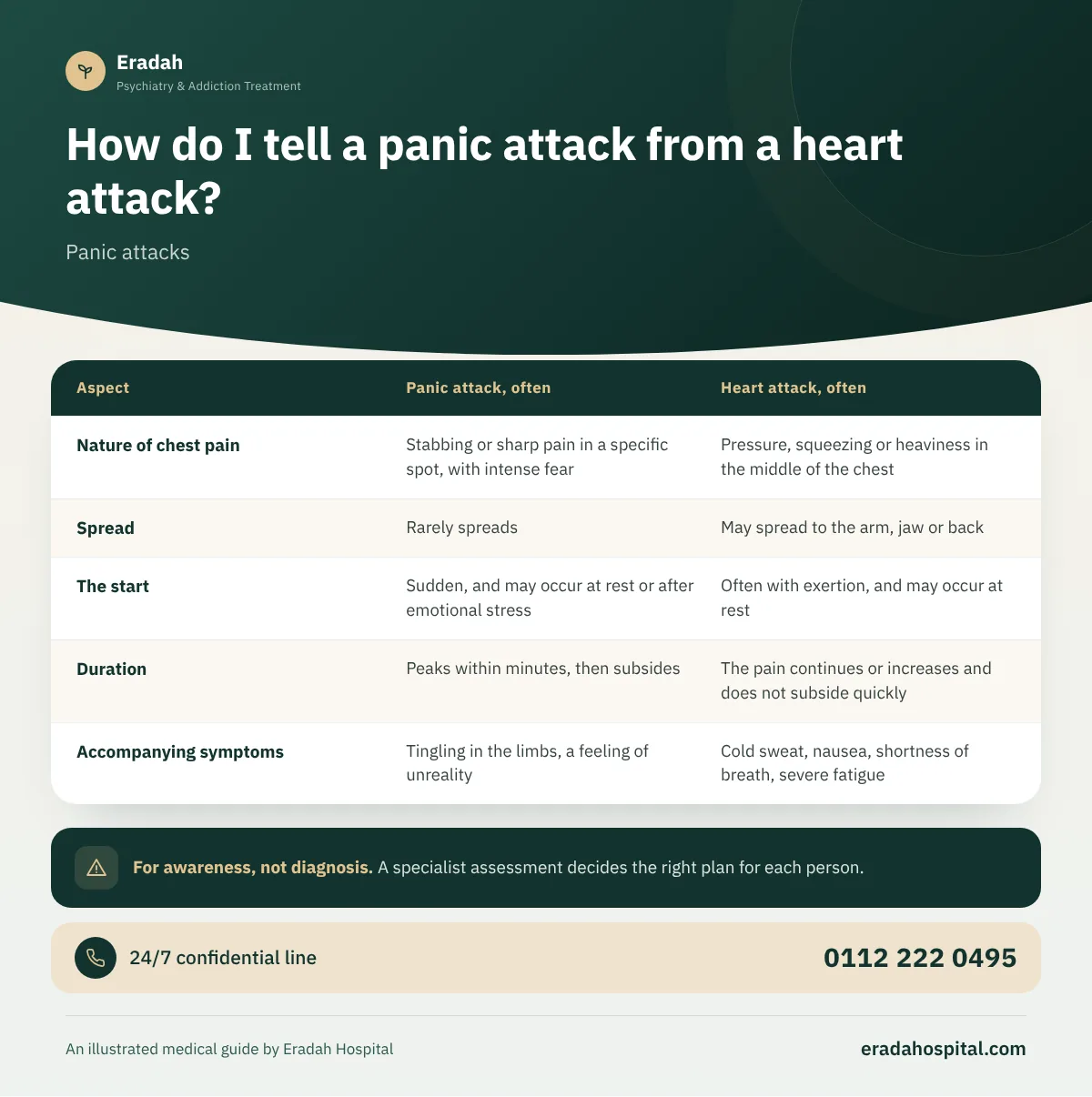
How do I tell a panic attack from a heart attack?
The symptoms are quite similar, which is why many sufferers go to the emergency room many times. The table below shows general differences for awareness only, and is not a way to diagnose at home:
| Aspect | Panic attack, often | Heart attack, often |
|---|---|---|
| Nature of chest pain | Stabbing or sharp pain in a specific spot, with intense fear | Pressure, squeezing or heaviness in the middle of the chest |
| Spread | Rarely spreads | May spread to the arm, jaw or back |
| The start | Sudden, and may occur at rest or after emotional stress | Often with exertion, and may occur at rest |
| Duration | Peaks within minutes, then subsides | The pain continues or increases and does not subside quickly |
| Accompanying symptoms | Tingling in the limbs, a feeling of unreality | Cold sweat, nausea, shortness of breath, severe fatigue |
What is agoraphobia and how is it related to panic?
Agoraphobia is broader than fear of open spaces; it is fear of places and situations that are hard to escape from, or where it is hard to get help if an attack comes: public transport, crowded markets, queues, bridges, and going out alone.
It develops in some people with panic attacks when they start avoiding every place where an attack happened or might happen. Modern diagnostic manuals treat it as a separate disorder that may occur together with panic disorder. With increasing avoidance, a person's life may shrink until they leave home only with a companion, and this too is treatable.
How many people have panic disorder?
Source: the US National Institute of Mental Health (NIMH), NCS-R survey. No documented Egyptian figures are available, so we rely on global figures.
According to NIMH, the disorder often begins in late adolescence or early adulthood, and rarely begins before age fourteen. NIMH data also indicate that nearly half of those affected in a given year have severe impairment in their lives.
Why does the fear alarm go off without danger?
Research indicates that the brain's fear circuit, led by the amygdala, is more easily triggered in people with the disorder, so it interprets ordinary signals from the body, such as a slight speeding of the heart, as imminent danger. The full response then fires: adrenaline, rapid breathing and a racing pulse.
The person then enters a loop: the physical sensation triggers fear, and fear intensifies the physical sensation, until the attack reaches its peak. Because this loop is learned, it can also be “unlearned” with treatment. The genetic and psychological factors behind it are explained on the causes page.
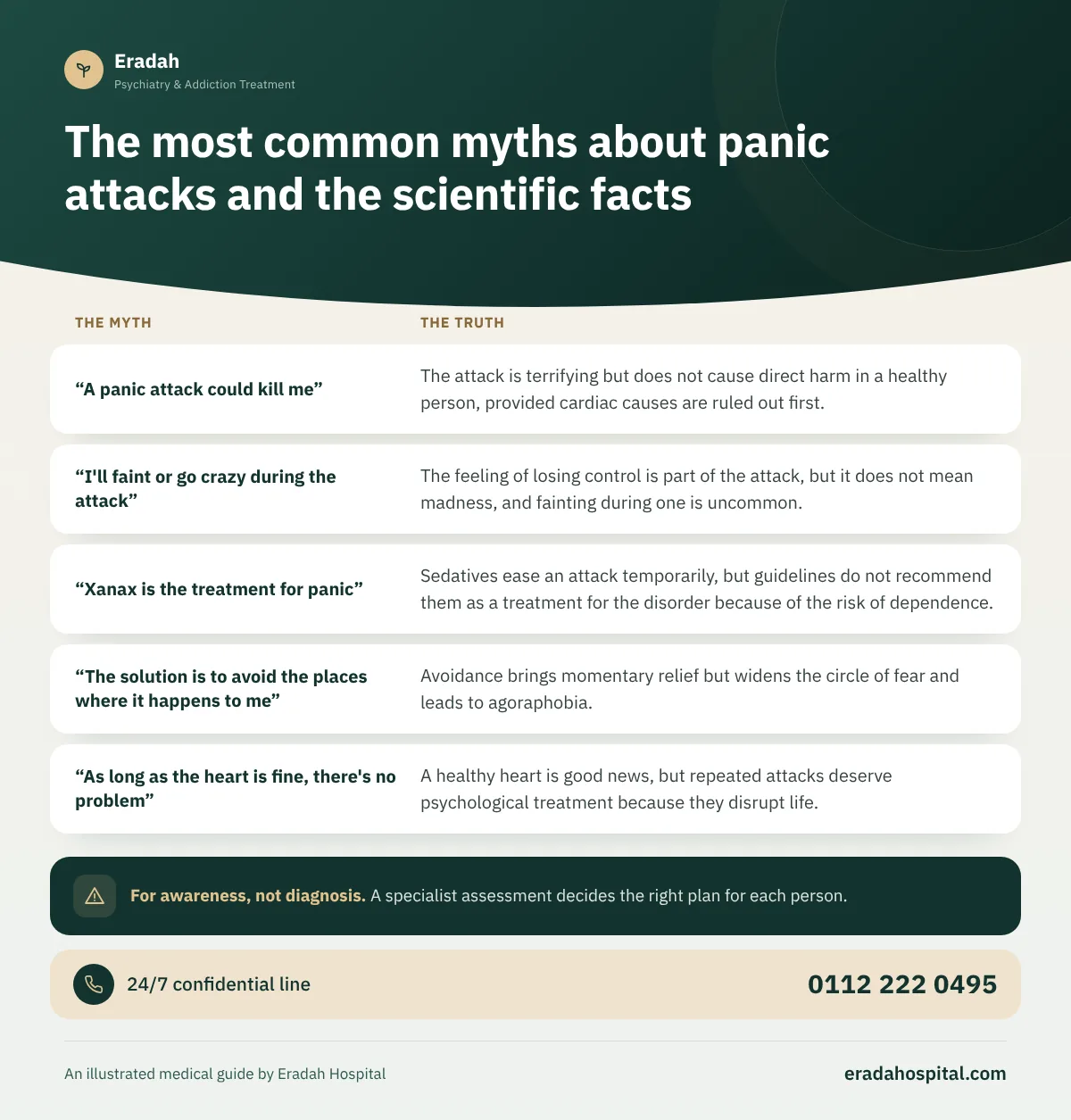
Common myths about panic attacks
| The myth | The truth |
|---|---|
| “A panic attack could kill me” | The attack is terrifying but does not cause direct harm in a healthy person, provided cardiac causes are ruled out first. |
| “I'll faint or go crazy during the attack” | The feeling of losing control is part of the attack, but it does not mean madness, and fainting during one is uncommon. |
| “Xanax is the treatment for panic” | Sedatives ease an attack temporarily, but guidelines do not recommend them as a treatment for the disorder because of the risk of dependence. |
| “The solution is to avoid the places where it happens to me” | Avoidance brings momentary relief but widens the circle of fear and leads to agoraphobia. |
| “As long as the heart is fine, there's no problem” | A healthy heart is good news, but repeated attacks deserve psychological treatment because they disrupt life. |
When do panic attacks need a psychiatrist?
- If the attacks recur after the doctor has ruled out cardiac and physical causes.
- If you live in constant anticipation of the next attack.
- If you have started avoiding places or activities or going out alone.
- If you use sedatives or alcohol to prevent attacks.
- If your emergency room visits keep recurring without psychological treatment being offered.
Can panic disorder be cured?
Yes, and panic disorder is one of the mental disorders that responds best to treatment. StatPearls states that about 80% of patients respond to medication and cognitive behavioral therapy. Many reach a stage where the attacks disappear or become rare and no longer frightening, and they return to the places they used to avoid. Symptoms may come back in periods of stress, but the skills gained make dealing with them quicker.
How should the family respond to a panic attack?
- If it is a first attack or there is chest pain: don't take chances; call an ambulance (123).
- If it is a previously diagnosed panic attack: stay beside them calmly, speak in a low voice, and remind them that the attack will pass.
- Help them breathe slowly without forcing them, and without paper bags over the mouth.
- Don't say “you're imagining it” or “calm down”; the symptoms are real to them.
- After the attack: encourage them to get treatment rather than accompanying them all the time, which reinforces avoidance.
Panic Attack Guide: Everything You Need to Know
We have gathered everything about panic attacks into 5 pages, each answering one question in detail. Choose what you are looking for:
Panic attack symptoms
The physical and psychological symptoms during an attack, night-time attacks, signs of panic disorder and agoraphobia, and how they appear in different groups.
Causes of panic attacks
Genetics and the sensitivity of the fear circuit, catastrophic interpretation of bodily sensations, and the stresses, stimulants and substances that spark attacks.
Harms of panic attacks
How untreated panic leads to agoraphobia, repeated emergency visits, depression, substance misuse, and disruption of work and family.
Panic attack treatment
Cognitive behavioral therapy and exposure, antidepressants, why guidelines do not recommend sedatives as long-term treatment, and what to do during an attack.
Panic attacks and addiction
The danger of relying on Xanax, Rivotril and alcohol to prevent attacks, how cannabis and stimulants ignite panic, and integrated treatment.
Chest pain: panic attack or heart attack? When in doubt, call an ambulance on 123
- Pain, pressure or squeezing in the chest that spreads to the arm, jaw or back, especially with exertion
- The first attack of your life, or an attack different from your usual ones in form or duration
- Heart risk factors: older age, diabetes, high blood pressure, smoking, or family history
- Fainting, or shortness of breath that doesn't improve, bluish lips, or sudden weakness on one side of the body
- Talk of wanting to die, or severe hopelessness because of recurring attacks
No one can tell with certainty at home between a panic attack and a heart attack; if there is chest pain and you suspect it, treat it as an emergency: call an ambulance on 123, do not drive yourself, and stay with the person until help arrives. If a doctor has previously diagnosed panic attacks and the attack comes in the same usual pattern, help them breathe slowly and remind them that it will pass. If there are thoughts of self-harm, call the mental health support line 16328.
Ambulance 123 Mental health support line 16328