What are hallucinogens?
Hallucinogens are a family of substances that share one thing: they change the way the brain takes in the world, including colors, sounds, the sense of time and the body, and sometimes the sense of self.
Some of these substances come from nature, like magic mushrooms, which contain psilocybin; some are entirely manufactured, like LSD and ecstasy; and some are medicines with a real medical use in anesthesia, like ketamine. Grouping them in one family depends on their most prominent effect, altering perception, not on their source or form.
Hallucinogen use is often presented to young people as an “experience” or a “trip” of self-discovery, but in reality, while under the effect, a person loses a large part of their ability to judge danger, and what happens in those hours cannot be predicted.
How do hallucinogens affect the brain?
Hallucinogens do not all work the same way, which is why their effects and dangers differ. Classic hallucinogens such as LSD and magic mushrooms act mainly on serotonin receptors in the brain areas responsible for perception, mood and thinking. Ecstasy drives nerve cells to release large amounts of serotonin along with dopamine and norepinephrine. Ketamine blocks glutamate receptors, producing a feeling of detachment from the body and reality.
Changes in vision, sounds and the sense of time, and shifting emotions that can suddenly turn into panic.
Euphoria, energy and a feeling of closeness to others, with a rise in body temperature and pulse.
A feeling of detachment from the body, numbness, and impaired movement and awareness of the surroundings.
What the person experiences is strongly shaped by their mental state at the time, and by the place and the people around them; anxiety, tension or an unfamiliar place can turn the experience into a bad trip full of terror.
Types of hallucinogens
Each substance in this family has a full guide and separate pages. Here is a short card for each:
Ecstasy
MDMAAlso known as: MDMA
A stimulant and hallucinogen common at parties, whose most serious dangers are a rise in body temperature, dehydration and disturbed salt balance.
- Classification
- Synthetic stimulant and hallucinogen
- Medical use
- Not used medically
- Addiction potential
Moderate- Withdrawal
Moderate
Main risk: high body temperature and disturbed salt balance
LSD
LSDAlso known as: lysergic acid diethylamide
A very powerful hallucinogen taken in tiny amounts, causing visual hallucinations and distorted perception that can return later.
- Classification
- Synthetic hallucinogen
- Medical use
- Not used medically
- Addiction potential
Low- Withdrawal
Low
Main risk: panic attacks, accidents and returning hallucinations
Magic mushrooms
PsilocybinAlso known as: psilocybin
Types of mushroom that contain the hallucinogen psilocybin, and the greatest danger is poisoning from a toxic mushroom that looks similar.
- Classification
- Natural hallucinogen
- Medical use
- Not used medically
- Addiction potential
Low- Withdrawal
Low
Main risk: poisoning from a similar-looking toxic mushroom
Ketamine
KetamineA medical anesthetic used in anesthesia, misused for its dissociative effect, and it can damage the bladder over time.
- Classification
- Dissociative anesthetic (medication)
- Medical use
- Anesthesia during operations
- Addiction potential
Moderate- Withdrawal
Moderate
Main risk: bladder damage and accidents
Parkinol
TrihexyphenidylAlso known as: cockroach pills, trihexyphenidyl
An anticholinergic medication for tremor that is misused in large amounts, causing delirium, hallucinations and a rise in temperature.
- Classification
- Anticholinergic (medication)
- Medical use
- Tremor and side effects of antipsychotics
- Addiction potential
Moderate- Withdrawal
Moderate
Main risk: delirium, high temperature and heart disturbance
Mydriabid eye drops
TropicamideAlso known as: Mydrabid, Mydriasyl
Eye drops that dilate the pupil, which are injected outside their medical purpose, often together with heroin, causing delirium and prolonging withdrawal.
- Classification
- Anticholinergic (eye drops)
- Medical use
- Dilating the pupil for eye examination
- Addiction potential
High- Withdrawal
Moderate
Main risk: delirium, seizures and harms from injecting
Blue Elephant
Blue ElephantAlso known as: Blue Elephant pills, DMT
A street name, taken from a novel and film, for pills said to be DMT; their actual contents are unknown and vary.
- Classification
- Alleged hallucinogen (street name)
- Medical use
- Not used medically
- Addiction potential
Low- Withdrawal
Low
Main risk: unknown contents, terror attacks and psychosis
What is the difference between classic hallucinogens, ecstasy and ketamine?
The family divides into three groups. The first is the classic hallucinogens such as LSD and magic mushrooms, whose main effect is altered perception for hours. The second is the hallucinogenic stimulants, represented by ecstasy (MDMA), which is chemically in the amphetamine family but has a mild hallucinogenic effect and an added feeling of closeness to others. The third is the dissociative drugs, represented by ketamine, which causes detachment from the body and reality more than visual hallucinations.
| Point of comparison | Ecstasy | LSD | Magic mushrooms | Ketamine |
|---|---|---|---|---|
| Type | Hallucinogenic stimulant | Classic hallucinogen | Classic hallucinogen | Dissociative drug |
| Source | Synthetic, made in unlicensed labs | Chemically synthesized | Wild or cultivated mushroom | Manufactured anesthetic drug |
| Medical use in Egypt | None | None | None | Anesthesia in medical facilities only |
| Likelihood of dependence | Moderate, mostly psychological | Weak physically, with rapid tolerance | Low physically | Moderate, with cravings |
| Main risk | High temperature and salt imbalance | A bad trip and accidents | Poisoning from a look-alike toxic mushroom | Accidents and bladder damage |
The legal status mentioned is general awareness information, not legal advice. The hallucinogens listed are prohibited substances in Egypt, and ketamine is a controlled medicine.
Hallucinogens in numbers
It is hard to count hallucinogen users accurately because use is often occasional and tied to parties and events, but the UN Office on Drugs and Crime's World Drug Report 2025 puts the number of ecstasy users alone in the millions:
Sources: World Drug Report 2025 (UNODC), and the European Drug Report from the European Union Drugs Agency.
Common myths about hallucinogens
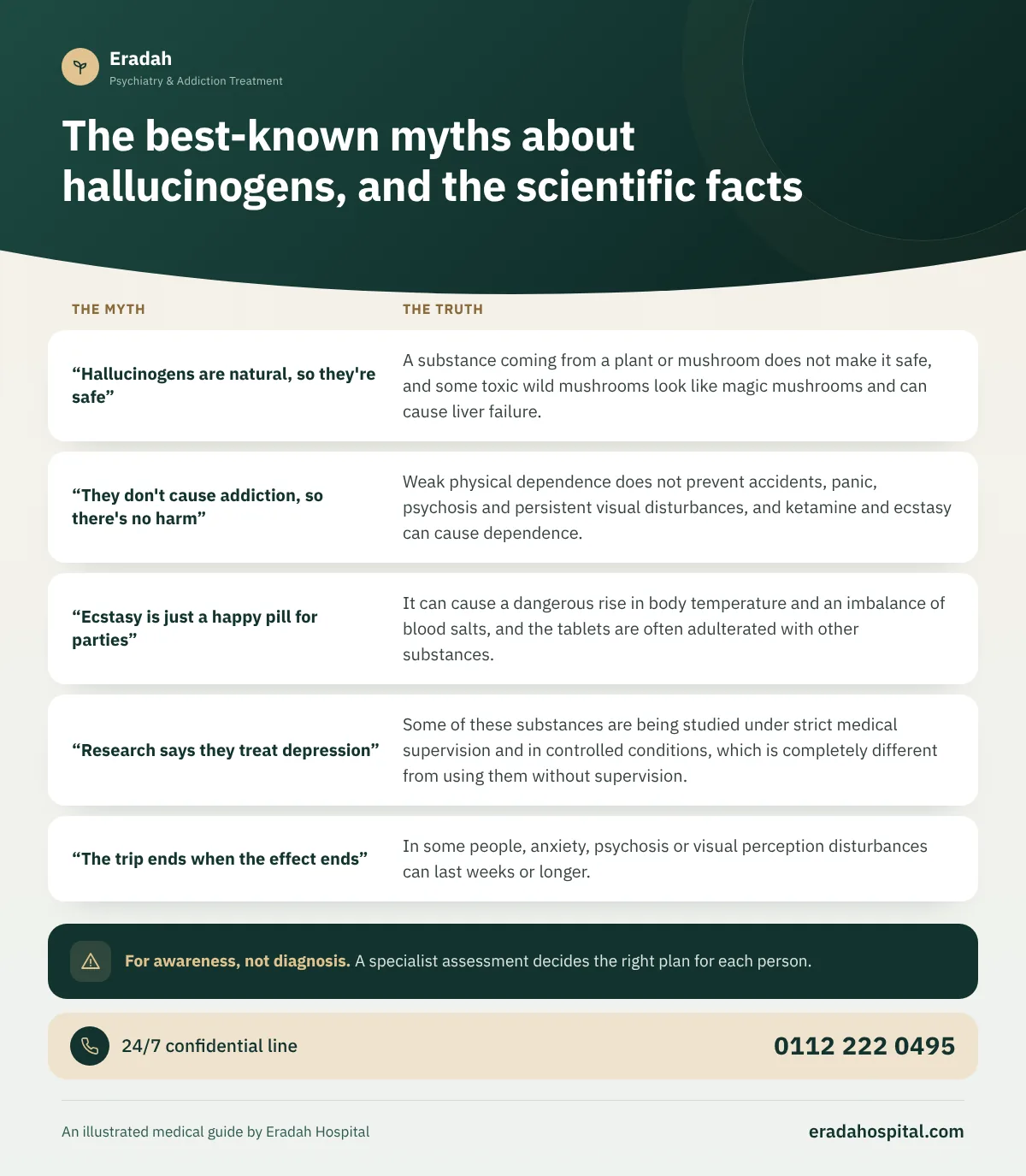
| The myth | The truth |
|---|---|
| “Hallucinogens are natural, so they're safe” | A substance coming from a plant or mushroom does not make it safe, and some toxic wild mushrooms look like magic mushrooms and can cause liver failure. |
| “They don't cause addiction, so there's no harm” | Weak physical dependence does not prevent accidents, panic, psychosis and persistent visual disturbances, and ketamine and ecstasy can cause dependence. |
| “Ecstasy is just a happy pill for parties” | It can cause a dangerous rise in body temperature and an imbalance of blood salts, and the tablets are often adulterated with other substances. |
| “Research says they treat depression” | Some of these substances are being studied under strict medical supervision and in controlled conditions, which is completely different from using them without supervision. |
| “The trip ends when the effect ends” | In some people, anxiety, psychosis or visual perception disturbances can last weeks or longer. |
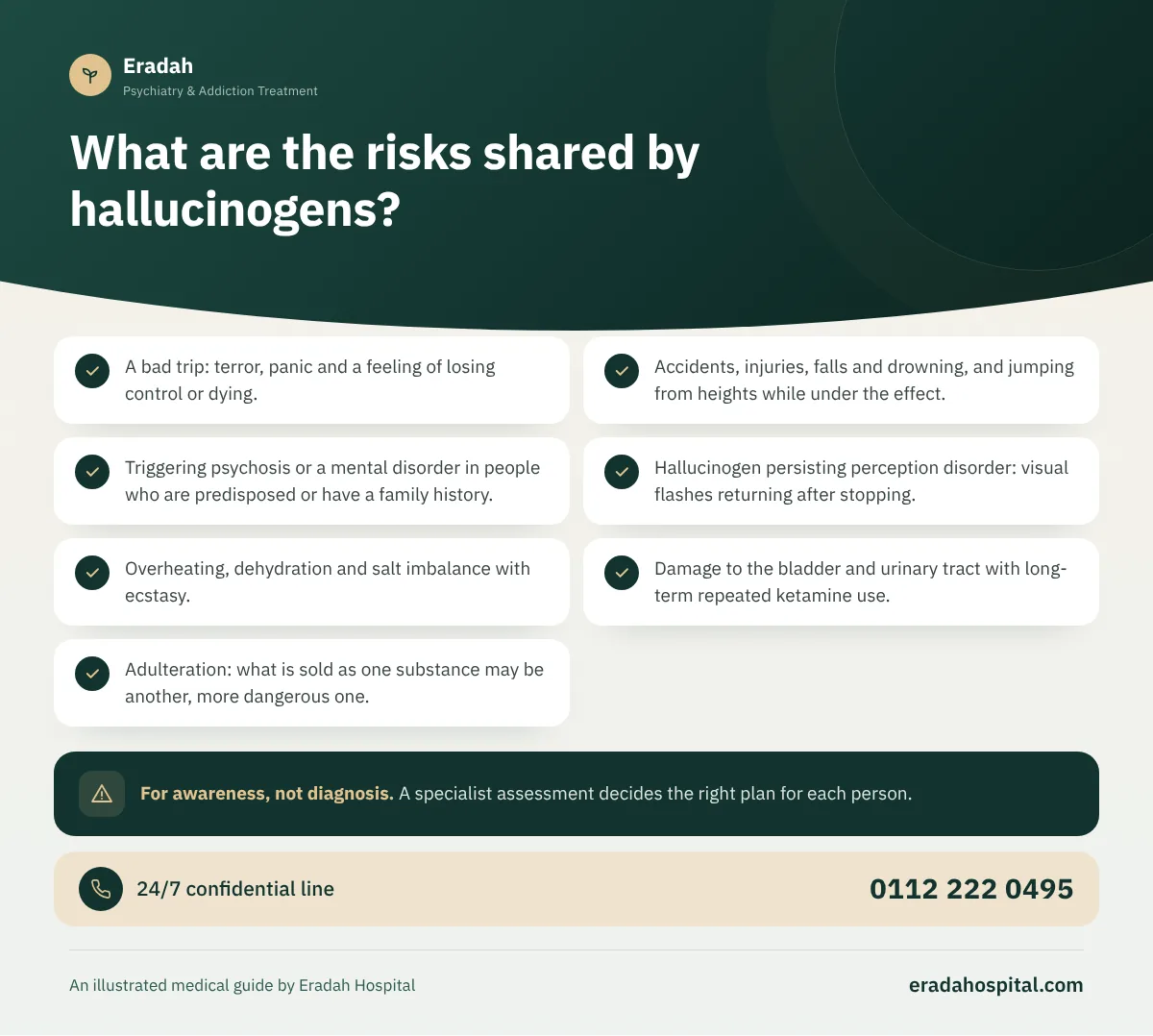
What are the risks shared by hallucinogens?
- A bad trip: terror, panic and a feeling of losing control or dying.
- Accidents, injuries, falls and drowning, and jumping from heights while under the effect.
- Triggering psychosis or a mental disorder in people who are predisposed or have a family history.
- Hallucinogen persisting perception disorder: visual flashes returning after stopping.
- Overheating, dehydration and salt imbalance with ecstasy.
- Damage to the bladder and urinary tract with long-term repeated ketamine use.
- Adulteration: what is sold as one substance may be another, more dangerous one.
The details differ from one substance to another, so we have given separate pages to the harms of ecstasy, the harms of LSD, the harms of magic mushrooms and the harms of ketamine.
Why are hallucinogens linked to parties and young people?
Hallucinogens, especially ecstasy and ketamine, are tied to party settings, music and travel, and are presented to young people as a way to have fun or “open the mind.” The danger rises in these settings because of crowds, heat, hours of dancing and dehydration, the mixing of more than one substance, and not knowing what the tablet or powder contains.
Another party-related risk is a substance being put in someone's drink without their knowledge, which is why we advise young people not to leave their drinks unattended, and to go out in a group whose members look after one another.
Who is most at risk of psychological harm from hallucinogens?
The risk of psychological harm is higher in people with a personal or family history of schizophrenia or bipolar disorder, in teenagers, in people who use while feeling severe anxiety or sadness, and in those who mix hallucinogens with other substances. In these people, a single experience can trigger a psychotic episode that needs long treatment. If psychological symptoms appear after use, it is important to have them assessed by a psychiatrist, and it may be a dual diagnosis that needs treatment of the mental disorder and the substance use together.
Does a person who uses hallucinogens need treatment?
Physical withdrawal from the classic hallucinogens is rare, but that does not mean treatment is not needed. Repeated use, psychological dependence on ecstasy or ketamine, or the appearance of psychosis, persistent anxiety or perception disturbances all call for assessment and psychological treatment. Treatment includes cognitive behavioral therapy, treatment of co-occurring mental disorders, and family support, and with ketamine, follow-up of the urinary tract.
Read more in ecstasy addiction treatment, ketamine addiction treatment and LSD use treatment, and about symptoms after stopping in ecstasy withdrawal symptoms. The Fund for Drug Control and Treatment of Addiction provides free, confidential treatment through the hotline 16023.
Do hallucinogens show up in a drug test?
Not every initial screening test covers hallucinogens. Ecstasy may show up within the amphetamine category, while LSD, magic mushrooms and ketamine often need special tests. Detection windows are approximate and vary by laboratory. Details are in ecstasy testing and ketamine testing.
How can families protect their children from hallucinogens?
- Talk with your children about hallucinogens using accurate information, without exaggeration that costs you your credibility or downplaying that encourages trying.
- Explain that “natural” and “non-addictive” do not mean “safe,” and that the tablets in circulation have unknown contents.
- Ask about parties, travel and friends with interest rather than interrogation, and agree that they can call you in any dangerous situation without immediate punishment.
- If there is a family history of schizophrenia or bipolar disorder, explain to your child that their risk is greater.
- If psychological symptoms appear after use, seek an early psychological assessment and do not wait for them to go away on their own.
Danger signs with hallucinogens: call ambulance (123) immediately
- Severe agitation or panic that leads the person to hurt themselves or try to jump or run toward the road
- A very high body temperature with confusion, especially after ecstasy and hours of dancing
- Seizures, loss of consciousness or difficulty waking the person
- Severe headache with vomiting and confusion or swelling, which may be signs of an imbalance of blood salts
- Severe hallucinations and suspicion, or psychosis that will not settle, or thoughts of self-harm
- Vomiting, diarrhea and severe abdominal pain after eating wild mushrooms, which may be delayed by hours
Call ambulance on 123, and stay with the person in a quiet, dimly lit, safe place away from windows and roads, speak calmly and reassure them that the effect is temporary. If they lose consciousness, place them on their side. Do not give them other substances, and do not push large amounts of water without medical advice with ecstasy.
Call the ambulance 123