What are magic mushrooms?
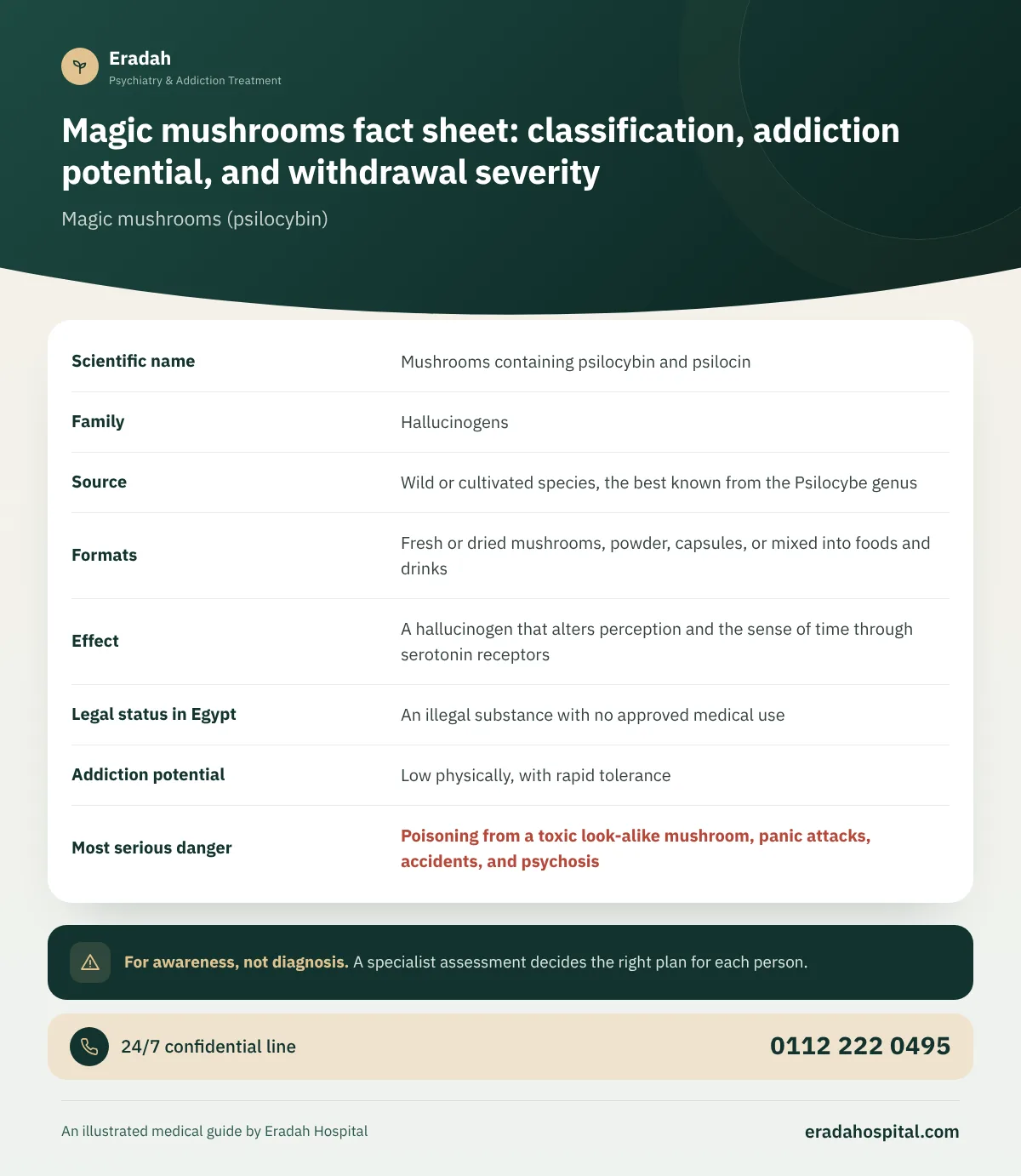
Magic mushrooms, or “psilocybin mushrooms,” is the common name for dozens of mushroom species that naturally contain the hallucinogens psilocybin and psilocin, and the best-known belong to a genus called Psilocybe.
Some ancient cultures knew of this mushroom and used it in traditional rituals. Its active compound was isolated in the 1950s, and its use spread in the following decades. European references describe most of its species as small brown or brownish mushrooms, a description that also fits many species that are inedible or highly toxic.
Magic mushrooms are classed among the classic hallucinogens along with LSD, meaning substances that deeply alter perception, thinking, and emotions without being strong stimulants or breathing depressants like opioids.
Forms of magic mushrooms
Magic mushrooms circulate in different forms, and the further the form is from the natural mushroom, the harder it is to know what it really contains:
The original form. The concentration of the active compound varies widely from one species to another and from one mushroom to the next.
They hide the appearance of the mushroom completely, so the species is unknown and so is whether it has been mixed with another substance.
Such as candy and chocolate, which are a particular danger to children who may eat them unknowingly.
How do magic mushrooms affect the brain?
After it is eaten, psilocybin is converted in the body into psilocin, the substance that is actually active. Psilocin resembles the neurotransmitter serotonin in structure, so it binds to one of its receptors in the brain, especially in the cortex that is responsible for perception and thinking, producing:
- Altered perception: Moving colors and shapes, distorted sounds and distances, and sometimes vivid hallucinations.
- Altered sense of time and self: Minutes may feel like hours, and the person feels detached from their body or surroundings.
- Sharp emotional swings: From laughter and wonder to intense fear and panic, sometimes within the same experience.
- Physical effects: Dilated pupils, rapid heartbeat, and sometimes nausea.
The effect usually begins within about half an hour and lasts roughly four to six hours. Its direction depends largely on the person's psychological state and the place they are in, which is what makes the experience unpredictable.
Magic mushrooms do not give a fixed experience; the same substance can be wonder for one person and terror for another, or for the same person on a different day.
Are magic mushrooms addictive?
NIDA research indicates that psilocybin does not usually lead to addiction in the way known with opioids or stimulants, and that its reinforcing effect is weak in laboratory experiments. But the body develops tolerance very quickly, so the effect weakens with closely spaced repeated use.
Even so, “low addiction potential” does not mean “safe.” Some people use it so often that it affects their lives and may be diagnosed with a hallucinogen use disorder, and many combine it with other, more addictive substances.
What about research on psilocybin treatment?
Researchers are currently studying pure psilocybin as a possible treatment for some cases of treatment-resistant depression and substance use disorders, within structured psychotherapy sessions, with medical and psychological screening beforehand and monitoring throughout the session. The US National Institutes of Health supports this research, but stresses that much is still unknown.
A few countries have allowed its use in a very narrow scope under specialized medical supervision, while there is no approved therapeutic use of it in Egypt. Most importantly, mushrooms of unknown species and concentration that are used outside this setting have nothing to do with what is tested in research.
Common myths about magic mushrooms
| The myth | The truth |
|---|---|
| “It's natural, so it's safe” | Many of the most dangerous poisons are natural, and some look-alike mushrooms are deadly even after cooking. |
| “I can tell the right species by its look” | Even specialists need careful examination, and a mistake can cost the liver or a life. |
| “Research has proven it's a treatment” | Research is still ongoing, and it is conducted with a pure substance under strict supervision, excluding those at higher risk. |
| “It causes no problems because it isn't addictive” | Low addiction potential does not cancel out panic, accidents, psychosis, and persistent perceptual disturbance. |
Correcting these ideas with accurate, calm information works much better with young people than exaggerated scare tactics, which quickly lose credibility when they hear different accounts from friends or online.
The legal status of magic mushrooms in Egypt
Psilocybin and psilocin are listed internationally in Schedule I of the 1971 United Nations Convention on Psychotropic Substances, and mushrooms containing them are treated in Egypt as illegal narcotic substances. Drug Control Law No. 182 of 1960 and its amendments criminalize their possession and trade. The Fund for Drug Control and Treatment of Addiction offers free, confidential consultations and treatment through the hotline 16023.
This is general educational information and not legal advice.
Magic mushrooms compared with other hallucinogens
| Point of comparison | Magic mushrooms | LSD | Ecstasy |
|---|---|---|---|
| Source | Natural mushroom | Synthetic substance | Synthetic substance |
| Approximate duration of effect | 4 to 6 hours | Much longer, possibly more than half a day | About 3 hours, then a comedown |
| Addiction potential | Low | Low | Moderate |
| Most serious danger | Poisoning from a toxic mushroom, panic, and accidents | Panic, accidents and the return of hallucinations | Overheating and disturbed blood salts |
Magic mushrooms share with LSD the fact that tolerance to one extends partly to the other, because they act on the same receptors. Also read about LSD and ecstasy.
The magic mushrooms guide: everything you need to know
We have gathered everything about magic mushrooms into 3 pages, each answering one question in detail. Choose what you are looking for:
Magic mushroom harms
From poisoning by toxic mushrooms that can damage the liver, to panic attacks, accidents, psychosis, and persistent perceptual disturbance after hallucinogens.
Symptoms of magic mushroom use
The physical and behavioral signs during use, when use becomes a disorder, and how to talk with the person.
How long magic mushrooms stay in the body
Why they often do not show up in routine tests, and roughly how long psilocin stays in urine and blood.
Did you find out your son tried magic mushrooms? Start here
Many young people see magic mushrooms as a “natural substance” or a harmless “spiritual experience,” especially with news of treatment research spreading. These steps will help you:
- Stay calm, and remember that a single experience does not mean addiction, but it deserves a serious conversation.
- Ask with curiosity what drew him to try it: curiosity, an escape from sadness or anxiety, or the influence of friends?
- Correct the information calmly: natural is not safe, and a toxic mushroom can kill.
- Watch for any lasting change in thinking, perception, or mood after the experience, and seek a psychological assessment if one appears.
- If there is a family history of psychotic disorders or bipolar disorder, tell him so clearly, because his risk is greater.
- Learn the emergency signs and the ambulance number, 123, and seek specialist family consultation when needed.
Why does the experience differ from one person to another?
The effect of hallucinogens depends on three elements: the substance itself and its unknown concentration in the mushroom, the person's psychological state and expectations, and the place and the people around them. An anxious or sad person, or someone in a crowded or unfamiliar place, is more likely to have a terrifying experience. And because no one can control all of these elements, every experience remains an open possibility that cannot be guaranteed.
Emergency signs with magic mushrooms: call an ambulance (123) immediately
- Severe vomiting, diarrhea, and abdominal cramps starting hours after eating the mushroom, a possible sign of a toxic mushroom
- Yellowing of the skin or eyes, reduced urine, or drowsiness and confusion in the following days
- Severe panic that does not settle, or behavior that puts the person or others in danger
- Complete detachment from reality, or talk of self-harm
- Injury or a fall, seizures, or loss of consciousness
Call an ambulance on 123 immediately. Do not try to make the person vomit, and do not give them food or drink. Keep any leftover mushroom or its packaging to show the doctors, and do not be reassured if symptoms improve temporarily, because poisoning from some toxic species can seem to improve and then get worse. Stay with them in a quiet, safe place, and if they lose consciousness but are breathing, place them on their side in the recovery position.
Call the ambulance 123