Can Rivotril addiction be treated?
Yes. Rivotril addiction is a treatable illness, and treatment results are good when it is gradual and comprehensive. The basic idea differs from treating many other substances: the aim is to reduce the drug safely and at a pace the brain can tolerate, not to "pull it out" quickly, while building healthy alternatives for dealing with anxiety and insomnia.
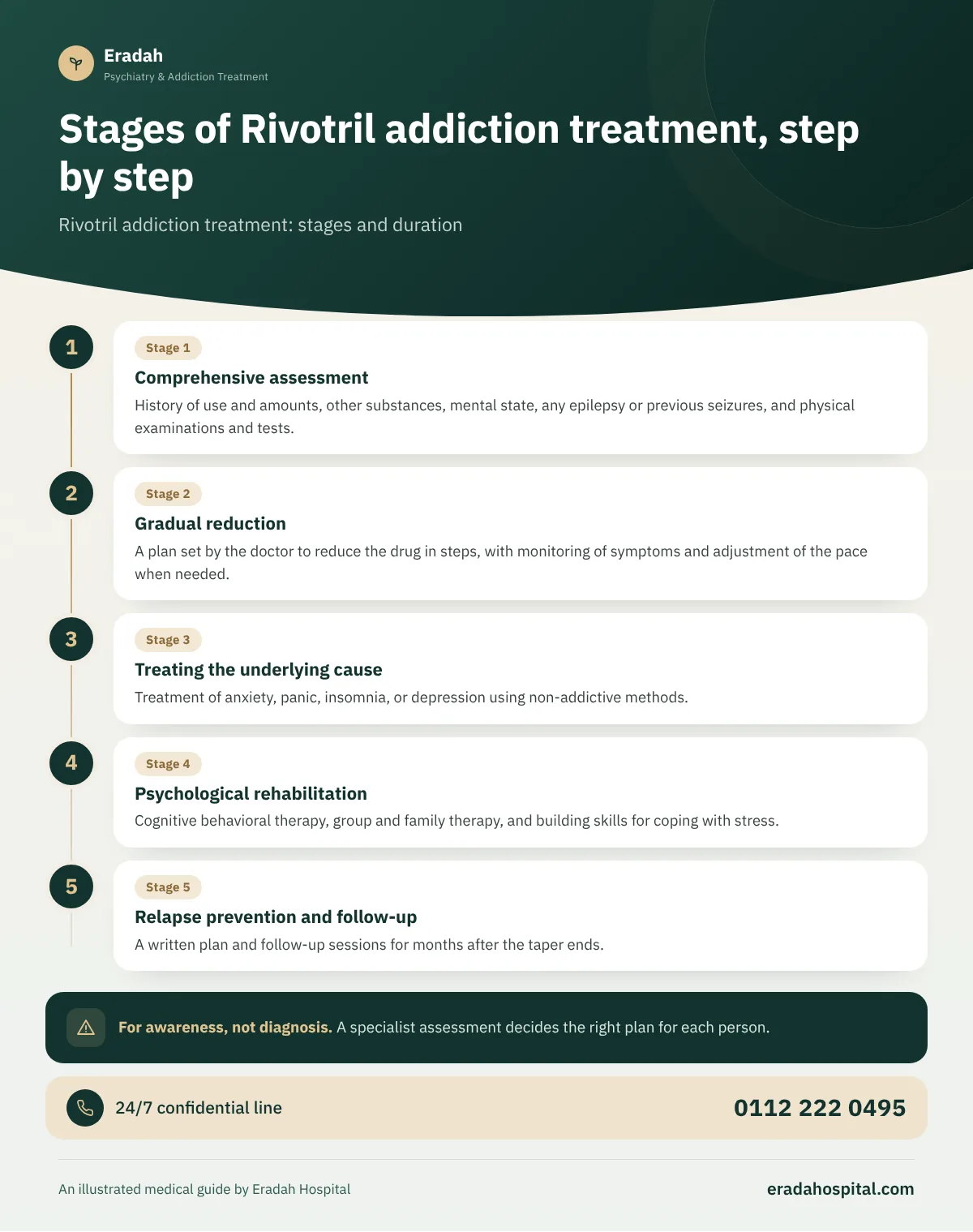
What are the stages of Rivotril addiction treatment?
- Stage 1Comprehensive assessment
History of use and amounts, other substances, mental state, any epilepsy or previous seizures, and physical examinations and tests.
- Stage 2Gradual reduction
A plan set by the doctor to reduce the drug in steps, with monitoring of symptoms and adjustment of the pace when needed.
- Stage 3Treating the underlying cause
Treatment of anxiety, panic, insomnia, or depression using non-addictive methods.
- Stage 4Psychological rehabilitation
Cognitive behavioral therapy, group and family therapy, and building skills for coping with stress.
- Stage 5Relapse prevention and follow-up
A written plan and follow-up sessions for months after the taper ends.
How is Rivotril withdrawn safely?
Gradual tapering is the accepted medical standard for stopping benzodiazepines. The doctor sets its speed according to length of use, amount, and health, and it may last from weeks to months. In some cases the doctor may switch the patient from a short-acting sedative to a long-acting one to make tapering easier, but clonazepam is already long-acting, which makes tapering smoother if done patiently.
Details of the symptoms to expect during this stage and their duration are on the page about Rivotril withdrawal symptoms.
Are there medications that help treat Rivotril addiction?
There is no single approved medication that "treats" benzodiazepine addiction as there is for opioid addiction, but the doctor may use supporting medications depending on the case, always under their supervision:
To treat anxiety, panic attacks, and depression over the long term without a risk of addiction.
Non-addictive ways to improve sleep, along with a healthy sleep habits program.
For people with epilepsy, the neurologist may adjust the anticonvulsant medication plan before and during the taper.
If the person depends on tramadol or alcohol, each substance is treated with a suitable, simultaneous plan.
How is a person with epilepsy who became addicted to Rivotril treated?
This is a special case that needs cooperation between the psychiatrist and the neurologist. It may be enough to bring use back into a safe medical framework without stopping the drug altogether, or to gradually replace it with another antiepileptic medication if the neurologist sees fit. A person with epilepsy must never have their medication stopped without an alternative plan to protect them from seizures.
Which psychological therapies are used?
- Cognitive behavioral therapy: helps in understanding the thoughts and situations that drive use of the drug, teaches alternative ways of dealing with anxiety and insomnia, and has good scientific evidence for supporting tapering.
- Cognitive behavioral therapy for insomnia: a structured program to improve sleep without dependence-forming drugs.
- Relaxation, breathing, and mindfulness techniques: practical tools for anxiety and panic attacks.
- Motivational interviewing: to strengthen the person's motivation to change.
- Family therapy: to repair communication and teach the family how to support without harsh monitoring.
- Therapy groups: to share experiences and feel that the person is not alone.
Is Rivotril addiction treated at home or in the hospital?
| Point of comparison | Inpatient treatment (residential) | Outpatient treatment (clinic) |
|---|---|---|
| Who is it suitable for? | Long use and large amounts, or mixing with other substances, a history of seizures, or previous failed attempts | Shorter use with family support, stability, and no other substances |
| Follow-up | around the clock | Regular visits and contact with the team |
| Speed of tapering | Can be adjusted more precisely with monitoring | Usually slower to ensure safety |
| Environment | Away from triggers and sources of the drug | Within daily life, with its pressures |
The doctor determines the most suitable type after assessment, and treatment often begins as residential and continues as outpatient.
How long does Rivotril addiction treatment take?
There is no fixed duration. The gradual taper itself can take from weeks to several months, and then psychological rehabilitation and follow-up continue for months afterward. More important than speed is safety and consistency; tapering too quickly raises the risk of seizures and relapse.
How do we prevent relapse after Rivotril treatment?
- Knowing your personal triggers: stress, insomnia, anxiety attacks, and places and people linked to the drug.
- A written plan for moments of weakness: whom to call and what to do.
- Continuing treatment for anxiety or depression even after stopping.
- Avoiding alcohol and other sedatives without a prescription.
- Telling any new doctor about the history of Rivotril dependence before they prescribe any sedative.
- A healthy routine of sleep, exercise, and supportive relationships.
What is the family's role during Rivotril addiction treatment?
- Making sure the doctor's plan is followed, and preventing any self-directed increase or decrease of the drug.
- Storing sedative medications at home safely, out of everyone's reach.
- Attending family therapy sessions to learn supportive communication instead of blame.
- Watching for early signs of relapse such as the return of severe insomnia, withdrawal, or seeking the drug.
- Caring for the family's mental health too, because caring for someone in recovery is exhausting.
How do you choose a Rivotril addiction treatment center?
- Officially licensed, with psychiatrists who specialize in addiction treatment.
- Has experience in gradual tapering of sedatives, not just "rapid withdrawal."
- Able to coordinate with a neurologist for people with epilepsy.
- Treats dual diagnosis and other substances at the same time.
- Offers psychological and family therapy and a follow-up program after discharge.
- Respects confidentiality and dignity.
Choosing a hospital for Rivotril addiction treatment
Rivotril is a relatively long-acting benzodiazepine, and stopping it suddenly after long use can cause seizures, acute anxiety, or disturbed perception. For this reason, any place that promises a quick "cleanse" in a few days is not suitable for this condition. The right treatment is a gradual taper that the doctor sets and adjusts to the patient's response, and it may take weeks or months. When evaluating any facility, pay attention to the following:
- Who writes and adjusts the tapering schedule? It should be a doctor who follows the patient personally.
- Is the history of seizures and epilepsy asked about, and is a neurologist consulted when needed?
- Is the anxiety, insomnia, or panic the drug was started for being treated, so the same cause doesn't return?
- Is mixing Rivotril with tramadol, pregabalin, or alcohol asked about? Each combination changes the withdrawal plan.
- Is there overnight monitoring on the days the drug is reduced?
At Eradah, the doctor sets a monitored tapering plan that a nursing team present day and night follows, psychologists work on anxiety with cognitive behavioral therapy, and dual diagnosis care addresses the underlying disorder along with the dependence. If a case needs a general hospital, the patient is transferred by ambulance to the nearest hospital.
Rivotril addiction treatment at Eradah
At Eradah we start with a comprehensive medical and psychological assessment, then set a safe gradual tapering plan for each patient under psychiatrists' supervision, with round-the-clock monitoring when needed, treatment of anxiety, insomnia, and co-occurring disorders, and a psychological and family rehabilitation program with follow-up after discharge. We treat every case with complete confidentiality and respect.