What is Rivotril?
Rivotril is the best-known brand name in Egypt and the Arab world for the medicine clonazepam, which belongs to the benzodiazepine family that also includes Xanax (alprazolam) and Valium (diazepam). It is classed among sedatives and sleeping pills because it slows the activity of the central nervous system.
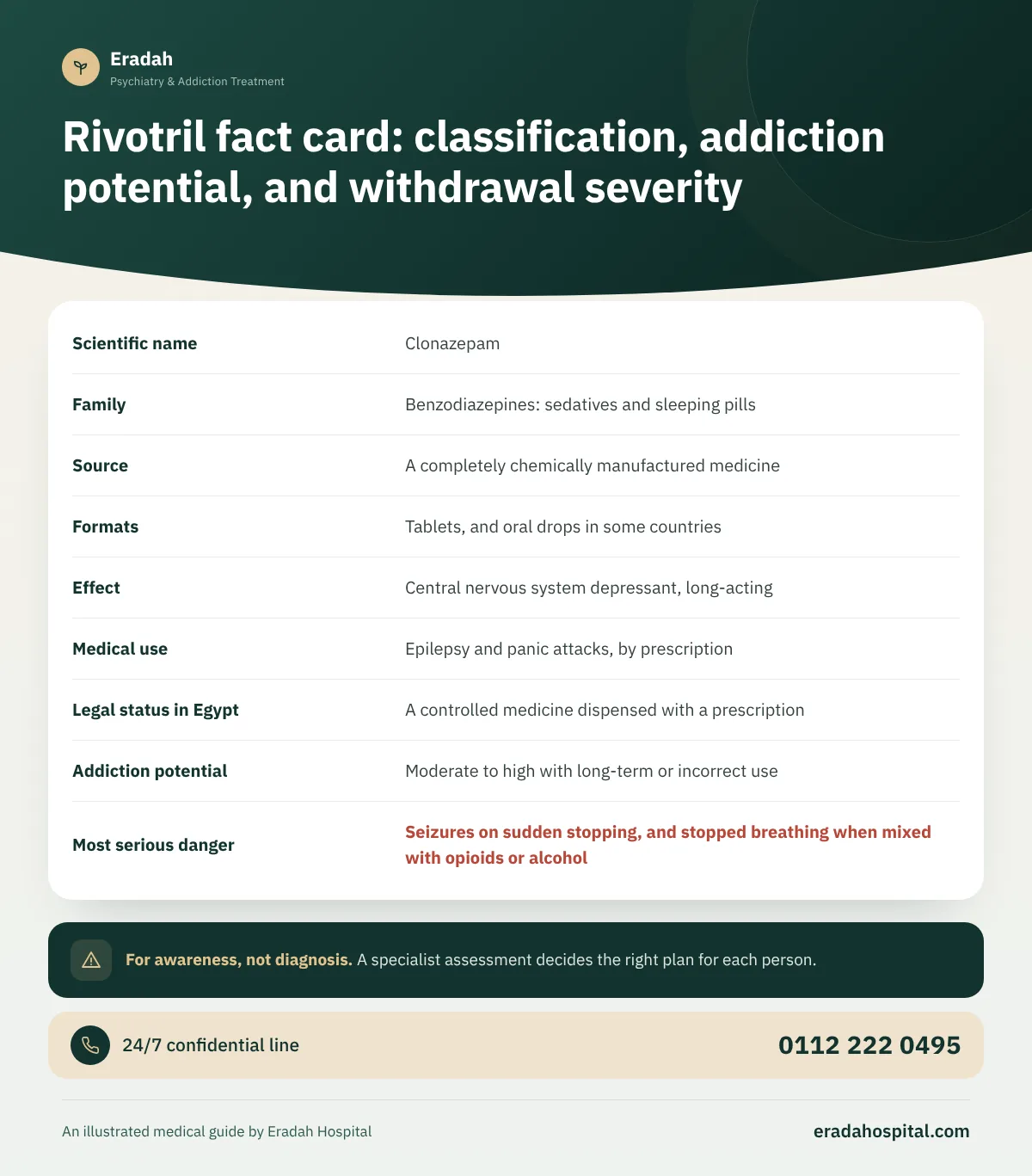
Clonazepam differs from many of its family members in being long-acting; its half-life in the body usually ranges between 30 and 40 hours, meaning the body needs more than a full day to get rid of only half the amount. This property explains much of what distinguishes it: its prolonged effect, its buildup with repeated use, and the delay of its withdrawal symptoms.
On the Egyptian street it is known by short names such as "Rivo" or "Roche", and it is often misused away from its medical purpose, either on its own or with other substances, which turns a useful medicine into a real source of danger.
Why do doctors prescribe Rivotril?
Clonazepam has approved medical uses, and it should not be viewed as a "narcotic" in itself; the problem lies in the pattern of use, not in the medicine itself. Its most important uses include:
It is used to treat some types of epileptic seizures, sometimes together with other anticonvulsant medicines, and some patients may rely on it for years under follow-up.
It is prescribed for panic disorder, usually for a limited period until the main long-term treatment begins to work, such as some antidepressants and psychological therapy.
A specialist doctor may use it in other conditions, such as some movement or sleep disorders, depending on their assessment of each patient.
How does Rivotril affect the brain?
Clonazepam acts on GABA-A receptors in the brain, which are the receptors the brain uses as natural "brakes" to calm the electrical activity of nerve cells. The medicine does not create calm out of nothing; it strengthens the effect of the GABA that is already there, so nerve cells become less excitable.
- In the short term: Calming of anxiety, muscle relaxation, and preventing the spread of the electrical discharges that cause seizures, with drowsiness and slowed thinking and movement.
- When misused: A feeling of detachment from worries and emotional numbness, which is the sensation sought by those who misuse it.
- With repeated use: The brain adapts by reducing the sensitivity of these receptors, so the effect weakens (tolerance), and the brain becomes dependent on the medicine to stay in balance.
This adaptation is the reason that stopping suddenly is dangerous: when the medicine's "brakes" are suddenly lifted, the brain stays in a state of overexcitation, which can appear as severe anxiety, insomnia, and tremors, and may reach seizures.
Rivotril is a medicine that protects a person with epilepsy from seizures, but stopping it suddenly can cause the very seizures it was prescribed to prevent.
Because clonazepam is long-acting, it does not give a quick, strong "rush" as some short-acting sedatives do, but it builds up in the body with repeated use. For this reason, a person who misuses it may think they "feel nothing" and increase the amount, when the level of the medicine in their blood has in fact already risen, increasing drowsiness, confusion, and the risk of accidents in the following hours and days.
Why is Rivotril misuse widespread in Egypt?
Rivotril is one of the most misused sedatives in Egypt, and its spread is linked to several reasons: its circulation outside the medical framework, the mistaken belief that it is "just a medicine" that does no harm, and its use to relieve anxiety and insomnia without a diagnosis.
More dangerously, it is often used with other substances; some mix it with tramadol to increase the effect, or with alcohol or hashish, or use it to ease the "crash" from stimulants such as crystal meth (shabu). This mixing multiplies the risk of slowed breathing and accidents, and makes later treatment more complicated because the person is dependent on more than one substance.
What is the difference between Rivotril, Xanax, and Valium?
The three medicines belong to the same family and work by the same mechanism, but they differ in speed of action, duration, and main use. The following table is a general simplification for awareness and is not a substitute for a doctor's opinion:
| Point of comparison | Rivotril (clonazepam) | Xanax (alprazolam) | Valium (diazepam) |
|---|---|---|---|
| Duration of effect | Long-acting | Short- to intermediate-acting | Long-acting |
| Best-known medical use | Epilepsy and panic attacks | Anxiety and panic attacks | Anxiety, muscle spasms, and some cases of alcohol withdrawal |
| When withdrawal appears | Relatively late and may be prolonged | Faster and may be severe | Relatively late and may be prolonged |
| What distinguishes it | Special sensitivity in people with epilepsy when stopping | Causes quick "rebound" anxiety between doses | Has active metabolites that prolong its effect |
Rivotril also differs from pregabalin (Lyrica); pregabalin is not a benzodiazepine and has a different mechanism, but it is misused in the same way in Egypt, and mixing it with Rivotril or opioids increases respiratory depression.
Legal status of Rivotril in Egypt
Rivotril is a controlled medicine in Egypt, dispensed only by prescription, and its dispensing in pharmacies is subject to special rules for psychotropic medicines. Possessing, circulating, or selling it outside this framework exposes a person to legal liability. The Fund for Drug Control and Treatment of Addiction offers free, confidential treatment through hotline 16023.
This is general educational information and not legal advice.
Common myths about Rivotril and the truth
Mistaken beliefs spread about Rivotril that lead many people to underestimate it, and it is important to correct them before they turn into dangerous decisions:
| The myth | The truth |
|---|---|
| "It's a medicine from the pharmacy, so it's safe" | Safe only with a prescription and medical follow-up; outside that it can cause dependence, addiction, and accidents. |
| "I can stop it whenever I want" | Stopping suddenly after regular use can cause life-threatening seizures. |
| "With tramadol it gets better" | Mixing multiplies respiratory depression, which is one of the most dangerous causes of sedative-related deaths. |
| "As long as I feel fine, there's no addiction" | Its long action hides dependence at first, and it shows when a dose is late or reduced. |
| "A small sleeping pill every night does no harm" | Regular nightly use without follow-up builds tolerance and weakens sleep quality and memory over time. |
What should the family do if they suspect Rivotril misuse?
- Speak calmly at a time when the person is alert, and avoid accusation and threats.
- Do not force them to stop suddenly, and do not hide their prescribed medicines without a doctor; stopping suddenly may cause seizures.
- If they take it by prescription, contact the treating doctor to review the plan.
- Ask for a specialist assessment from a psychiatrist or an addiction treatment center, especially if they mix it with other substances.
- Save the ambulance number, 123, and learn the danger signs listed at the bottom of this page.
Rivotril guide: everything you need to know
We have gathered everything about Rivotril into 6 pages, each answering one question in detail. Choose what you are looking for:
Harms of Rivotril
From memory impairment, falls, and accidents to depression and paradoxical irritability, the most dangerous being respiratory depression when mixed with tramadol or alcohol.
Causes of Rivotril addiction
How does addiction begin from a medical prescription or from a "sleeping pill"? The role of anxiety, insomnia, mixing with other substances, and environment.
Symptoms of Rivotril addiction
Drowsiness, slurred speech, memory impairment, and behavior change, and the criteria for telling medical use from addiction.
Rivotril withdrawal symptoms
They are delayed by days because of its long action and may last weeks, the most dangerous being seizures; this is why gradual reduction under medical supervision is needed.
Rivotril addiction treatment
Safe gradual reduction under medical supervision, treatment of the underlying anxiety or epilepsy, and psychological therapy and relapse prevention.
How long Rivotril stays in the body
How long it remains in urine, blood, and hair, and why some rapid tests may not detect it.
Signs of serious Rivotril poisoning: call an ambulance on 123 immediately
- Deep drowsiness from which the person does not wake easily or does not respond to calling and shaking
- Very slow, weak, or irregular breathing, or bluish lips
- Loss of consciousness or coma, especially if they took tramadol or alcohol with it
- Seizures or an epileptic fit, especially after suddenly stopping the medicine
- Severe confusion, slurred speech, and inability to stand
Call an ambulance on 123 immediately, place the person on their side (recovery position) so they do not choke, do not leave them alone, and do not give them anything by mouth. Tell the medical team everything they took, especially opioids and alcohol.
Call the ambulance 123