Why does Rivotril withdrawal happen?
With regular use, the brain adapts to the presence of clonazepam, which strengthens the nervous system's "brakes." The brain reduces its sensitivity to the calming chemical GABA and raises the activity of its excitatory systems to keep its balance. When the drug is stopped suddenly, the pharmacological brakes vanish while the brain remains in a state of excitation, and withdrawal symptoms appear.
These symptoms are not limited to people who misuse the drug; they can also happen to a patient who follows their prescription if they stop suddenly, as the US Food and Drug Administration confirmed in its prominent warning for the benzodiazepine family.
When does Rivotril withdrawal start and how long does it last?
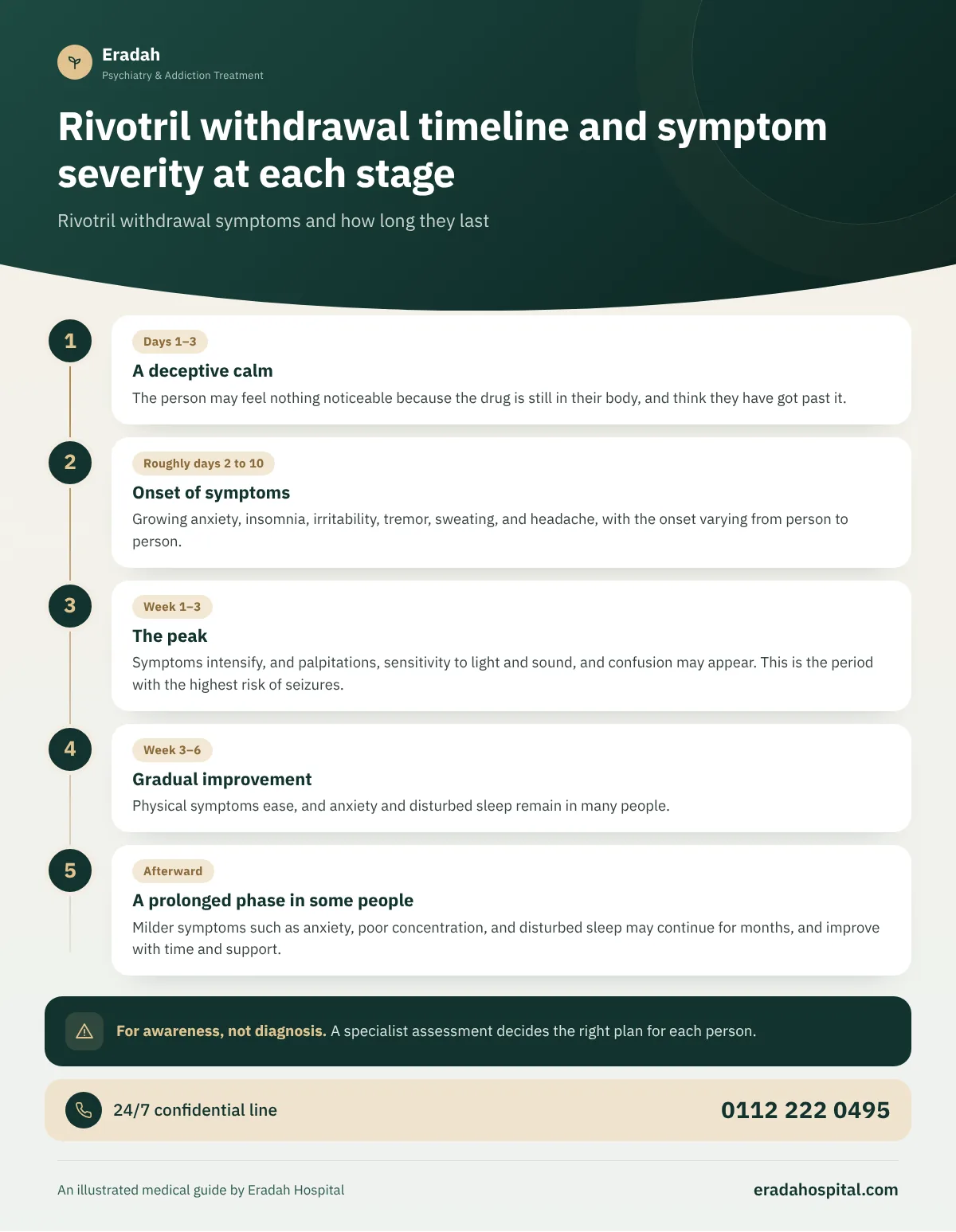
Because clonazepam has a long half-life, symptoms are delayed compared with short-acting sedatives such as Xanax. The timeline below is approximate and varies widely with length of use, amount, and the presence of other substances:
- Days 1–3A deceptive calm
The person may feel nothing noticeable because the drug is still in their body, and think they have got past it.
- Roughly days 2 to 10Onset of symptoms
Growing anxiety, insomnia, irritability, tremor, sweating, and headache, with the onset varying from person to person.
- Week 1–3The peak
Symptoms intensify, and palpitations, sensitivity to light and sound, and confusion may appear. This is the period with the highest risk of seizures.
- Week 3–6Gradual improvement
Physical symptoms ease, and anxiety and disturbed sleep remain in many people.
- AfterwardA prolonged phase in some people
Milder symptoms such as anxiety, poor concentration, and disturbed sleep may continue for months, and improve with time and support.
What are the symptoms of Rivotril withdrawal?
| Type | Symptoms |
|---|---|
| Psychological | Severe anxiety and panic attacks, irritability, depression, and difficulty with concentration and memory. |
| Sleep | Severe insomnia, nightmares, and broken sleep. |
| Physical | Tremor, sweating, headache, palpitations, muscle tension, nausea, and loss of appetite. |
| Sensory | Heightened sensitivity to light, sound, and touch, and numbness or tingling in the limbs. |
| Serious | Seizures, delirium and severe confusion, hallucinations, and sometimes thoughts of self-harm. |
Why is Rivotril withdrawal dangerous for people with epilepsy?
Benzodiazepine withdrawal in general can cause seizures even in people who have never had epilepsy. But a person with epilepsy is in a more dangerous position: they take clonazepam in the first place to prevent seizures, and stopping suddenly can bring seizures back with force. It can cause "status epilepticus," a series of seizures in which the patient does not regain consciousness, which is a life-threatening emergency.
What determines the severity of withdrawal?
- Length of use: the longer it is, months or years, the more likely and severe the symptoms.
- Amount: amounts higher than prescribed raise the risk.
- Speed of stopping: stopping suddenly is far more dangerous than a gradual taper.
- Mixing with other substances: simultaneous withdrawal from alcohol, tramadol, or pregabalin multiplies the risk and complicates the picture.
- Health status: epilepsy, psychiatric disorders, older age, and a previous history of seizures.
Is withdrawal different if the person mixes Rivotril with other substances?
Yes, and the difference is clear. A person who depends on Rivotril along with tramadol, alcohol, or pregabalin may go through withdrawal from more than one substance at the same time, so symptoms overlap and their source is hard to tell apart. Alcohol withdrawal and benzodiazepine withdrawal can both cause seizures, and having both together raises the risk, while tramadol itself can lower the seizure threshold.
For this reason no attempt at home is suitable in these cases, and the person needs an assessment that decides the order and speed of dealing with each substance, and the greatest safety is often within a facility equipped for continuous monitoring.
Why does Rivotril withdrawal need medical supervision?
Benzodiazepine withdrawal, like alcohol withdrawal, is one of the few conditions that can directly threaten life. Medical supervision provides:
- A personalized gradual tapering plan, since no single schedule suits everyone.
- Monitoring of vital signs and spotting any early sign of seizures.
- Safe treatment of distressing symptoms such as insomnia and anxiety.
- Handling any other substances the person depends on at the same time.
- Assessment of the risk of self-harm and monitoring of mood.
- Slowing or adjusting the plan if symptoms intensify.
In some cases, such as long use at large amounts, mixing with other substances, or a history of seizures, doctors prefer that withdrawal take place in the hospital. You will find the full treatment plan after withdrawal on the page about Rivotril addiction treatment.
Do withdrawal symptoms last for months?
In a proportion of users, especially after long use, milder symptoms can extend for months after the acute phase ends, such as anxiety, poor concentration and memory, disturbed sleep, and mood swings, and in a few they may last up to a year. These symptoms improve gradually, but they are among the most important causes of relapse if the person is not prepared for them and does not have psychological support.
How can the family support someone going through Rivotril withdrawal?
- Make sure stopping is done under a medical plan, and do not encourage stopping suddenly.
- Treat irritability and anxiety as temporary symptoms, not a personal insult.
- Help them with a calm sleep routine and cutting back on stimulants such as coffee at night.
- Watch for warning signs: severe confusion, hallucinations, worsening tremor, or thoughts of self-harm.
- Keep the ambulance number (123) handy and know what to do if a seizure happens.
Signs of serious Rivotril poisoning: call an ambulance on 123 immediately
- Deep drowsiness from which the person does not wake easily or does not respond to calling and shaking
- Very slow, weak, or irregular breathing, or bluish lips
- Loss of consciousness or coma, especially if they took tramadol or alcohol with it
- Seizures or an epileptic fit, especially after suddenly stopping the medicine
- Severe confusion, slurred speech, and inability to stand
Call an ambulance on 123 immediately, place the person on their side (recovery position) so they do not choke, do not leave them alone, and do not give them anything by mouth. Tell the medical team everything they took, especially opioids and alcohol.
Call the ambulance 123