Why does Rivotril cause dependence?
Clonazepam has properties that make it able to cause dependence, even in people who started it for a legitimate medical reason:
It calms anxiety and tension quickly, so the brain learns that the drug is the fastest answer to any distress.
With regular use, the same amount has less effect, so the person tends to increase it without going back to the doctor.
The brain adapts to the presence of the drug, so anxiety, insomnia, and tremor appear when it is delayed or reduced.
Its long stay in the body hides the signs of dependence at first, so the person does not notice until it has deepened.
How does addiction start from a medical prescription?
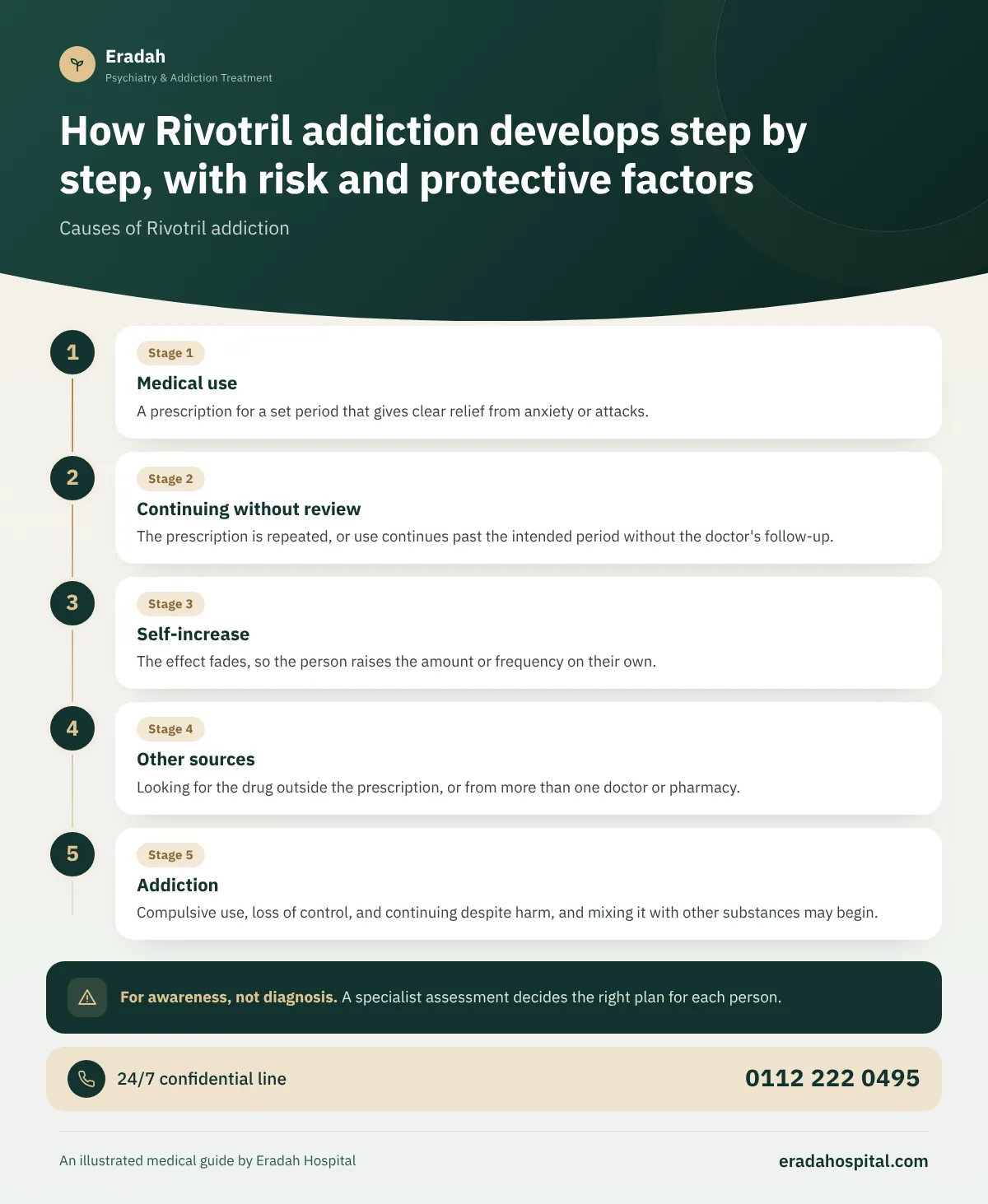
Some cases begin with a genuine prescription for panic attacks, anxiety, or insomnia, and the journey then changes gradually through overlapping stages:
- Stage 1Medical use
A prescription for a set period that gives clear relief from anxiety or attacks.
- Stage 2Continuing without review
The prescription is repeated, or use continues past the intended period without the doctor's follow-up.
- Stage 3Self-increase
The effect fades, so the person raises the amount or frequency on their own.
- Stage 4Other sources
Looking for the drug outside the prescription, or from more than one doctor or pharmacy.
- Stage 5Addiction
Compulsive use, loss of control, and continuing despite harm, and mixing it with other substances may begin.
The role of anxiety, insomnia, and psychiatric disorders
Many people turn to Rivotril to soothe psychological suffering that has not been properly treated. The drug eases the symptom temporarily but does not treat the cause, so the anxiety returns stronger and dependence grows. Among the conditions most linked to its misuse are:
- Panic disorder, generalized anxiety, and social phobia.
- Chronic insomnia.
- Depression and post-traumatic stress disorder (PTSD).
- Bipolar disorder and personality disorders, especially borderline.
When a psychiatric disorder exists alongside addiction, both must be treated together. Otherwise the cause that drove the use remains and the risk of relapse rises.
Why is Rivotril linked to tramadol and stimulants in Egypt?
In Egypt, Rivotril is rarely misused on its own. Many people start it as part of a pattern of using multiple substances, and three patterns recur:
- With tramadol: to strengthen the sedative effect, a mix that is extremely dangerous for breathing.
- After stimulants such as crystal meth (shabu) or Captagon: to ease the insomnia and tension when their effect ends, so the person becomes dependent on a "stimulant and a sedative" together.
- With hashish or alcohol: to deepen relaxation, which multiplies confusion and memory problems.
Why does a person keep using Rivotril even when they know the harm?
Families often ask: "Why doesn't he just stop?" The answer is that addiction changes the brain's reward and self-control circuits, so the drug becomes a priority that outranks everything else. With Rivotril specifically, two reasons are added: fear of the return of the anxiety or panic attacks it was started for, and the distressing symptoms when a dose is delayed, such as insomnia, tension, and tremor.
The person may also have tried to stop suddenly on their own and suffered harsh symptoms, and came away with the mistaken belief that they "can't live without it." The truth is that stopping is possible, but through a carefully planned gradual reduction with psychological support, not through willpower alone.
Many people who became addicted to Rivotril were not looking for a high, but for a quiet night's sleep or a day without anxiety, and this is exactly what makes treating the cause an integral part of treating the addiction.
Do genetics and biology play a role?
Research indicates that an important part of a person's susceptibility to addiction comes from genetic factors that affect the brain's response to substances and its ability to control impulses. That is why the risk is higher in people with a family history of addiction or psychiatric disorders. But genetics is not destiny; environment, upbringing, and early treatment change the course a great deal.
Environmental and social factors
- Easy access: the drug circulating among friends or at home without oversight.
- The belief that it is safe: because it is a "medication," some people think it is less dangerous than drugs.
- Ongoing stress: unemployment, debts, family problems, and night work.
- Starting at an early age: teenagers are more vulnerable because the self-control regions of the brain are not yet fully developed.
- Isolation and weak support: no one to notice the change early and encourage asking for help.
Risk factors versus protective factors
| Factors that raise the risk | Protective factors |
|---|---|
| Long-term use without medical review | A prescription for a set period with regular follow-up |
| Untreated anxiety or insomnia | Psychological treatment for anxiety and insomnia alongside the medication or instead of it |
| A family or personal history of addiction | Telling the doctor about this history before prescribing |
| Mixing it with tramadol, alcohol, or stimulants | Never mixing sedatives with any other substance |
| Isolation and ongoing stress | Supportive relationships and a healthy routine of sleep and activity |
How can you protect yourself or a family member?
- Use Rivotril only by prescription, for the period the doctor sets, and ask about the stopping plan from the start.
- Do not share your medication with anyone, and keep it somewhere safe, away from teenagers.
- Treat anxiety and insomnia with effective psychological therapy, because medication alone is not a long-term solution.
- Pay attention if you start needing a larger amount or thinking about the drug a lot, and talk to your doctor right away.
- Ask for specialist consultation at the first sign of misuse, and do not try to stop suddenly on your own.