“A respectable young man with a job has asked to marry me, but he told me honestly that he used to be addicted and was treated two years ago. My family refuses, and I’m confused.” This situation repeats in many homes, and between flat rejection and hasty acceptance there is a space the decision needs. This guide helps you and your family assess the matter with information rather than fears.
Can marriage to someone in recovery work?
Yes. A US national study published in the journal Drug and Alcohol Dependence in 2017 found that about 9.1% of adults said they once had a problem with alcohol or drugs and had overcome it, which is tens of millions of people. So recovery is not a rare exception, and many people in recovery build stable families.
But success does not come from good intentions alone. According to the US National Institute on Drug Abuse (NIDA), addiction is a chronic disease, and its relapse rates are similar to those of other chronic diseases such as high blood pressure and asthma. So the right question is not “Was he addicted?” but “How is he living his recovery today?”
Signs of real recovery and signs that call for taking more time
| Reassuring signs | Signs that call for taking more time | |
|---|---|---|
| Length of abstinence | A long, stable period during which they went through real pressures without returning to use | Only weeks or a few months since leaving treatment |
| Follow-up | Regular therapy sessions, a support group, or a doctor who follows them | Feels they are “done” and need no follow-up |
| Honesty | Talks about their past clearly and accepts questions | Downplays what happened or gets angry at the question |
| Lifestyle | Steady work, new friends, and regular sleep | The same old circle of friends, late nights, and the same places |
| Responsibility | Has paid off or is organizing their debts and takes responsibility for the consequences of the past | Blames others and asks that everything be forgotten |
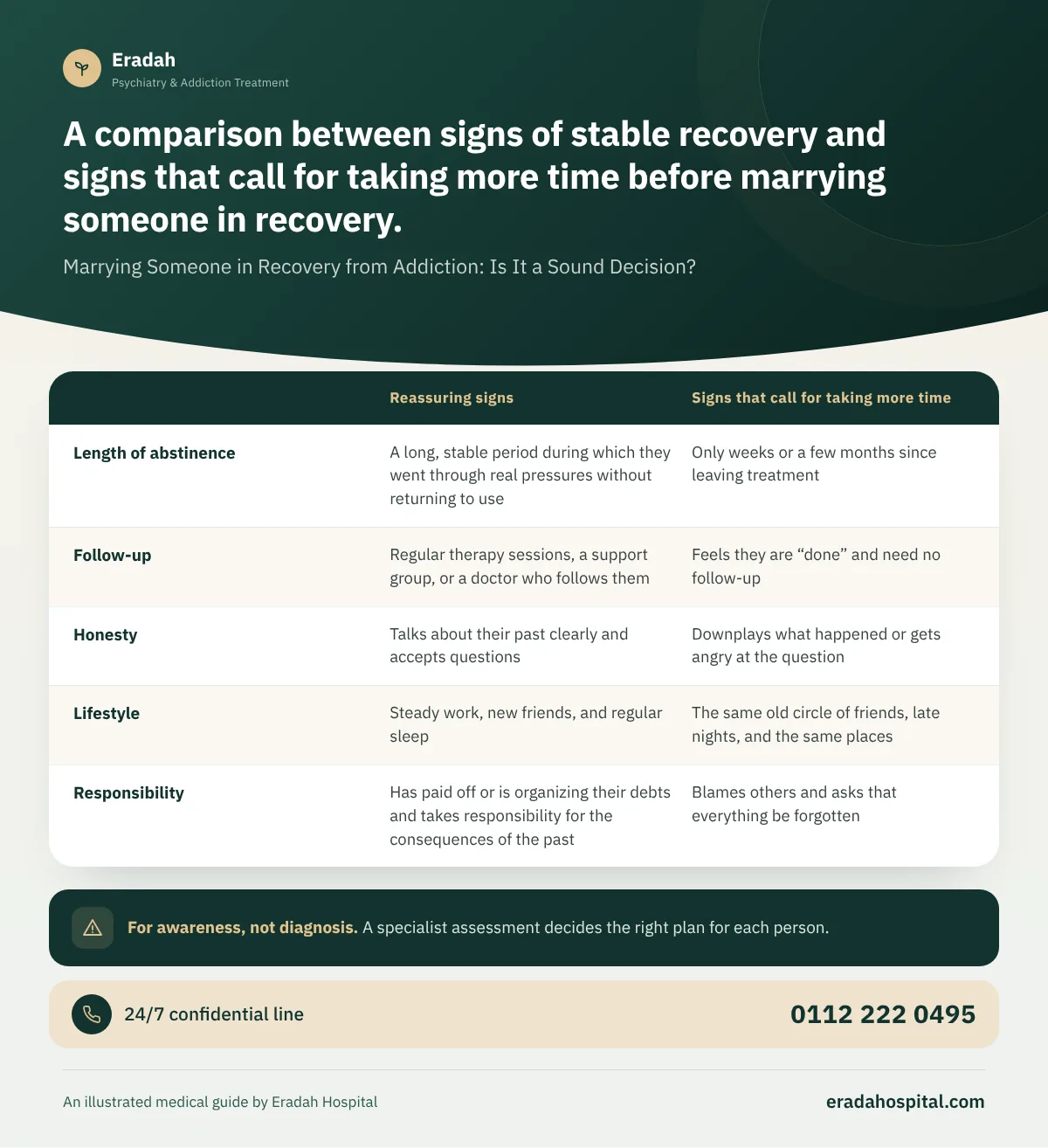
There is no magic number of years, but the longer the stable recovery lasts and the more situations the person has come through, the more reassurance it gives. We explain how a relapse begins weeks before use in our guide to relapse in addiction.
Questions that must be asked before engagement
- Which substances did they use, for how long, and did they ever inject?
- When did they stop, how were they treated, and do they still see a doctor or a group?
- Have they relapsed before? What did they do when it happened?
- Do they have a co-occurring psychiatric diagnosis such as depression or anxiety, and are they being treated for it?
- Are there debts, legal cases, or obligations left over from the period of use?
- Would they agree for both of you to attend a session with the therapist before the marriage?
Honest answers are a healthy sign in themselves. The goal is not to interrogate them but for both of you to enter the marriage with your eyes open.
Medical tests before marrying someone in recovery
The World Health Organization notes that sharing needles and syringes among people who inject drugs is one of the ways hepatitis C virus is transmitted, as are sexual practices that involve exposure to blood. The good news is that modern antiviral medicines cure more than 95% of people infected, according to the WHO. For this reason, both partners have the right to be tested for hepatitis viruses and HIV, especially if the substance use was by injection, in addition to the usual pre-marital tests. We explain the risks on our page on the harms of drugs.
What if a relapse happens after marriage?
It is best to agree on this in advance while you are both calm. A 2019 US study found that the median number of serious attempts before overcoming the problem was two, meaning many people stumble once before they settle. The real difference between one person in recovery and another is what happens after the slip: do they admit it quickly and return to treatment, or hide it and lie?
- Agree on the warning signs that each of you will watch for.
- Decide what happens at the first slip: who calls the therapist, and what the next steps are.
- Set clear, non-negotiable boundaries, such as violence or using in front of the children.
- Agree on reasonable financial transparency in the early years, without humiliation.
Common ideas that harm the decision
- “Marriage will straighten him out”: Marriage is not a treatment, and its pressures can trigger a relapse if the recovery is not stable.
- “Once an addict, always an addict”: This is an unfair generalization; many people recover and stay stable.
- “Let’s hide it from her family”: Concealment destroys trust the moment it is discovered, and thoughtful honesty is better.
- “Love is enough”: Love matters, but recovery needs a plan and follow-up.
How do you build a marriage that protects recovery?
Research shows that involving the partner in treatment helps: a meta-analysis published in the journal Clinical Psychology Review in 2008 found that behavioral couples therapy was better than individual therapy at reducing substance use and improving relationship satisfaction. You can start with sessions before the marriage with a therapist who knows the history of addiction, and continue with a follow-up program afterward.
At Eradah, a fiancé in recovery or the family can book a free, confidential first consultation to assess how stable the recovery is and to set up a follow-up plan, and the family program helps both sides talk openly. We explain what returning to normal life after treatment means in our guide on life after leaving the hospital.