"I started by sniffing, and the needle came later, when sniffing stopped doing anything." Many people with heroin addiction describe this path, and moving to injecting is often a sign that addiction has progressed. The harms of injecting drugs add a whole layer of infections and injuries on top of the harm of the substance itself.
Why is injecting the most dangerous route of use?
- The whole dose at once: the dose reaches the brain within seconds, which raises the risk of breathing stopping.
- Impurities enter the blood: cutting agents and powder from crushed tablets can block small blood vessels.
- Germs bypass the skin barrier: they reach the veins and the heart.
- Sharing: shared needles and equipment pass bloodborne viruses from one person to another.
The US National Institute on Drug Abuse notes that people who use heroin are at particular risk of HIV and hepatitis B and C, not only through shared needles but also through preparation equipment, and that drugs impair judgment, which increases other risky behaviors.
Harms of injecting drugs: viral infections
In the global review published in The Lancet Global Health in 2023, injecting drug use was recorded in 190 of 207 countries and territories. The researchers estimated that 15.2% of people who inject drugs worldwide live with HIV, 38.8% have an active hepatitis C infection, and 18.5% recently experienced an overdose.
The World Health Organization says hepatitis C is spread through blood, and one of its main routes is the sharing of needles and syringes among people who inject drugs. There is no effective vaccine against it yet, but direct-acting antiviral medications cure more than 95% of people who have it.
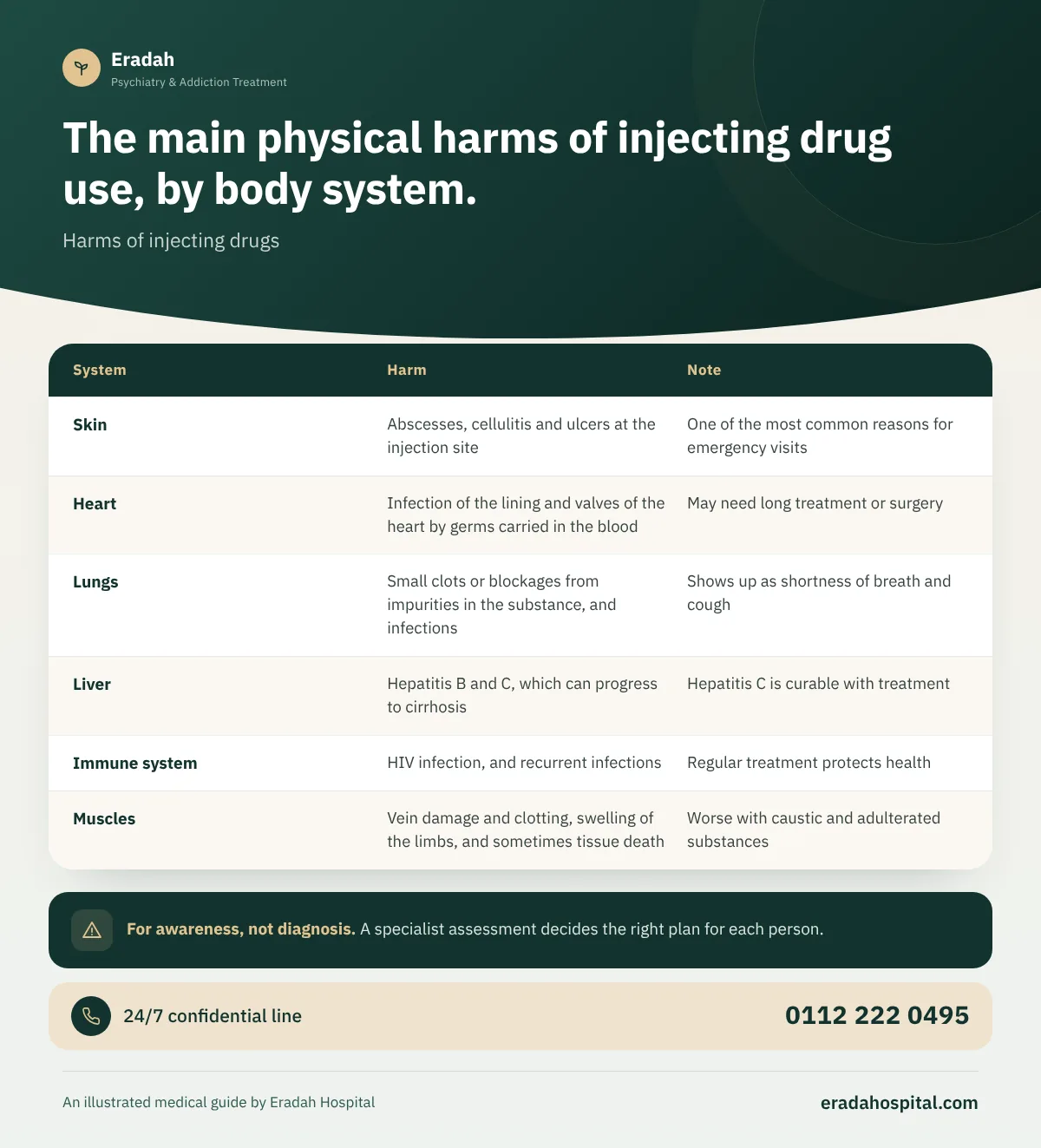
What does injecting do to the body?
| System | Harm | Note |
|---|---|---|
| Skin | Abscesses, cellulitis and ulcers at the injection site | One of the most common reasons for emergency visits |
| Heart | Infection of the lining and valves of the heart by germs carried in the blood | May need long treatment or surgery |
| Lungs | Small clots or blockages from impurities in the substance, and infections | Shows up as shortness of breath and cough |
| Liver | Hepatitis B and C, which can progress to cirrhosis | Hepatitis C is curable with treatment |
| Immune system | HIV infection, and recurrent infections | Regular treatment protects health |
| Muscles | Vein damage and clotting, swelling of the limbs, and sometimes tissue death | Worse with caustic and adulterated substances |
In some substances the injuries reach a terrifying degree: a study published in the International Journal of Drug Policy in 2013 described severe injuries and tissue death among people who inject home-made krokodil made with caustic chemicals.
Vein damage and abscesses
With repeated injecting, the veins become inflamed, scarred and closed off, so the person looks for deeper veins or ones in dangerous places such as the neck and groin, which can hit an artery or a nerve. An abscess should never be dismissed as an ordinary "boil": if it comes with spreading redness, fever or chills, the germs may have reached the blood and urgent treatment is needed.
Injecting and overdose
Because an injected substance arrives whole and fast, the margin for error is smaller. The World Health Organization counts injecting use as a risk factor for opioid overdose, as is returning to use after a period of abstinence, because tolerance will have dropped. The three typical signs, as the organization lists them, are pinpoint pupils, loss of consciousness and difficulty breathing. Emergency details are in the overdose guide.
Which drugs are usually injected?
The best known is heroin, along with some medications injected outside their medical use such as nalbuphine and pethidine, and sometimes stimulants. Anabolic hormones are also injected in gyms with non-sterile equipment, which the National Institute on Drug Abuse says exposes those who use them to HIV and hepatitis.
What next after injecting? Testing and treatment
- Get tested for hepatitis C, hepatitis B and HIV; early diagnosis changes the outcome.
- Have any abscess or skin infection treated by a doctor, and do not open it at home.
- Start treatment for the addiction itself, since injecting is a sign of advanced addiction that needs a comprehensive plan.
- If the substance is an opioid, there are approved medications that reduce the risk of death, which the doctor will determine.
Treatment at Eradah includes medically supervised detox with comprehensive tests, then a residential program for rehabilitation, and referral of the patient to specialist treatment for any infection found.