Where does stress treatment begin?
There is no single treatment that suits everyone, and finding what suits you may take some trial. But the starting point is much the same: to know what is putting pressure on you and what you can do about it, and to treat stress as a skill to be learned, not a fate to be endured.
It helps to sort sources of stress into three boxes: what you can change now, such as organizing your time, asking for help or refusing an extra task; what you can partly influence, such as a strained relationship or work pressure; and what you cannot change for now, such as a relative's illness or a public crisis. The first needs a plan, the second needs negotiation and boundaries, and the third needs skills of acceptance and calming. Cleveland Clinic advises accepting that you cannot control everything, and finding ways to let go of worrying about what cannot be changed.
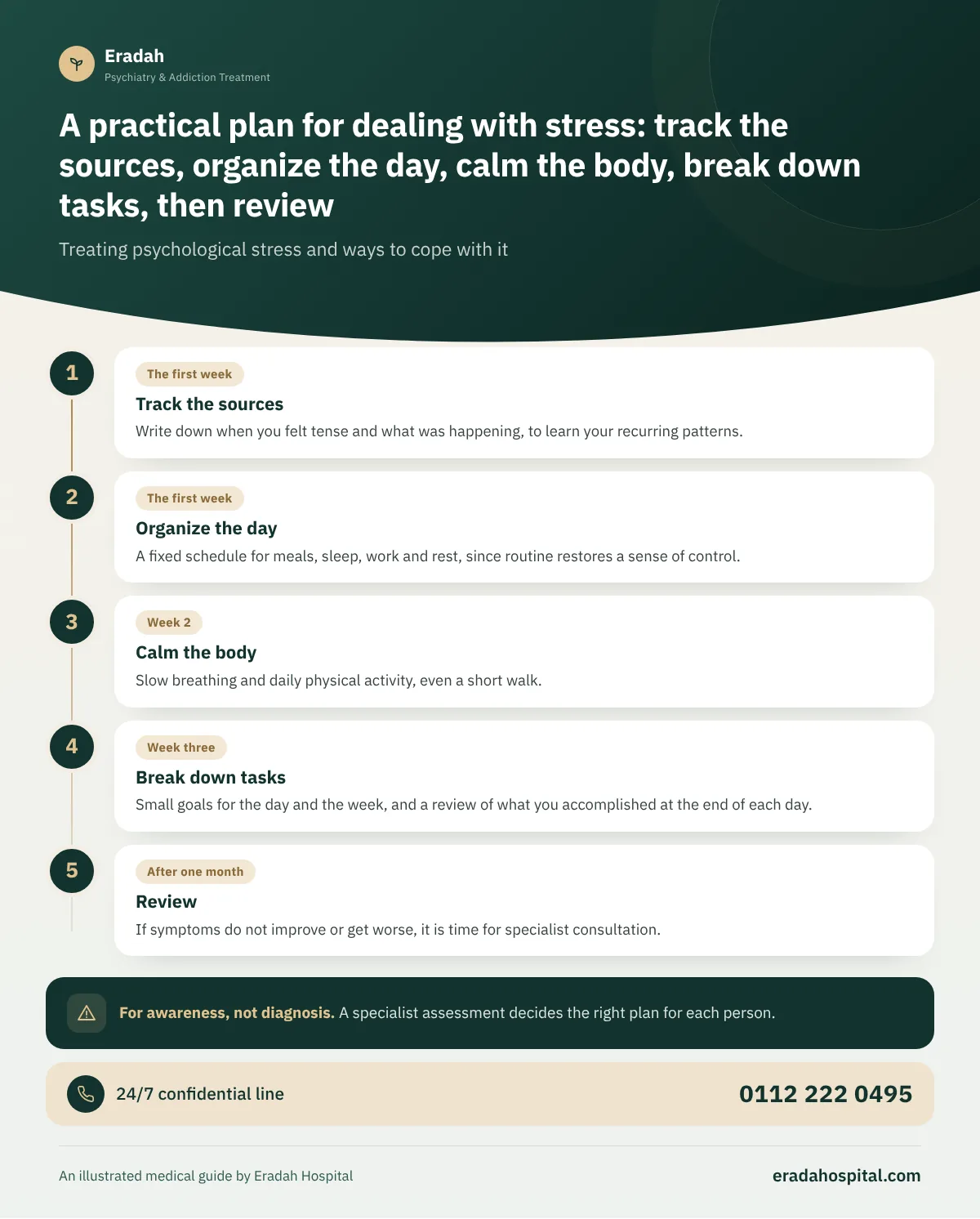
A practical plan for dealing with stress
These are gradual steps drawn from recommendations by the World Health Organization and Cleveland Clinic, which you can adapt to your circumstances:
- The first weekTrack the sources
Write down when you felt tense and what was happening, to learn your recurring patterns.
- The first weekOrganize the day
A fixed schedule for meals, sleep, work and rest, since routine restores a sense of control.
- Week 2Calm the body
Slow breathing and daily physical activity, even a short walk.
- Week threeBreak down tasks
Small goals for the day and the week, and a review of what you accomplished at the end of each day.
- After one monthReview
If symptoms do not improve or get worse, it is time for specialist consultation.
The World Health Organization says a fixed daily schedule helps us use our time efficiently and feel more in control, and that a few minutes a day of the exercises in its self-help guide “Doing What Matters in Times of Stress” is enough to start.
How do you calm your body when stress is intense?
- Slow breathing: slow your breathing until the exhale is longer than the inhale, for several minutes. A systematic review by Zaccaro and colleagues indicates that slow breathing techniques (fewer than 10 breaths per minute) are linked to higher heart rate variability and changes in nervous system activity associated with relaxation.
- Movement: the World Health Organization says regular daily exercise, including walking, helps reduce stress, and Cleveland Clinic advises moving as soon as you start to feel symptoms of tension.
- Muscle relaxation: tense a muscle group for a few seconds and then release it, working upward from the feet to the face.
- Sleep: a fixed time to go to bed and wake up, even on holidays, a quiet dark room, and less screen time, caffeine and heavy meals before bed, as the World Health Organization recommends.
- Food and fluids: balanced meals at regular times, enough fluids, and plenty of vegetables and fruit if possible.
What mental skills ease stress?
- Small goals: Cleveland Clinic advises setting goals for the day, week and month; narrowing your view gives a sense of control, and at the end of the day you think about what you accomplished rather than what you did not.
- Reviewing thoughts: the US National Institute of Mental Health recommends recognizing unhelpful negative thoughts and challenging them. Ask yourself: what is the evidence? What is the most likely outcome?
- Gratitude: Cleveland Clinic suggests paying attention to the good aspects of your day and life.
- Boundaries: say “no” to extra responsibilities when you are overloaded, as Cleveland Clinic advises.
- News and screens: cut down the time you spend following the news if it adds to your tension, according to the World Health Organization.
- Connection: share your worries with people you trust, since connection improves mood and eases the feeling of stress, as the World Health Organization says.
What specialized psychological treatment is there for stress?
When self-help is not enough, there are structured programs that research has studied:
| Program | What it involves | What the evidence says |
|---|---|---|
| Cognitive behavioral stress management programs | Changing thoughts and behaviors linked to stress, and problem solving | In an analysis of 36 experimental studies and 2,847 participants in workplaces, cognitive behavioral programs consistently achieved a larger effect than the others |
| Mindfulness-based stress reduction (MBSR) | Structured training in paying attention to the present moment and accepting feelings | An analysis of 29 studies involving 2,668 healthy people found a large effect on stress, which persisted at a follow-up averaging 19 weeks |
| Relaxation training | Progressive muscle relaxation, breathing and guided imagery | The most widely used in work stress studies, and with a smaller effect than cognitive behavioral programs in the same analysis |
Cognitive behavioral therapy sessions deliver these skills individually or in groups, and help especially when stress overlaps with overthinking or anxiety. Group therapy sessions may also help break the feeling that you are alone in this.
Is there a medicine to treat stress?
There is no medicine that treats “stress” as a natural response. But if it turns into an anxiety disorder, depression or chronic insomnia, the doctor may prescribe treatment for that condition after assessment, and the US National Institute of Mental Health says psychotherapy and medication are the main treatments for anxiety, and that many people benefit from combining them. Only the doctor decides the type and duration of a medicine, so do not start or stop any medicine without a doctor.
When do you need a specialist to treat stress?
Cleveland Clinic advises consulting your care provider if stress symptoms do not ease with calming methods, or if you are using drugs or alcohol to cope. Add to this insomnia lasting weeks, panic attacks, sadness and loss of pleasure, or a clear decline in work and relationships. At Eradah Psychiatric Hospital it starts with a confidential consultation to assess the situation, then in most cases a follow-up plan in the outpatient clinics.
Has stress turned into danger? Ask for help now
- Talking about death, wanting to disappear, or being a “burden” on others
- Severe or crushing chest pain, sudden shortness of breath, or fainting (treat as a heart problem until proven otherwise)
- Complete inability to sleep, eat or do any task for several days
- Excessive use of sedatives, or mixing them with alcohol or drugs “to calm the nerves”
- Fits of anger that reach threats or violence toward oneself or others
Do not leave the person alone. Calmly and frankly ask how they feel and what they are thinking, and listen without blame; asking directly does not plant the idea, it opens the door to help. For chest pain, fainting or any threat to life, call an ambulance (123) immediately. For suicidal thoughts, call an ambulance or take them to the nearest emergency room, or call the mental health support line 16328 (24 hours), and keep medications and anything they could use to hurt themselves away from them.
Ambulance 123 Mental health support line 16328