What is attention-deficit/hyperactivity disorder?
Attention-deficit/hyperactivity disorder, known by the abbreviation ADHD, is one of the best-known neurodevelopmental disorders. That means it is tied to how the brain develops and works from early childhood, and is not an illness a person suddenly acquires as an adult.
The American Psychiatric Association describes it along three dimensions: inattention, meaning difficulty sustaining focus and staying organized; hyperactivity, meaning physical activity that does not suit the situation; and impulsivity, meaning hasty actions without thinking about the consequences. One dimension may dominate over the others depending on the person and their age.
The essential condition is that these difficulties are clearly greater than expected for the person's age, persistent, present in more than one setting such as home and school or work, and genuinely disruptive to their life. All children move a lot and everyone is absent-minded sometimes, and that alone is not a disorder.
What are the presentations of ADHD?
| Situation | What predominates | Who it is noticed in most |
|---|---|---|
| Predominantly inattentive | Absent-mindedness, forgetfulness, poor organization and difficulty finishing tasks, with fairly normal movement | Girls and adults, and it is often missed |
| Predominantly hyperactive-impulsive | Excess movement, talking a lot, interrupting and difficulty waiting | Young children especially |
| Combined presentation | Combines both dimensions to a marked degree | The most common in clinics |
The picture can change with age. A hyperactive child may become an adult who does not look overactive, yet feels inner restlessness and has trouble with organization and time management. Because the types do not have a separate page, you will find the details of the signs of each presentation on the symptoms page.
How common is ADHD?
It is diagnosed more in males than in females in childhood, but the gap narrows in adulthood, because girls more often have the quiet inattentive form that does not catch teachers' attention. There are no accurate Egyptian figures published at the national level, but there is no reason to believe it is less common than global rates.
Sources: American Psychiatric Association and StatPearls. Figures are approximate and vary between studies.
How does the brain work in ADHD?
Research points to differences in the brain networks responsible for executive functions: planning, time management, inhibiting responses, working memory and emotion regulation. Neurotransmitters such as dopamine and norepinephrine play a role in these networks, and they are the same ones that the disorder's medications act on.
This is why a person can sometimes focus for hours on a game or a subject that excites them, yet be unable to focus for minutes on a boring task. A person with ADHD is capable of paying attention, but finds it hard to regulate and direct it according to what is required rather than what is stimulating.
How does it feel from the inside?
As if ten channels are playing in your head at once and you do not have the remote. You know what you need to do but cannot start, and then you start at the last minute under pressure.
Many adults describe years of feeling smart but “not achieving what they are capable of,” and of hearing words like “careless,” “lazy” and “doesn't care.” This leaves an effect on self-esteem that is sometimes deeper than the symptoms themselves, which is why many people feel relief when they finally get an explanation for what they have been struggling with.
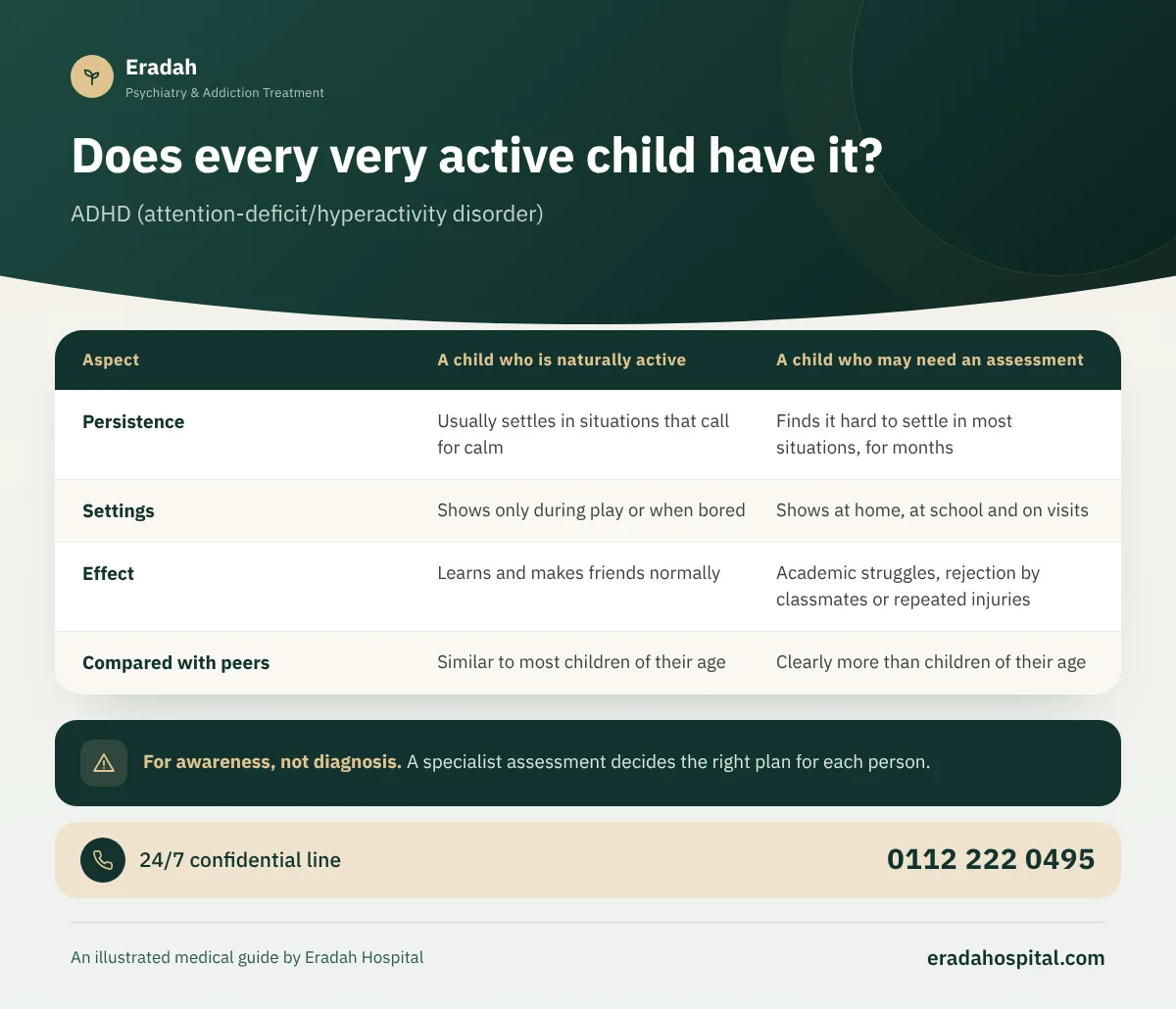
Does every very active child have it?
| Aspect | A child who is naturally active | A child who may need an assessment |
|---|---|---|
| Persistence | Usually settles in situations that call for calm | Finds it hard to settle in most situations, for months |
| Settings | Shows only during play or when bored | Shows at home, at school and on visits |
| Effect | Learns and makes friends normally | Academic struggles, rejection by classmates or repeated injuries |
| Compared with peers | Similar to most children of their age | Clearly more than children of their age |
Myths and facts about ADHD
Fact: research does not show that sugar causes the disorder, and screens may increase distractibility but are not a proven cause.
Fact: the disorder has a strong neurological and genetic basis. Parenting style affects how severe the problems are, not whether the disorder exists.
Fact: excess movement usually eases, but distractibility and poor organization continue in many adults.
Fact: medication taken under a doctor's supervision does not raise the risk of addiction, whereas untreated ADHD is linked to a higher risk.
High intelligence can hide the symptoms for years, until demands increase at university or work and the problem shows.
Does ADHD affect adults?
Yes. The disorder continues into adulthood in a large share of children, and many adults discover their condition for the first time after one of their children is diagnosed, or when problems at work, with deadlines and with money pile up. An adult does not suddenly develop it; its roots have been there since childhood, even if no one noticed.
When should you see a psychiatrist?
- When complaints from school about distractibility, movement or impulsivity continue for more than six months.
- When a child struggles academically despite their intelligence and their family's effort.
- When an adult feels that distractibility and disorganization threaten their job, marriage or finances.
- When anxiety, depression, early smoking or substance use appears alongside it.
- Immediately if there are thoughts about death or self-harm, or impulsive behavior that puts life at risk.
What can be expected in the long term?
With the right diagnosis and support, most people with ADHD live successful, stable lives, and many stand out for energy, creativity and quick thinking. The big difference is made by catching the condition early, by the family and school handling it with understanding, and by regular follow-up with the doctor.
Why do families delay asking for help?
Many families in Egypt delay out of fear of stigma or of “psychiatric medication,” or because relatives say the child “will grow up and sort himself out.” But delay means extra years of criticism and struggle, whereas an assessment commits the family to nothing and instead gives them understanding and options. A child psychiatry visit is confidential and as ordinary as any other medical visit.
What is the family's role?
The family is the first line of support: understanding that the behavior is not deliberate stubbornness, replacing constant punishment with a clear routine and rewards for effort, staying in touch with the school, and protecting the child's self-esteem from too much criticism. If one parent has the same symptoms, an assessment for them is useful because the disorder runs in families.
ADHD guide: everything you need to know
We have gathered everything about ADHD into 6 pages, each answering one question in detail. Choose what you are looking for:
ADHD symptoms
Signs of inattention, hyperactivity and impulsivity in children, teenagers and adults, and why symptoms are missed in girls.
Causes of attention-deficit/hyperactivity disorder
Heredity is the strongest factor, along with brain development, premature birth, and exposure to smoking, alcohol and lead during pregnancy, plus common myths about causes.
Harms of ADHD
What happens without treatment: academic and career setbacks, accidents, relationship problems, anxiety and depression, and a higher risk of addiction.
Diagnosing ADHD
Who diagnoses it, the assessment steps, the recognized rating scales, and the look-alike conditions that must be ruled out.
Treatment of hyperactivity and attention deficit
Parent training, behavioral therapy and school support, and stimulant and non-stimulant medications and how the doctor monitors their effects.
ADHD and addiction
Why untreated ADHD raises the risk of addiction, the misuse of stimulants, and how both are treated together.
Suicidal thoughts or danger to self? Get help now
- Talk of wanting to die or of the family being better off without them
- Severe hopelessness after failing, being dismissed, a breakup or harsh punishment
- Sudden dangerous impulsiveness: reckless driving, heavy substance use or self-harm
- Sudden withdrawal from friends and family and saying goodbye to them
- Severe agitation or sleeplessness for days, or strange symptoms after taking stimulants without a prescription
Do not leave the person alone. Listen calmly without blame or lectures, and keep dangerous objects out of their reach in general. Call an ambulance (123) or go to the nearest emergency room, or call the mental health support line 16328 around the clock, and inform their treating doctor.
Ambulance 123 Mental health support line 16328