“He was the best student in the class, and suddenly he shut himself away, his grades dropped, and his friends changed.” Many parents discover their children’s substance use late, not because they are neglectful but because the beginning of teen addiction looks very much like ordinary adolescent mood swings.
Why are teenagers more vulnerable to addiction?
The US National Institute of Mental Health explains that the teenage brain goes through a period of “fine-tuning” that lasts until the mid-to-late twenties, and that the prefrontal cortex, responsible for planning and decision-making, is among the last areas to mature. At the same time, teenagers’ interest in their friends and their standing among them increases, so they lean toward risk when they see the social benefit as greater than the consequences. The US National Institute on Drug Abuse confirms that teenagers and people with mental health disorders are more vulnerable to substance use and addiction than others.
Why is starting early dangerous?
In a large US study published in 1998, starting to use early was a strong predictor of later addiction, and the likelihood of misuse and dependence fell by about 4% to 5% with each year that first use was delayed. The US National Institute on Drug Abuse suggests the reason is a mix of the substance’s effect on a brain that is still growing and the risk factors that push people to start early in the first place, such as a troubled family environment, trauma and mental illness. This is why delaying any experimentation is a real gain.
Which substances might a teenager come near?
- E-cigarettes and smoking: often the first step, and the idea of “smoke” becomes familiar along with them.
- Hashish and Strox: promoted as “natural” or “not addictive,” while Strox is a synthetic substance with unpredictable effects.
- Medicines: painkillers such as tramadol and sedatives from the home medicine drawer or from friends.
- Volatile solvents: such as glue and gasoline, which are cheap, within reach of young people and dangerous to the brain.
- Stimulants: sometimes on the pretext of studying and staying up late.
Early signs of teen addiction
- A sudden change of friends and a refusal to introduce them to you.
- A clear decline in school performance or skipping school.
- Disturbed sleep: staying up very late, then sleeping most of the day.
- Unusual irritability, lying or secrecy, especially around the phone.
- Repeated requests for money, or items or cash disappearing from the home.
- Red eyes, strange smells, or heavy use of eye drops and perfume.
- Losing interest in hobbies and sports.
The difference between teenage mood swings and signs of substance use
| Ordinary teenage ups and downs | Signs that call for concern | |
|---|---|---|
| Mood | Mood swings and irritability that pass within days | Severe irritability or depression lasting for weeks |
| Friends | Spending more time with friends | A complete change of friends and hiding who they are |
| Sleep | Staying up late on vacation | A complete reversal of sleep with severe lethargy during the day |
| School | Ups and downs in some subjects | A sudden decline and repeated absences |
| Privacy | A wish for personal space | Extreme secrecy, repeated lying and anger at any question |
| Money | Sometimes asking for a bigger allowance | Constant requests for money with no explanation, or things disappearing |
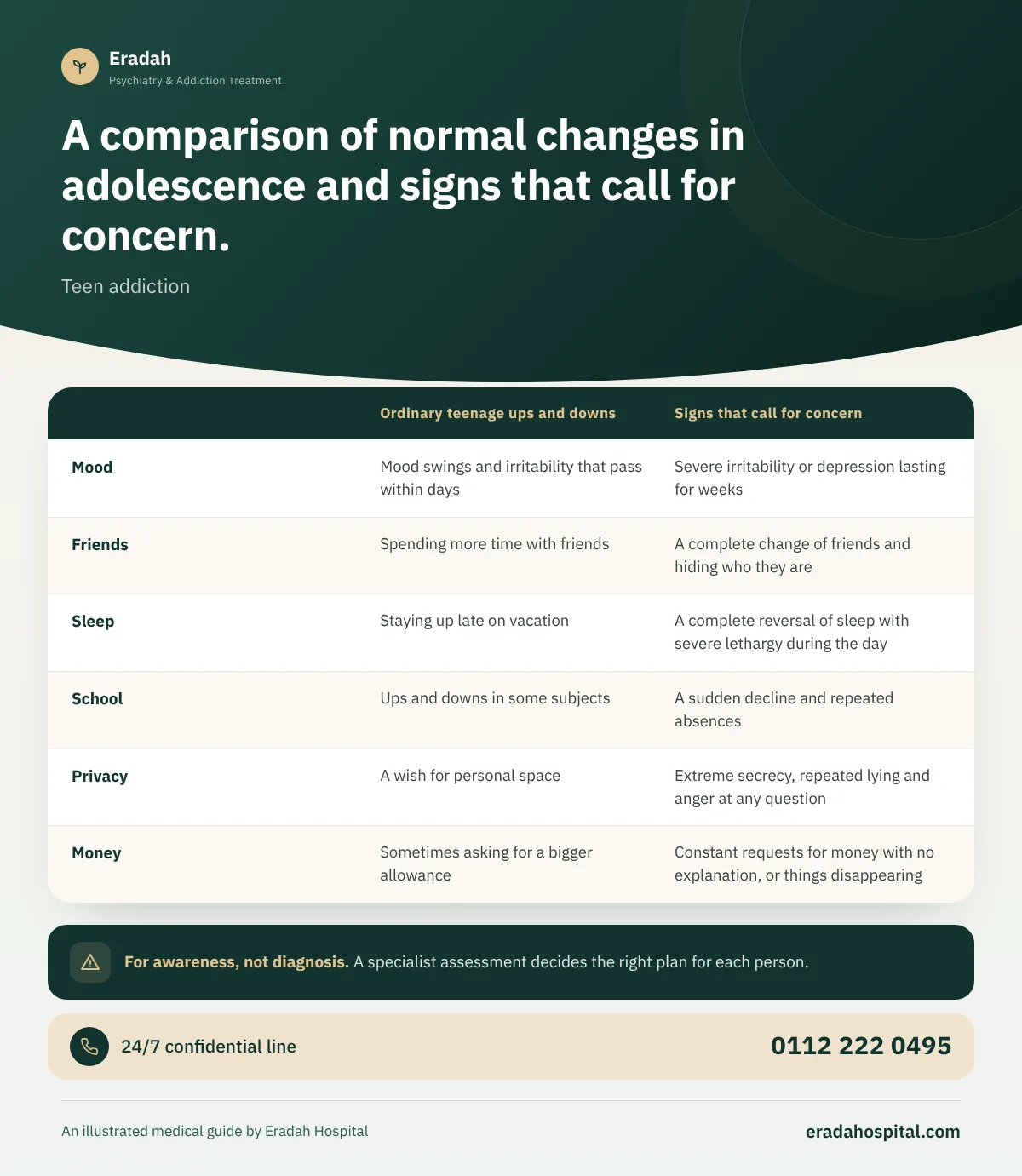
The rule: don’t judge from one sign, but from a pattern of changes that lasts for weeks. The page on signs of drug use details the physical and behavioral signs and what does not count as a sign.
What should the family do if they discover substance use?
- Calm down before you speak: a confrontation in a moment of anger ends in denial and stubbornness.
- Choose a time when he is sober, and start with worry, not accusation: “I see you’ve changed and I’m worried about you.”
- Listen more than you talk: why did he start? What is he facing at school or with his friends?
- Agree on one step: an assessment by a psychiatrist or an addiction specialist.
- Set clear rules for going out, money and the phone, and apply them consistently without humiliation.
- Don’t carry it alone: both parents, father and mother, need to agree on one message.
Treatment for teen addiction
In an analysis of 45 studies on outpatient treatment for teenagers, published in 2013, family therapy had the strongest evidence of effectiveness compared with other approaches, although most types of treatment helped teenagers reduce their use. A recent review of principles of adolescent treatment published in 2025 also recommends combining treatment of coexisting mental health disorders with treatment of substance use, involving the family, and keeping the teenager engaged in treatment and in follow-up afterward. This is why treatment begins with a comprehensive assessment that determines the right level of care, and the family program involves parents in the plan.
Teenagers and mental health: the other side of the problem
Many teenagers use substances to calm an anxiety or sadness they don’t know how to express, or because of hyperactivity and attention difficulties. This is why the assessment needs to look for depression, anxiety and ADHD, and to treat whatever it finds as part of dual diagnosis.