“My brother isn't mentally ill, he's just going through a hard time psychologically.” Many families say this in defense of their son, as if “mental” were a stigma and “psychological” were milder. So is there really a difference between psychological and mental illness? And where do neurological disease and intellectual disability fit in relation to the two?
The difference between psychological and mental illness in modern medicine
Modern psychiatry does not distinguish between “psychological” and “mental.” The World Health Organization uses a single term, mental disorder, and defines it as a clinically significant disturbance in a person's cognition, emotional regulation or behavior, usually accompanied by distress or impairment in important areas of life. This category includes anxiety, depression, bipolar disorder, schizophrenia, eating disorders and more, with no separation between “psychological” and “mental.”
The English word “mental” is sometimes translated into Arabic as one word and sometimes as the other, and that is where the confusion comes from. This is why doctors prefer to name the specific disorder rather than use a general label.
What do people mean by mental illness and psychological illness?
In common usage in Egypt and the Arab world:
- “Psychological illness” usually means anxiety, depression, OCD and stress, that is, conditions in which the person stays aware of reality.
- “Mental illness” usually means psychosis, schizophrenia and severe manic episodes, that is, conditions in which the perception of reality is disturbed.
- Sometimes “mental” is mistakenly used to describe intellectual disability or dementia.
This popular division resembles the old distinction between neurosis and psychosis, but it is not accurate, because severe depression with suicidal thoughts can be far more dangerous than a psychotic condition that is stable on treatment.
Severity is the real difference
Instead of “psychological” and “mental,” the US National Institute of Mental Health (NIMH) uses a division by severity: any mental illness (AMI), which includes all mental, behavioral and emotional disorders regardless of severity, and serious mental illness (SMI), a disorder that causes serious functional impairment that limits one or more major life activities.
According to NIMH estimates for 2022 in the United States, 23.1% of adults lived with a mental illness of any level, while the share with serious mental illness was 6%. In other words, most mental disorders do not reach the level of severity that people imagine when they hear the word “mental.”
The difference between psychological illness, neurological disease and intellectual disability
| Mental health disorder | Neurological disease | Intellectual disability | |
|---|---|---|---|
| What is affected? | Thinking, emotions and behavior | The brain and nerves as an organ: movement, sensation or consciousness | Intellectual abilities and life skills from an early age |
| Examples | Depression, anxiety and schizophrenia | Strokes, epilepsy, migraine and dementia | Down syndrome and some cases of oxygen deprivation at birth |
| The start | At any age, mostly in young people | At any age, and some increase with advancing age | Before birth, during birth or in early childhood |
| Specialist | Psychiatrist and psychotherapist | Neurologist | Rehabilitation, education and family support team |
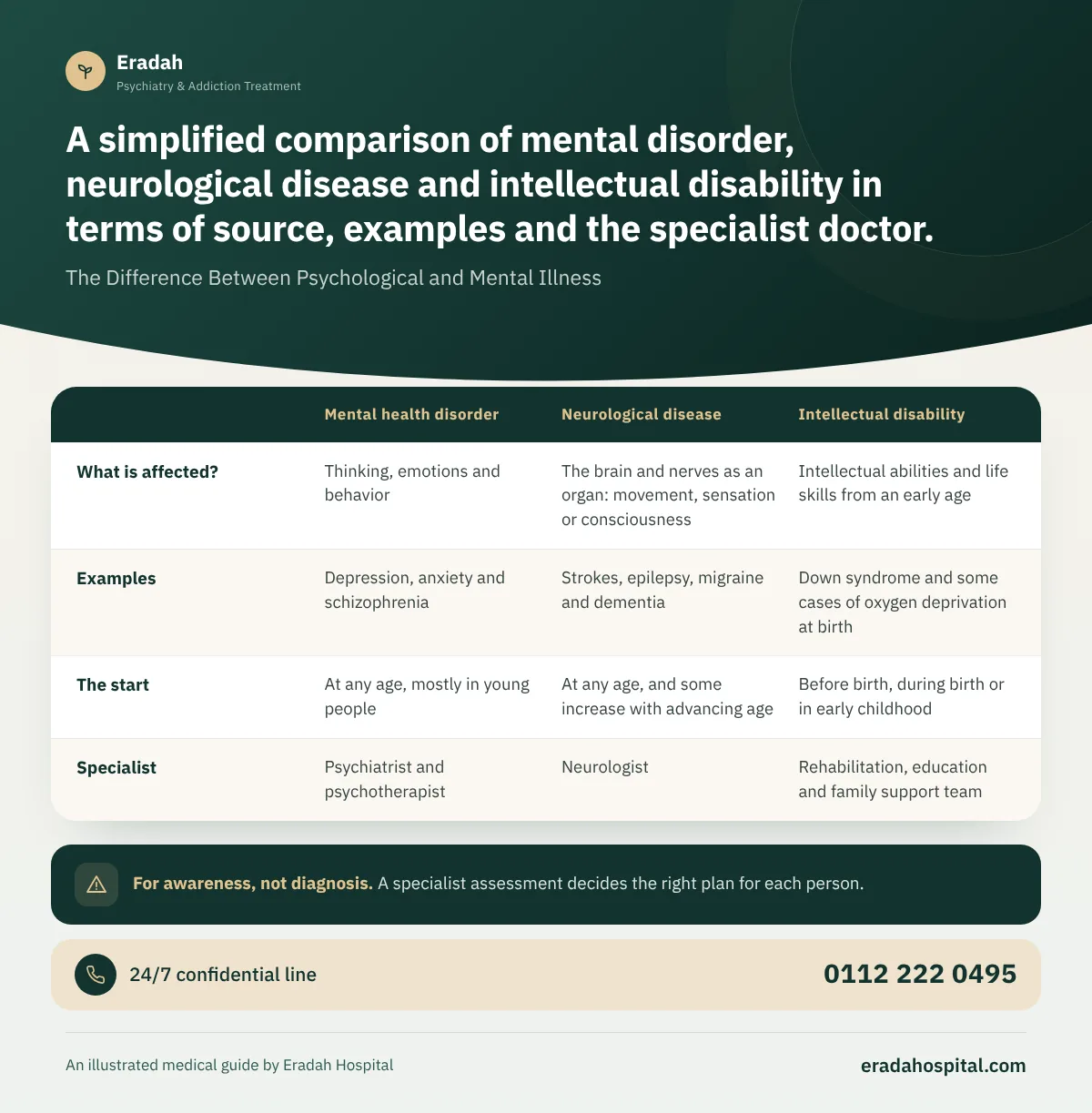
The World Health Organization says that more than 3 billion people were living with a neurological condition in 2021, and that those with the greatest health impact were stroke, neonatal brain injury, migraine, dementia and diabetic neuropathy. As for intellectual disability, the NHS explains that it means difficulty understanding complex information, learning some skills and living independently, and that it usually results from the development of the brain being affected before birth, during birth or in early childhood, and that many people with it work, marry and live independently.
When the categories overlap
The boundaries are not always sharp. Dementia is a neurological disease that may begin with psychological symptoms such as depression or hallucinations, a person with epilepsy may develop depression, and brain diseases can cause psychosis, as the NHS notes. The World Health Organization classifies autism, attention deficit hyperactivity disorder and intellectual disability under “neurodevelopmental disorders,” a bridge between psychiatry and neurology. So is functional (conversion) disorder, in which real neurological symptoms appear without damage to the nerves.
How does Egyptian law treat psychological and mental illness?
Modern Egyptian law does not distinguish between them in terms of protection. Law No. 71 of 2009 is called the “Law on the Care of Persons with Mental Illness,” and Article 62 of the Penal Code, as amended by that law, speaks of a person who suffers a “psychological or mental disorder” that deprived them of awareness or choice, as its text was published by a parliamentary website. You will find the details of patients' rights inside mental health facilities in the guide Caring for a Person with Mental Illness.
Why does the popular distinction between “psychological” and “mental” do harm?
When the word “mental” becomes a stigma, families delay treatment for psychosis until the condition becomes severe, and try to convince themselves that their son is “just going through a hard time psychologically.” And when “psychological” is treated as something minor, depression that may end in suicidal thoughts is neglected. The World Health Organization notes that many people with mental disorders face stigma and discrimination, and that most do not receive effective care. Accurate naming is the first step toward the right treatment.
Who treats what?
- The psychiatrist: diagnoses mental disorders of every severity, and prescribes and monitors medication.
- The therapist or psychologist: provides talk therapy such as cognitive behavioral therapy, and does not prescribe medication.
- The neurologist: treats epilepsy, strokes, headaches, peripheral nerve diseases and dementia, in collaboration with psychiatry.
- Rehabilitation teams: support people with intellectual disability in learning, working and independence.
At Eradah, the medical team includes psychiatrists and therapists, and the first consultation is free and confidential. You can start there even if you are not sure what kind of problem you have, and the doctor will direct you to the right specialty. When a stay is needed, Eradah Psychiatric Hospital offers a treatment program for men.