What is hashish?
Hashish is a brown-to-black substance made from resin, the sticky secretion produced by the glandular hairs on the flowering tops of the cannabis plant. The resin is collected and pressed into pieces or slabs, which makes it more concentrated than the dried leaves known as bango.
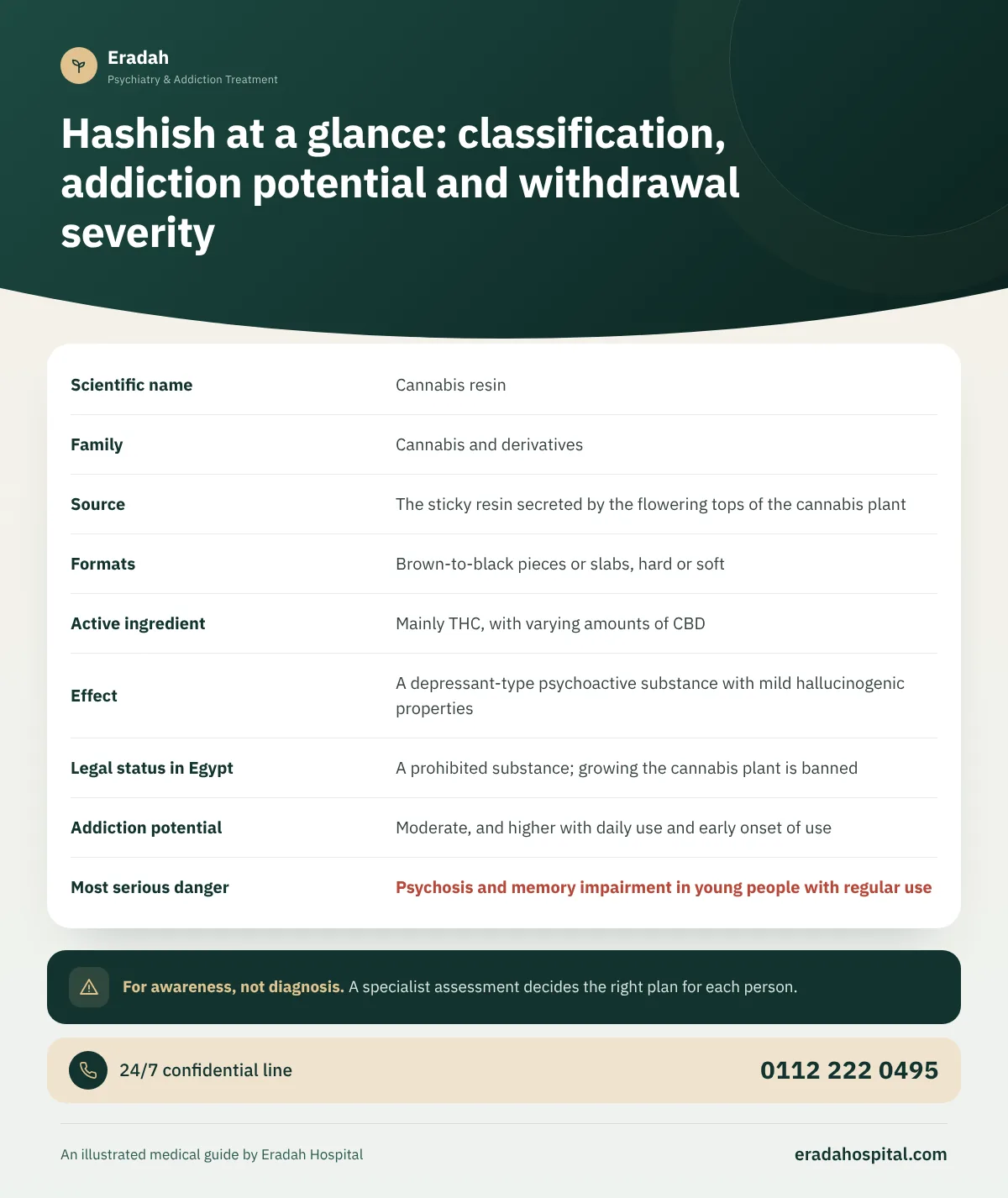
The cannabis plant contains more than a hundred compounds called cannabinoids, two of which matter most: THC, which is responsible for the "high" and for most of the psychological harms, and CBD, which does not cause a high and appears to soften some of THC's effects. The ratio of the two varies widely between strains, which explains why hashish can affect the same person differently from one time to the next.
Hashish goes by many names on the Egyptian street, and some people treat it as a "light high" or a "social habit". But recent research paints a different picture, especially as the potency of the hashish in circulation has risen in recent years.
Where does hashish come from, and what forms does it take?
Cannabis grows in many parts of the world, and North Africa is one of the largest sources of cannabis resin globally, according to reports from the United Nations Office on Drugs and Crime. Most hashish reaches the Egyptian market through smuggling, alongside illegal cultivation of the plant in some areas.
Hard or soft pieces, light brown to black, and on average more concentrated than dried leaves.
The herbal form of the same plant, known worldwide as marijuana.
Very high-potency products that are common abroad. The effect of edibles is delayed, which increases the risk of poisoning, especially in children.
How does hashish affect the brain?
The human body has a natural system called the endocannabinoid system, which releases compounds similar in structure to THC and regulates mood, memory, appetite, sleep, pain and movement. When THC enters the body it mimics these compounds and binds to their receptors, but far more strongly and for much longer, which disrupts this finely tuned system.
| Area | Its role | What happens with THC |
|---|---|---|
| Hippocampus | Forming new memories | Difficulty learning and remembering recent events |
| Prefrontal cortex | Planning, decision-making and attention | Slower thinking and poorer judgment |
| Cerebellum and basal ganglia | Balance and coordination of movement | Slower reactions and poorer coordination, which makes driving dangerous |
| Amygdala | Fear and anxiety | Calm in some people, but anxiety, suspicion and panic attacks in others |
| Reward circuits | Feeling pleasure and motivation | Increased dopamine and a sense of euphoria, followed over time by reduced motivation |
The effect of smoked hashish appears within minutes and lasts several hours. The effect of edible products is delayed and longer-lasting, which leads some people to take more before the first dose has taken effect, resulting in acute intoxication. Because THC dissolves in fat, it is stored in body tissues and leaves them slowly.
Is today's hashish stronger than it used to be?
Yes, and the difference is large. Data from the European Union Drugs Agency show that the average THC content of cannabis resin seized in Europe has nearly doubled in ten years, reaching about 23% in 2023, more than twice the average for dried herb.
The higher THC content means that the experience older generations talk about is no longer the same today. Higher concentrations are linked to a greater risk of addiction, anxiety and psychotic episodes, as we explain on the page about the harms of hashish.
Is hashish really non-addictive? Common myths and facts
| The myth | The truth |
|---|---|
| Hashish isn't addictive | About three in ten people who use cannabis develop cannabis use disorder according to the CDC, and people who use it regularly experience real withdrawal symptoms when they stop. |
| Hashish is natural, so it's safe | Being plant-based does not make a substance safe; opium and tobacco are plants too. What matters is the substance's effect on the brain, not its source. |
| Hashish calms the nerves and treats anxiety | It may calm you temporarily, but regular use is linked to more anxiety, depression and sleep disturbance in the long term. |
| Hashish is lighter than cigarettes | Cannabis smoke contains many of the same irritants found in tobacco smoke, and it is often smoked mixed with tobacco. |
| As long as it doesn't cause a fatal overdose, there's no danger | Death from direct poisoning is rare, but the real dangers are psychosis, road accidents, addiction, and declining performance at school and work. |
Does hashish have any medical use?
The hashish sold on the street is not a medicine. However, some compounds derived from cannabis, or manufactured to resemble it, have been approved in other countries as medications for specific conditions, such as certain rare forms of epilepsy in children, nausea associated with chemotherapy, and severe loss of appetite.
These medications are produced with a fixed, known composition and dispensed under medical supervision, which is entirely different from smoking hashish of unknown composition and strength. None of them justifies using hashish to treat yourself.
Hashish in Egypt: prevalence and the law
Hashish is the most widely used drug in Egypt, and cannabis is by far the most widely used drug in the world, according to the World Health Organization and the United Nations Office on Drugs and Crime. Its wide spread has led many people to consider it normal, and this normalization is itself one of the main reasons people delay seeking treatment.
Legally, hashish is a prohibited substance in Egypt under Law No. 182 of 1960 on drug control, and growing cannabis is banned. At the same time, the Fund for Drug Control and Treatment of Addiction offers free, confidential treatment through hotline 16023, alongside specialized centers.
This is general educational information and not legal advice.
What is the difference between hashish, bango and Strox?
| Point of comparison | Hashish | Bango | Strox |
|---|---|---|---|
| Source | Cannabis plant resin | Leaves and tops of the cannabis plant | Synthetic chemicals sprayed onto herbs |
| Active ingredient | Natural THC | Natural THC | Various synthetic cannabinoids |
| Strength | High on average | Moderate and variable | Much stronger and unpredictable |
| Most serious danger | Psychosis and addiction with regular use | Psychosis, addiction and the harms of smoking | Seizures, loss of consciousness, violence and sudden death |
For more on the herbal form, see the bango guide, and for synthetic drugs, see the Strox guide.
What should a family do if they discover their son uses hashish?
Finding out is a shock, but how you handle the first few days makes a big difference. Shouting and threats often push a son toward denial and hiding, while calm conversation opens a door to treatment.
- Choose a calm time to talk, not when he is under the influence or in a moment of anger.
- Talk about your worry and the specific behaviors you have noticed, rather than making general accusations.
- Listen more than you speak, and ask about the pressures he is under.
- Don't dismiss it on the grounds that it is "just hashish", and don't exaggerate to the point of losing your credibility.
- Ask for a specialist assessment if the use continues or if you notice changes in school performance, mood or sleep.
The hashish guide: everything you need to know
We have gathered everything about hashish into 12 pages, each answering one question in detail. Choose what you are looking for:
Harms of hashish
From memory, concentration and motivation to psychosis, the heart and lungs, cannabis hyperemesis syndrome, and the effects on pregnancy, adolescents and driving.
Causes of hashish addiction
Why does "recreational" use turn into addiction for some people? The role of age, potency, genetics, anxiety and environment.
Symptoms of hashish addiction
The physical and behavioral signs a family may notice, and the criteria for diagnosing cannabis use disorder.
Hashish and bango withdrawal symptoms
Irritability, insomnia, loss of appetite and disturbing dreams that begin within days of stopping and usually ease within two weeks. The full timeline.
Hashish and bango addiction treatment
Cognitive behavioral therapy, motivational therapy and incentive-based programs, when inpatient admission is needed, and how relapse is prevented.
How long hashish stays in the body
From days to weeks in urine depending on how often it is used, how long it lasts in blood, saliva and hair, and the factors that affect it.
Hashish and sex: the feeling in the moment versus what research says
Hashish and sex, myth versus evidence: why some people feel a temporary improvement, what studies say about erections, hormones, fertility and anxiety, and when it becomes a problem.
Dealing with a person addicted to hashish: a family guide to talking and setting boundaries
Dealing with a person addicted to hashish without confrontation: how to respond to "it's not addiction", what people who use it dislike about how their family reacts, how to handle suspicion, irritability and teenagers, and when to ask for an assessment.
Medications for hashish addiction: the whole truth, no "courses"
Medications for hashish addiction in detail: N-acetylcysteine, gabapentin, cannabidiol and THC substitutes, what each trial found, and why there is still no approved medication.
Hashish and paranoia: how to understand and deal with it
Hashish and suspicion: how hashish triggers thoughts of being watched or plotted against, who is most vulnerable, when the suspicion fades after stopping, when it is a sign of psychosis, and what treatment is appropriate.
Behavior of people who use hashish: understanding it before judging it
Behavior of people who use hashish in detail: how a person acts while under the effect, in daily life, and when hashish is withdrawn, why they lie and avoid, and which behaviors signal addiction or a danger that needs intervention.
Body recovery after quitting hashish: an evidence-based timeline
Body recovery after quitting hashish, with a timeline: when withdrawal ends, when memory, sleep, mood and the lungs improve, and what research says about brain receptors returning to normal.
When does a person who uses hashish need emergency care? Call ambulance (123) immediately
- A severe panic attack that does not settle, or psychosis: hallucinations, intense suspicion, incoherent speech or aggression
- Chest pain, severe palpitations or fainting
- Repeated vomiting that does not stop, with signs of dehydration: intense thirst, passing little urine and dizziness on standing
- Seizures, loss of consciousness or sudden agitation, especially if the substance is suspected of being mixed with a synthetic drug such as Strox
- A child swallowing any product containing cannabis: extreme drowsiness, unsteadiness or difficulty breathing
Call ambulance (123) and do not leave the person alone. If they are vomiting or have lost consciousness, place them on their side (recovery position) so they do not choke, and tell the paramedics honestly what was taken so they can choose the right treatment. Do not use any home remedies.
Call the ambulance 123