What are kolla and inhalants?
Inhalants are a broad group of chemicals that turn into vapors at room temperature. They are not made to be used as drugs at all; they are ingredients in everyday products used in homes, workshops and factories.
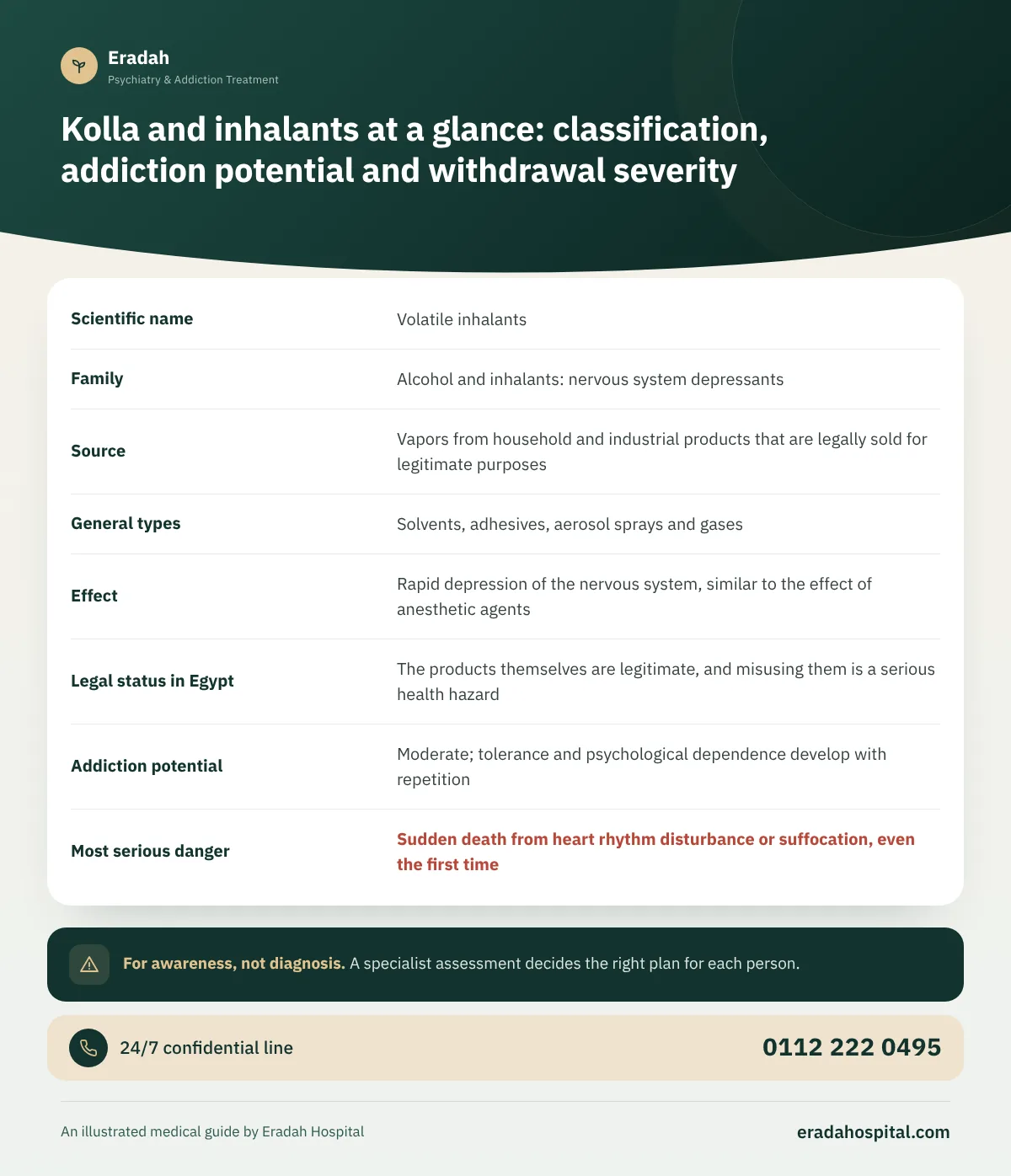
"Kolla" is the popular name in Egypt for adhesive glues, and it has come to refer to the practice of inhaling their fumes in general. Some are also known by a common brand name, "Selsion". But the problem is not limited to glues; it includes any product that contains volatile solvents or gases.
What makes inhalants different from other substances is that they are not drugs in the traditional sense: they are available in almost every home, they are cheap, and many parents do not realize they can be a danger to their children.
What types of inhalants are there?
Doctors group inhalants into broad categories according to their chemical nature. We list them here only to help families stay alert:
Liquids that easily turn into vapors, found in paint, cleaning and industrial products.
Some types of industrial and household glue that contain strong solvents, which is where the name "kolla" comes from.
Pressurized cans containing propellants and solvents.
Household, commercial and medical gases, some of which are among the most dangerous inhalants for the heart.
How do inhalants affect the brain and body?
Inhaled vapors reach the lungs and then the blood and brain within seconds, because they dissolve easily in fat and the brain is rich in fat. There they slow the activity of the nervous system in a way similar to alcohol or anesthetic agents:
- At first: dizziness, a brief high and loss of inhibition, with slurred speech and poor balance.
- After a few minutes: confusion, drowsiness and headache, and hallucinations may appear.
- With continued use: the person may lose consciousness, breathing may weaken and the heart rhythm may be disturbed.
- In the long term: solvents damage the fatty sheath that surrounds nerve fibers, affecting thinking, movement, hearing and vision.
Because the high is very short and fades within minutes, the person repeats the inhalation several times in a row, and this repetition is what raises the risk of loss of consciousness, suffocation and oxygen deprivation.
Inhalants are seen as the "poor man's drug" and as less harmful, but they are in fact among the most dangerous substances of all, because they can kill within the first minutes with no warning.
What is sudden sniffing death?
It is known medically as "sudden sniffing death syndrome". Some inhalants make the heart muscle extremely sensitive to adrenaline, so if the person experiences a sudden emotional shock while under the effect, such as a fright, running or being chased, the heart rhythm can become fatally disturbed and the heart can stop.
This can happen to a completely healthy young person the first time they try it, and it is a leading cause of inhalant-related deaths. That is why we always advise not to frighten or chase anyone suspected of being under the influence, but to deal with them calmly.
Why are inhalants common among children and teenagers?
Studies around the world indicate that inhalants are among the first substances young people may try, often at the start of adolescence, for the following reasons:
- They are available at home, at school and in workshops, and do not cost much.
- They are not seen as "drugs", so there is less fear of them.
- Peer pressure, curiosity and the wish to belong to a group.
- Escape from hunger, cold, violence or sadness, especially among children in difficult circumstances.
- Lack of supervision and long periods of free time.
In Egypt, United Nations reports have noted that inhalants top the list of substances used by street children, who often turn to them to endure hunger, pain and violence. These children are victims who need protection, care and treatment, not stigma or punishment.
Inhalants compared with alcohol and other substances
| Substance | Nature | Duration of effect | Main acute danger |
|---|---|---|---|
| Inhalants | Vapors from chemical products | Minutes | Sudden cardiac death and suffocation |
| Alcohol | A depressant drink | Hours | Alcohol poisoning and accidents |
| Sedatives | Prescription medications | Hours | Suppressed breathing, especially when mixed |
| Opioids | Painkilling and narcotic substances | Hours | Breathing stops in an overdose |
The danger rises sharply when inhalants are combined with any other depressant, such as alcohol or sedatives, because the suppression of breathing and consciousness is multiplied.
Common myths about kolla and inhalants
| The myth | The truth |
|---|---|
| "Kolla isn't a drug, so it's less dangerous" | It is among the most dangerous substances, because it can stop the heart the first time, and with repetition it damages the brain and nerves. |
| "Once won't hurt" | Sudden death and suffocation can happen any time, even the first, and in a completely healthy person. |
| "The effect wears off in minutes, so there's no harm" | The short effect drives repeated back-to-back use, which raises the risk of loss of consciousness and oxygen deprivation, and the damage to the brain accumulates. |
| "This is only a street-children problem" | Any child or teenager in any environment may try it, because the products are available in every home and school. |
| "Harsh punishment is the solution" | Punishment alone pushes a child to hide it. What really protects a child is conversation, smart supervision and treatment. |
Correcting these ideas within the family and school is one of the most important means of prevention, because many children try it simply because they do not know how great the danger is.
The legal status of inhalants in Egypt
Products containing solvents, adhesives and gases are legitimate products sold for their original purposes in homes and industry, and they are not banned in themselves. But misusing them by inhaling is a serious health hazard, and where children are concerned the response comes first from a standpoint of protection and care. A child in danger can be reported through the Child Helpline 16000, or treatment can be sought confidentially through the hotline of the Fund for Drug Control and Treatment of Addiction, 16023.
This is general educational information and not legal advice.
The kolla and inhalants guide: everything you need to know
We have gathered everything about kolla and inhalants into 3 pages, each answering one question in detail. Choose what you are looking for:
Harms of kolla and inhalants
From sudden death, suffocation and burns to damage to the brain, nerves, hearing, liver and kidneys, and children's delayed growth and falling school performance.
Symptoms of kolla and inhalant addiction
The chemical smell and the stains and rash around the nose and mouth, behavioral and school changes, and how to talk to your child without pushing them to hide it.
Treatment of kolla and inhalant addiction
Medical and neurological assessment, behavioral and family therapy, activity programs, the role of the school and social care, and relapse prevention.
How do you protect your children from inhalants?
- Keep chemical products with a strong smell in a closed place away from children, and watch for unexplained shortages.
- Talk to your children early and in simple language: these substances are toxic and can stop the heart even from a single use.
- Get to know their friends and where they spend their free time, and encourage them to take part in sports and arts activities.
- Watch for early signs such as a chemical smell, or stains or a rash around the nose and mouth.
- If you discover use, do not frighten or chase the child. Talk to them calmly and ask for a specialist assessment.
- Contact the school, since the teacher and the social worker are partners in prevention and early detection.
Danger signs with kolla and inhalants: call ambulance (123) immediately
- Loss of consciousness, or no response to calling or touch
- Difficulty breathing, or breathing that is very slow or has stopped
- Chest pain, or a fast or irregular heartbeat
- Seizures
- Vomiting with severe confusion, or pallor and blue lips
Call ambulance (123), move the person into fresh air and remove the source of the fumes, and place them on their side if they are unconscious but breathing. Do not frighten, chase or shout at them, because a sudden emotional shock can cause a fatal heart rhythm disturbance. Stay with them calmly until help arrives.
Call the ambulance 123