What is dependent personality?
“I can’t even pick what to eat without asking someone.” The sentence may sound simple, but when this feeling extends to every decision and comes with terror of being left alone, we are looking at a pattern that affects the whole of life and sometimes leads a person to accept what should not be accepted in order to keep the person they depend on.
Dependent personality is classified among personality disorders in the “anxious and fearful” cluster. It is more than a tendency to be close to people: it is an enduring pattern that appears in many situations, centered on a deep belief that the person is unable to manage on their own and always needs a stronger person to rely on. Studies estimate its prevalence at under 1% of people, but milder dependent traits are far more common.
Symptoms of dependent personality disorder
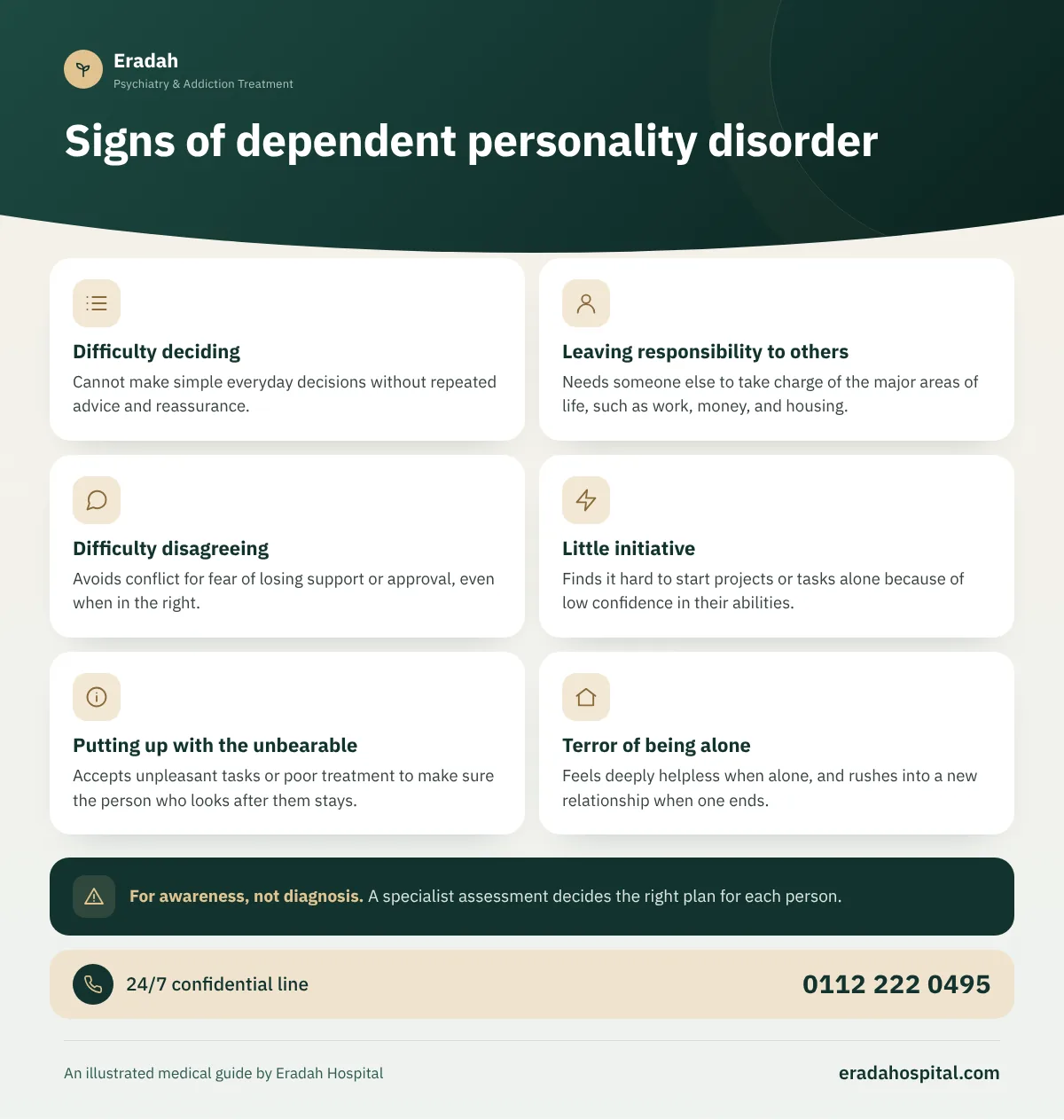
Cannot make simple everyday decisions without repeated advice and reassurance.
Needs someone else to take charge of the major areas of life, such as work, money, and housing.
Avoids conflict for fear of losing support or approval, even when in the right.
Finds it hard to start projects or tasks alone because of low confidence in their abilities.
Accepts unpleasant tasks or poor treatment to make sure the person who looks after them stays.
Feels deeply helpless when alone, and rushes into a new relationship when one ends.
How it differs from borderline and avoidant personality
| Dependent personality | Borderline personality | Avoidant personality | |
|---|---|---|---|
| Core fear | Helplessness and being alone | Abandonment | Rejection and criticism |
| Reaction | Submission, clinging, and seeking care | Anger, volatility, and impulsivity | Withdrawal and avoiding relationships |
| Relationships | Holds on to them whatever they are like | Swinging between idealization and rejection | Few, despite wanting them |
| Mood | Anxiety and fear | Sharp mood swings and a feeling of emptiness | Anxiety and extreme shyness |
You can read more about borderline personality disorder, which shares a fear of abandonment with dependent personality but differs in anger, emotional volatility, and impulsivity.
Causes of dependent personality
- Overprotective parenting: parents who make every decision and keep the child from trial and error.
- Authoritarian parenting: in which independence is punished or met with rejection.
- An anxious temperament and shyness from childhood.
- Chronic illness in childhood that made the child depend on others for a long time.
- Early experiences of loss or abandonment.
- Cultural beliefs that may encourage heavy dependence, which the doctor takes into account before diagnosing.
Harms of dependent personality
- Staying in abusive or violent relationships for fear of being alone.
- Depression and anxiety, especially after losing the supportive person.
- Stalled progress in studies and work because of little initiative.
- Being exploited by others who notice the difficulty in saying no.
- Turning to alcohol or sedatives to bear the anxiety and loneliness.
- A pathological attachment resembling love addiction.
Treatment of dependent personality disorder
Psychotherapy is the foundation, and its goal is for the person to build real confidence in their abilities step by step, not to become “completely independent” overnight. Cognitive behavioral therapy helps challenge the thought “I am helpless,” try small, graduated decisions, and learn problem-solving skills and expressing opinions and saying “no”. It is important that the therapist takes care not to become the person the patient depends on. The doctor may prescribe medication to treat accompanying depression or anxiety, while sedatives are best avoided because they carry a risk of addiction.
Steps that help from today
- Start with small decisions on your own: what to eat, what to wear, and how to spend a free hour.
- Before asking anyone, write down: what do I think? Then compare.
- Practice turning down a small request kindly and clearly.
- Widen your circle of support instead of relying on one person.
- Notice when you accept something you do not want for fear of losing someone.
- If you are in a relationship with insults or violence, ask for help; fear of being alone is not a reason to put up with harm.
A violent relationship or deep despair? Get help now
- Being exposed to violence or threats in the relationship while afraid to leave
- Severe despair after losing the person you depend on or after a relationship ends
- Talking about life being meaningless alone
- Growing reliance on alcohol or sedatives to bear loneliness
- Talking about self-harm
If there is violence or immediate danger, call ambulance (123) or ask for immediate protection; fear of being alone is not a reason to put up with harm. If thoughts of self-harm appear, do not leave the person alone, ask them calmly and listen without blame, and call the mental health support line 16328 (24 hours) or ambulance (123).
Ambulance 123 Mental health support line 16328