What Is Stockholm Syndrome?
"He beats her and humiliates her, and when anyone speaks against him, she defends him." Many people are baffled by a victim who defends the person who hurts her, and may blame her. But psychology sometimes sees in this an ancient survival mechanism, made famous as Stockholm syndrome, and understanding it helps in supporting the victim instead of blaming her.
The Cleveland Clinic describes Stockholm syndrome as a psychological response to captivity, in which a bond forms between the victim and the captor, and the victim begins to sympathize with them. The term was then widened to include other kinds of trauma in which there is a bond between abuser and victim, such as abuse in marriage, child abuse and human trafficking. Many specialists regard these feelings as a coping mechanism that helps the victim endure days, months or even years of danger.
Why Is It Called Stockholm Syndrome?
The name goes back to a bank robbery in Stockholm, Sweden, in 1973, in which the standoff with the police lasted six days. According to the Cleveland Clinic, a number of the hostage employees sympathized with the robbers, and some refused after their release to testify against them, and even raised money for their defense. A specialist in criminology and psychiatry who took part in the investigation of the incident coined the term to describe what happened.
Signs of Stockholm Syndrome
- Positive feelings toward the captor or abuser, defending them and justifying their actions.
- Sympathy with their thoughts and behavior and adopting their point of view.
- Negative feelings toward the police, family or any party trying to help.
- Symptoms resembling post-traumatic stress disorder (PTSD): intrusive memories, tension and irritability, inability to relax or enjoy things, and difficulty concentrating.
How Does Stockholm Syndrome Form?
- The startReal danger
The victim feels that their life or safety is in the hands of one person.
- IsolationNo escape
They are cut off from sources of support and information, and the abuser becomes their whole world.
- Small kindnessGratitude
Any moment of mercy or absence of harm is received with great gratitude.
- AppeasementPlacating
The mind learns that cooperation and sympathy are safer than resistance.
- AttachmentA strong bond
Appeasement turns into an emotional attachment that may continue after the danger ends.
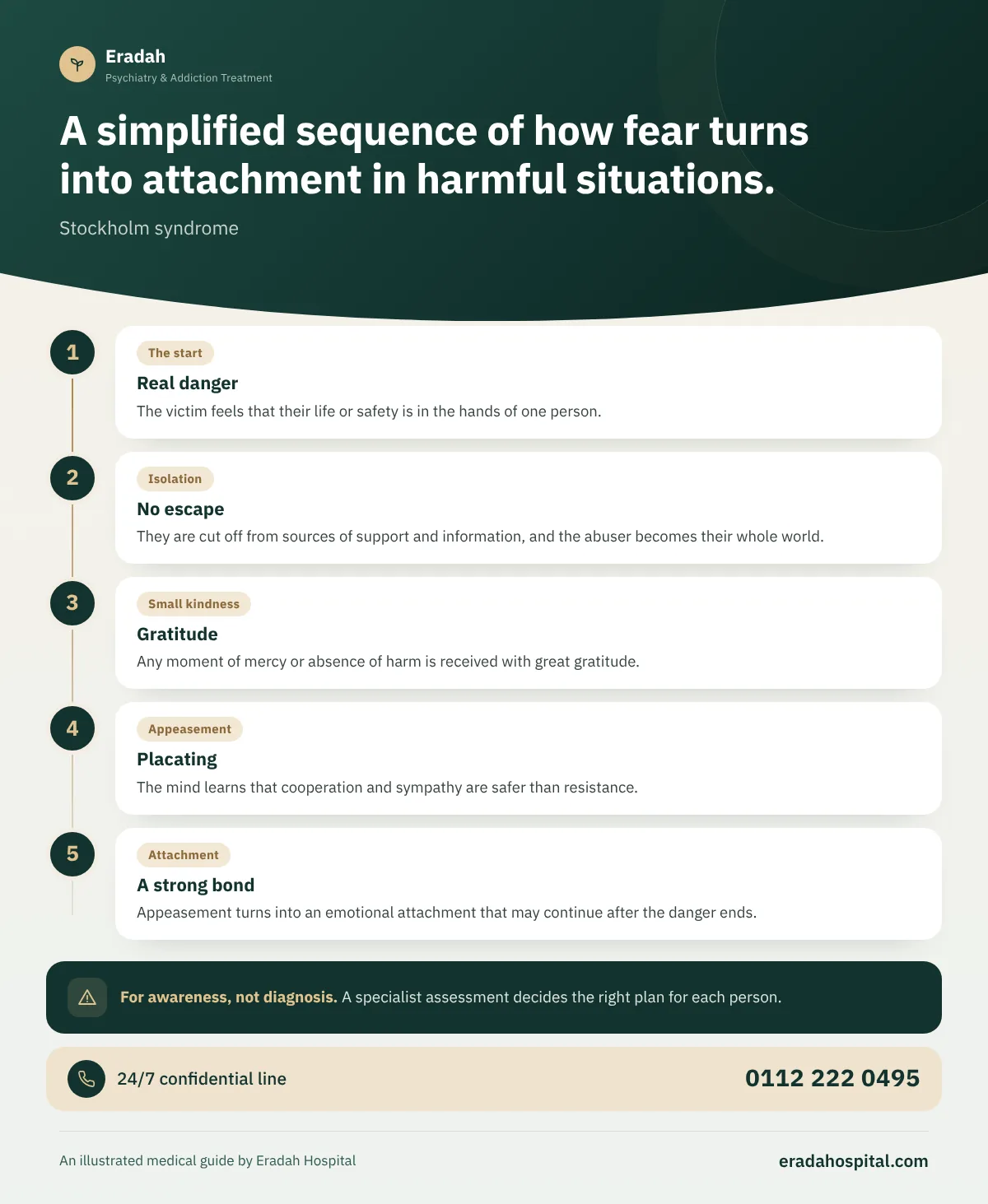
The physicians Cantor and Price offer an evolutionary explanation for this sequence in a paper published in 2007, arguing that appeasement is the closest defense against traumatic captivity, and pointing to similar behaviors in other mammals and to the fact that the phenomenon recurs among victims of severe abuse. The Cleveland Clinic also mentions another explanation: that a victim who is treated with some kindness, or is not harmed, may feel gratitude and see the abuser as human, and that cooperating with them may ensure their safety.
Is Stockholm Syndrome Scientifically Real?
The term is famous in the media but limited scientifically. In a systematic review published in 2008 in the journal Acta Psychiatrica Scandinavica, the researchers found only 12 papers that met their criteria, most of them case reports, and noted vagueness in how the term is used and no accepted diagnostic criteria. The Cleveland Clinic stresses that the American Psychiatric Association does not include it in its diagnostic manual, that it is a rare reaction, and that most people who are held captive or abused do not show it.
How Do You Help Someone with Stockholm Syndrome?
- Don't blame them or mock their defense of the abuser; blame pushes them closer to the abuser.
- Listen more than you talk, and be a steady source of safety.
- Focus on their safety and on actions, not on the abuser as a person.
- Help them reach a specialist or a protection agency when they are ready.
- If there is immediate danger, safety comes first: police emergency line 122 or ambulance 123.
Treatment of Stockholm Syndrome and Recovery
Because it is not an official diagnosis there is no standard treatment, but according to the Cleveland Clinic its treatment resembles that of post-traumatic stress disorder (PTSD): psychotherapy that helps the person understand the experience, recognize that sympathy for the abuser was a survival skill, and learn healthy ways to cope with the trauma. The doctor may prescribe medication for sleep, anxiety or depression when needed, and determines the type and dose. You can request a confidential assessment at Eradah Psychiatric Hospital, and if there are any thoughts of self-harm, call the mental health support line on 16328.
Danger from an abuser or thoughts of self-harm? Get help now
- Threats or physical violence from the abuser, or preventing the victim from leaving or making contact
- Fear for the safety of children in the same home
- The victim talking about death or self-harm or saying there is no way out
- Intrusive memories, severe panic and continuous insomnia after leaving the harmful situation
Safety before any discussion: don't confront the abuser alone, and help the victim reach a safe place among people they trust, without blame or pressuring them to make a decision immediately. Call the police emergency line on 122 if there are threats or violence, and an ambulance on 123 if there is an injury. If thoughts of self-harm appear, stay with them and call the mental health support line on 16328 around the clock.
Ambulance 123 Mental health support line 16328