Is love a real addiction?
"I know she's hurting me, and every time I say that's it... and I go back." This sentence is repeated in psychiatric clinics by men and women alike. It does not mean weak willpower, but an attachment that has formed in the brain in a way that resembles addiction, and it needs understanding before judgment.
There are no recognized definitions or diagnostic criteria for "love addiction," as a review published in the American Journal of Drug and Alcohol Abuse in 2010 explains, but it noted clear similarities between it and behavioral addiction and substance addiction. Researchers in philosophy and medical ethics suggest viewing it from two angles: a narrow view that counts only the most harmful forms of love as addiction, and a broad view that places every emotional attachment on one spectrum with addiction because it rests on similar chemistry.
The practical conclusion these researchers reach is important: the decision to seek treatment does not depend on the label, but on the extent of the harm and its effect on your life and health.
What is the difference between intense love and pathological attachment?
| Healthy love | Love addiction | |
|---|---|---|
| Main feeling | Security and comfort despite disagreements | Constant anxiety and fear of loss |
| Life outside the relationship | Friends, work and hobbies continue | Everything revolves around the person |
| Reaction to being hurt | Setting boundaries or ending the relationship | Accepting the harm to keep the relationship |
| When apart | Possible longing | Compulsive pain and relentless yearning |
| Self-worth | Independent of the other person's approval | Entirely tied to their presence and approval |
What happens in the brain in love and rejection?
In a functional MRI study published in 2005 of 17 people in the early stage of intense love, seeing a picture of the loved one activated dopamine-rich areas linked to reward and motivation. The same team then studied, in 2010, fifteen people who had recently been rejected and were still attached, and found activity in the same reward areas, along with areas linked to gains and losses, to craving in cocaine addiction, and to emotion regulation, which may explain obsessive behavior after rejection.
In a third study in 2011, people who had gone through an unwanted breakup showed activity in areas that process physical pain when they looked at a picture of their ex-partner. So the phrase "parting hurts" is not only a figure of speech. Dopamine plays a role in craving, while oxytocin is linked to bonding and attachment.
How is love addiction similar to substance addiction?
| In substance addiction | In love addiction |
|---|---|
| Euphoria when using | Euphoria and an overwhelming wish for the loved one's presence or reminders of them |
| Withdrawal symptoms | Sadness, loss of pleasure and disturbed sleep when apart |
| Mental preoccupation with craving | Persistent intrusive thoughts about the person |
| Continuing despite harm | Staying in the relationship despite recognizing its consequences |
What are the signs of love addiction and pathological attachment?
- Constant thoughts of the person that disrupt work, study and sleep.
- Feeling that your worth is entirely tied to their presence or approval.
- Accepting insults, betrayal or neglect to keep the relationship.
- Intense anxiety at any distance or delay in replying.
- Leaving friends, family and hobbies for the sake of the relationship.
- Moving quickly from one relationship to another out of fear of loneliness.
- Repeatedly returning to a harmful relationship despite deciding to stay away.
- Monitoring the other person's accounts and tracking them after the breakup.
How does the toxic relationship cycle work?
In many cases of pathological attachment the relationship itself is unstable, and that instability is what strengthens the attachment, just as irregular rewards make gambling more addictive than steady rewards:
- 1Closeness and attention
An ideal beginning and intense attention that makes you feel special.
- 2Tension
Coldness, criticism or sudden absence without explanation.
- 3Blow-up or harm
An argument, insult or threat to end the relationship.
- 4Reconciliation
An apology and the return of attention, and a relief that feels like euphoria.
- 5Stronger attachment
You hold on to the hope of the "beginning" returning, and the cycle repeats.
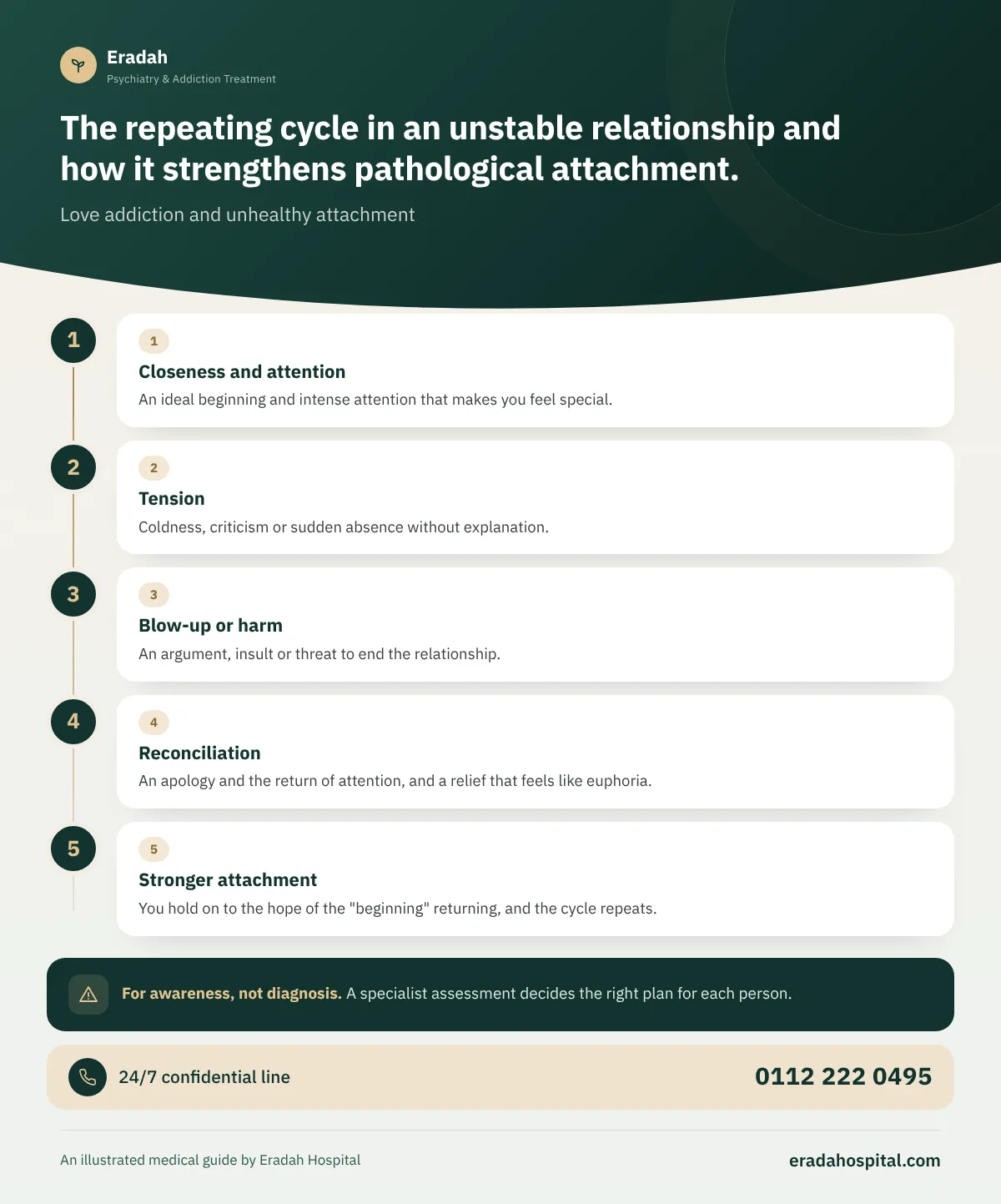
The bond that results from this cycle is sometimes called "trauma bonding," and it is close to what is explained under Stockholm syndrome. This pattern recurs in relationships with a narcissistic person, a person with an addiction, or a relationship involving violence.
Why does pathological attachment happen?
A systematic review published in 2026 in the journal Archives of Sexual Behavior pooled the results of 102 studies on "problematic romantic behaviors" and found that love addiction in particular is linked to an anxious attachment style and to other behavioral addictions, and that low self-esteem appears in closely related forms such as emotional dependence and obsessive love. Other factors therapists also observe include:
- Experiences of loss or unstable love in childhood that heighten the fear of abandonment.
- Co-occurring disorders such as borderline personality disorder, depression and anxiety.
- Loneliness and the lack of a support network of friends and family, as we explain in the guide to loneliness and isolation.
Is love addiction common?
There are no reliable figures for how common it is. The 2010 review pointed to a lack of data on its epidemiology and treatment, and the 2026 review described wide variation in the concepts researchers use. Any figure you read about the "percentage of love addicts" depends on a particular definition and scale, so do not base a judgment of yourself on it; what matters is the extent of the harm in your life.
Can love addiction be treated?
Yes. Treatment is built on breaking the cycle of returning, bearing the pain of separation in safe ways, understanding the roots of the attachment in individual or group psychotherapy, and treating any accompanying depression or anxiety. We explain the practical steps and what research says in treatment of love addiction.
When do you need urgent help?
Love addiction guide: everything you need to know
We have gathered everything about love addiction in 1 page, each answering one question in detail. Choose what you are looking for:
Violence or thoughts of self-harm after a relationship? Get help now
- Talk of death or a wish to self-harm after a breakup or rejection
- A relationship involving beating, threats, confinement or frightening stalking
- Being unable to eat or sleep for days with severe sadness that does not ease
- Turning to alcohol, sedatives or drugs to bear the pain of the breakup
- Threatening the other person, stalking them or thinking of harming them
Your safety comes first: if you are in a violent relationship, move to a safe place and ask for help from someone you trust. If you notice these signs in someone close to you, stay with them, ask calmly how they feel, and listen without blame or lecturing. If there is a danger to their life or anyone else's, call an ambulance (123) or go to the nearest emergency room, or call the mental health support line 16328 (24 hours), and do not leave them alone if they talk about harming themselves.
Ambulance 123 Mental health support line 16328