What is avoidant personality?
“I wish I had friends, but I'm afraid to talk in case someone says something about me.” This sentence sums up the dilemma of avoidant personality: a real desire for closeness, met by an inner certainty that others will reject or mock them, so they choose to withdraw before they get hurt. Over the years this choice becomes a pattern that narrows work, relationships, and life as a whole.
Avoidant personality disorder is one of the personality disorders that belong to the “anxious and fearful” cluster. It is deeper than passing shyness: it is a fixed pattern that begins in early adulthood and appears in many situations, rooted in a feeling of inadequacy and excessive sensitivity to any negative evaluation. According to the MSD Manual for professionals, its prevalence is estimated at about 2.1% in the United States, slightly more common in women by a small margin, and social avoidance has been observed in some children from around age 2.
Symptoms of avoidant personality
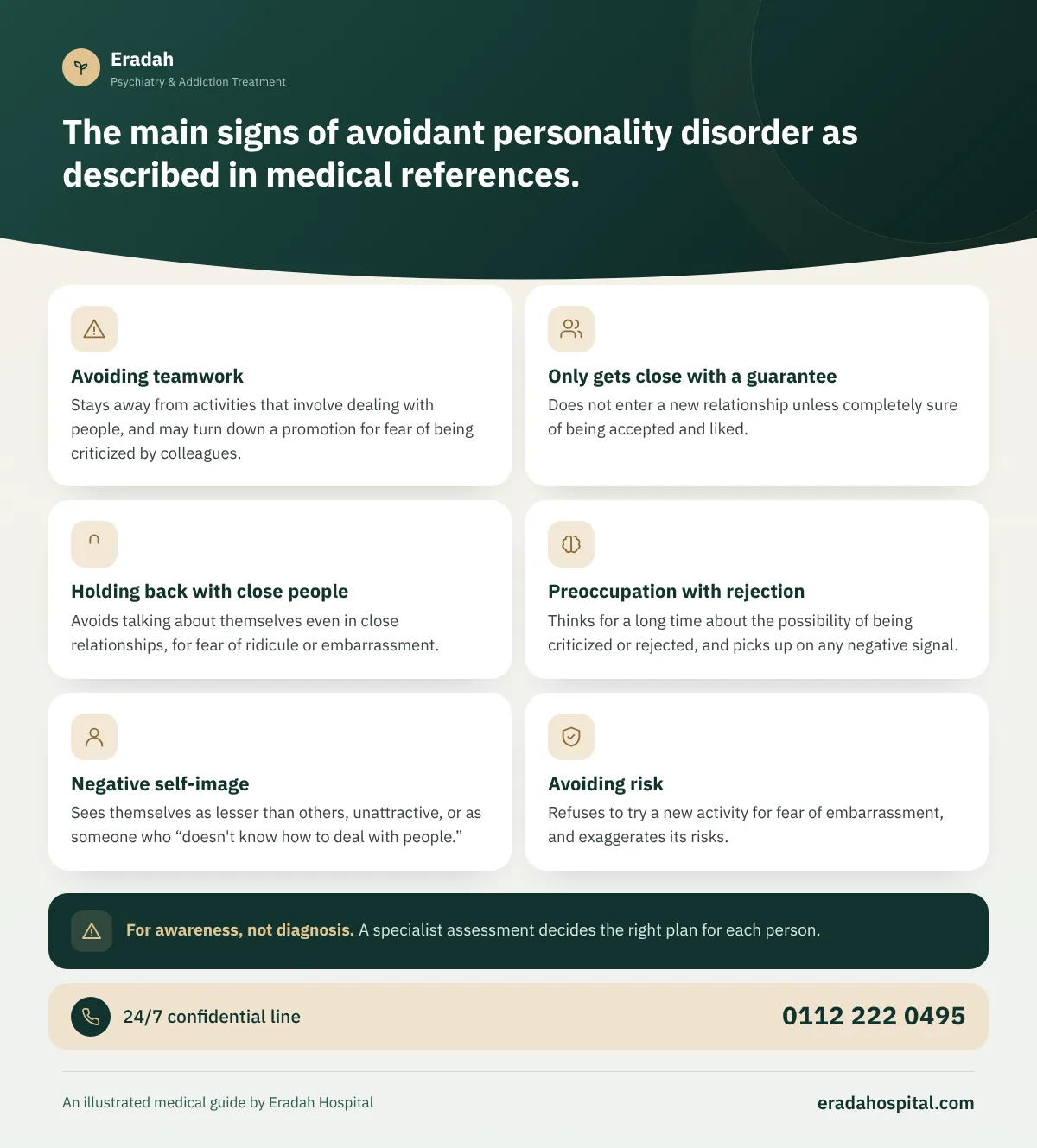
The American diagnostic manual lists seven signs, and at least four of them must be present for the disorder to be diagnosed:
Stays away from activities that involve dealing with people, and may turn down a promotion for fear of being criticized by colleagues.
Does not enter a new relationship unless completely sure of being accepted and liked.
Avoids talking about themselves even in close relationships, for fear of ridicule or embarrassment.
Thinks for a long time about the possibility of being criticized or rejected, and picks up on any negative signal.
Sees themselves as lesser than others, unattractive, or as someone who “doesn't know how to deal with people.”
Refuses to try a new activity for fear of embarrassment, and exaggerates its risks.
Why does avoidant personality develop?
- Experiences of rejection and marginalization in childhood: repeated ridicule, bullying, or harsh criticism from the family.
- An anxious, withdrawn temperament a child is born with, which makes them more wary of new situations.
- Emotional neglect, which leads a child to conclude that they are unwanted.
- A closed circle: visible tension can actually draw mocking comments, so the fear appears “confirmed.”
How does avoidant personality affect life?
- Isolation and no support network in times of crisis, which the MSD Manual describes as a direct effect of reduced contact with people.
- A stalled career and turning down suitable opportunities.
- Depression and anxiety, two of the most common co-occurring disorders.
- Loneliness despite the wish for company.
- Sometimes turning to alcohol or sedatives to ease social anxiety, which is where the risk of dual diagnosis begins.
Treatment of avoidant personality disorder
The MSD Manual lists several approaches shown to help, chiefly cognitive behavioral therapy, which focuses on gaining social skills and is most useful in groups of people with the same difficulties, which is what outpatient psychotherapy provides. Supportive therapy and psychodynamic therapy help in understanding the roots of the fear and the sense of inadequacy. The doctor may prescribe antidepressants or anti-anxiety medication when co-occurring anxiety or depression is severe, and the doctor decides the type and dose, with caution about sedatives, which can cause dependence. Never start or stop any medication without a doctor.
Small steps that break the cycle of avoidance
- Write a list of the situations you avoid, and rank them from easiest to hardest.
- Start with the easiest situation and repeat it until the anxiety lessens, then move on to the next.
- Notice thoughts like “they're going to make fun of me” and ask: what is the evidence? And what is the worst that could actually happen?
- Cut down on comparing yourself with others on social media.
- Choose one safe person with whom to share something small about yourself.
When should you seek specialist help?
If fear of rejection keeps you from studying, working, or forming any relationship, or if it comes with persistent sadness or reliance on a substance to calm anxiety, a psychological assessment is an important step. It can start with a session at Eradah Psychiatric Hospital, where the first consultation is free and confidential. If you have thoughts of harming yourself, call the mental health support line 16328 or the ambulance on 123.
Suicidal thoughts or danger to self? Get help now
- Talk of being a burden or that life is meaningless because of loneliness
- Complete withdrawal from people and from study or work
- Severe despair after a rejection, an embarrassment, or the end of a relationship
- Increasing reliance on alcohol or sedatives to bear anxiety
- Talk of self-harm or saying goodbye to loved ones
Do not leave the person alone. Ask them calmly and frankly what they are thinking, and listen without blame or mockery; asking does not plant the idea, it opens the door to help. Call an ambulance (123) or take them to the nearest emergency room, or call the mental health support line 16328 (24 hours), and keep medications and other things they could harm themselves with out of their reach.
Ambulance 123 Mental health support line 16328