What is histrionic personality?
"The whole conversation has to be about him, and if it goes to someone else he gets upset or makes a scene." Many people might describe someone this way, but when attention-seeking becomes a need that never settles, when emotions shift rapidly with it, and when this affects work and relationships, we may be looking at what doctors call histrionic personality disorder.
Histrionic personality is one of the personality disorders in the "dramatic and emotional" cluster, along with borderline, narcissistic and antisocial. The MSD Manual describes it as a long-standing pattern of excessive emotionality and attention-seeking that begins in early adulthood. It estimates prevalence at less than 2%, with similar rates in both sexes, and suggests that the belief that it is more common in women may have come from studies done inside hospitals. The Cleveland Clinic estimates it at about 1% of people.
Traits of histrionic personality
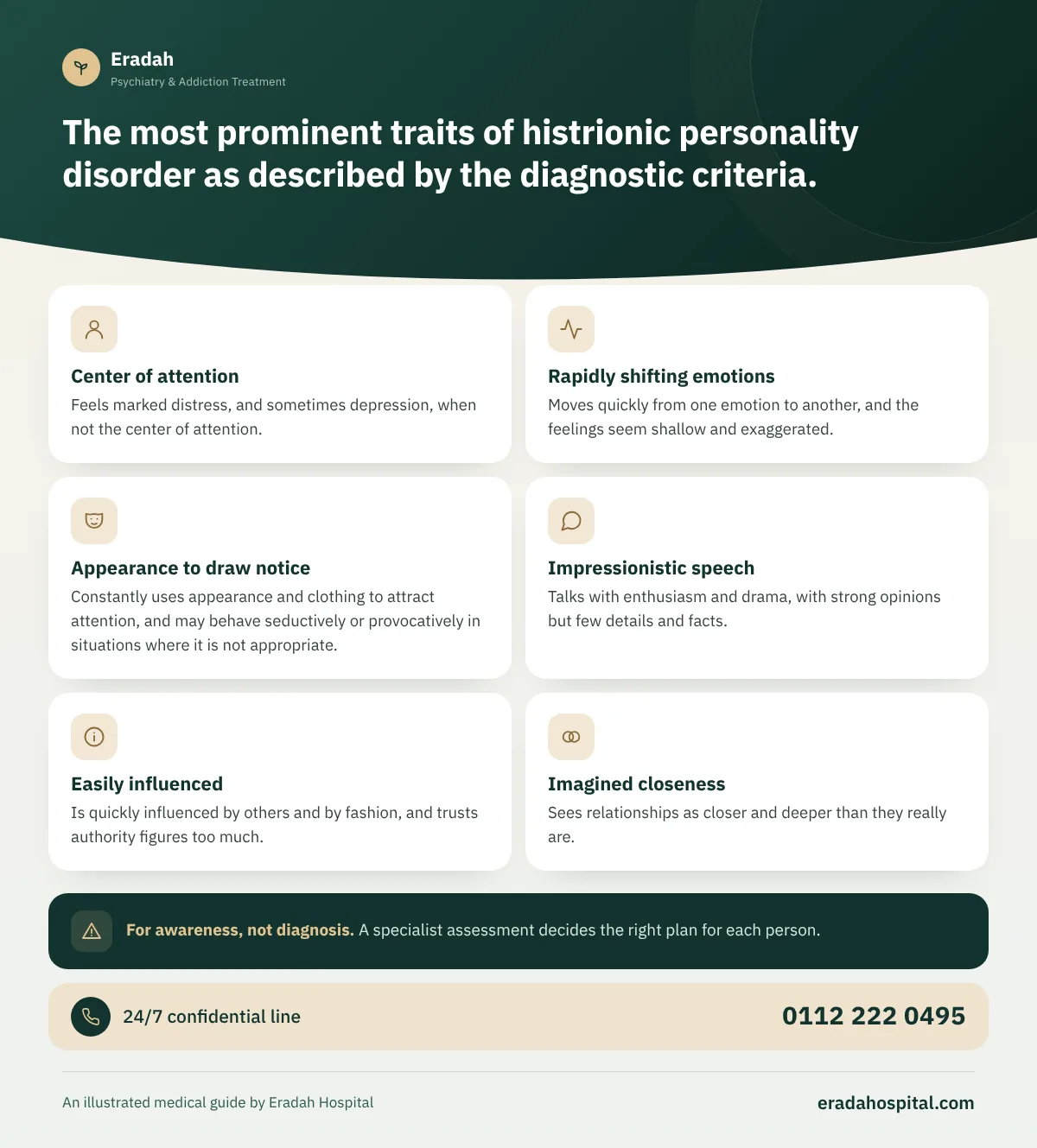
The American diagnostic manual requires at least five of eight signs, the most prominent being:
Feels marked distress, and sometimes depression, when not the center of attention.
Moves quickly from one emotion to another, and the feelings seem shallow and exaggerated.
Constantly uses appearance and clothing to attract attention, and may behave seductively or provocatively in situations where it is not appropriate.
Talks with enthusiasm and drama, with strong opinions but few details and facts.
Is quickly influenced by others and by fashion, and trusts authority figures too much.
Sees relationships as closer and deeper than they really are.
The MSD Manual adds that a person with this personality gets bored quickly and looks for novelty, so they change jobs and friends often, are impatient with delayed gratification, and may slip into a role such as the victim without noticing.
The difference between histrionic, narcissistic and borderline personality
| Histrionic personality | Narcissistic personality | Borderline personality | |
|---|---|---|---|
| What they seek | Any attention, even if it seems silly | Admiration and a sense of superiority | Security from abandonment |
| Self-image | Does not see themselves as bad | Inflated on the surface | Sees themselves as bad and empty |
| Feelings | Quick and shallow | Cold toward other people's needs | Deep, sharp and painful |
| Their style | Drama, charm and seduction | Arrogance and exploitation | Anger, impulsivity and sometimes self-harm |
This comparison is based on how the MSD Manual distinguishes between the disorders. You can read more about narcissistic personality and borderline personality.
How does histrionic personality affect the person who has it?
- Difficulty keeping stable, intimate romantic relationships.
- Instability at work and in friendships because of boredom and the search for novelty.
- Depression when attention is absent or a relationship ends, which is one of the common co-occurring disorders according to the MSD Manual.
- Vulnerability to exploitation because of being easily influenced and overly trusting.
- It may come with recurring physical symptoms that lead to doctor visits.
How do you deal with a histrionic personality?
- Give attention to calm behavior and clear speech, not to dramatic scenes.
- Set firm boundaries without ridicule or belittling.
- Calmly ask for details when the talk is general and exaggerated.
- Do not take the rapid mood swings personally.
- Encourage them to get treatment when their work suffers or emotional crises keep recurring.
Treatment of histrionic personality disorder
The MSD Manual states that information on the effectiveness of cognitive behavioral therapy and medication for this disorder is scarce, and that psychodynamic psychotherapy, which focuses on inner conflicts, can be tried. The therapist begins by encouraging the patient to express themselves in words instead of actions, so they relate to people in a less dramatic way, and then helps them see that this behavior is an unhelpful way of attracting attention and protecting self-esteem. Medication is prescribed by the doctor to treat co-occurring depression or anxiety if present, and no one should start or stop any medication without a doctor.
When should you ask for help?
If emotional crises keep recurring, if depression appears when attention is absent, or if reliance on alcohol or sedatives begins, a psychological assessment is important. Eradah's outpatient psychotherapy offers individual sessions, and dual diagnosis treatment when a personality disorder occurs together with substance use. If there is a threat of self-harm, do not dismiss it as acting; call the mental health support line 16328 or the ambulance (123).
A threat of self-harm? Take it seriously now
- Threatening self-harm after an argument or the end of a relationship
- Severe depression when attention is absent or a relationship ends
- Talking about death or that no one would miss them
- Drinking alcohol or taking large amounts of sedatives after an emotional crisis
Do not dismiss the threat as acting or a bid for attention, and do not leave the person alone. Ask calmly and listen without ridicule or blame. Call the ambulance on 123 or take them to the nearest emergency room, or call the mental health support line 16328 (24 hours), and keep medications and things they could use to harm themselves out of their reach.
Ambulance 123 Mental health support line 16328