What is narcissistic personality disorder?
Narcissistic personality disorder is one of the personality disorders, meaning stable patterns of thinking, feeling and dealing with people that begin in adolescence or early adulthood and continue across different situations, causing distress to the person or to those around them.
The core of this disorder is unstable self-esteem: from the outside the person seems confident, superior and always in need of admiration, but inside they depend on how others see them to feel their worth, so they are deeply hurt by any criticism or being ignored, and sometimes respond with anger, contempt or withdrawal.
Medical manuals such as the DSM-5 describe it as a pervasive pattern of grandiosity in fantasy or behavior, a need for admiration and a lack of empathy, and the doctor requires that a number of these features be present together and continue for years, not appear in a passing situation or a difficult period.
Does everyone we call “narcissistic” have narcissistic personality disorder?
The word “narcissist” has spread across social media until it is applied to any selfish partner, harsh boss or hurtful relative. This spread has helped some people name painful experiences, but it has mixed up three different things:
| Level | What it means | Is it a diagnosis? |
|---|---|---|
| The popular label “narcissist” | A general word for selfish or hurtful behavior in a relationship or situation | No, and it may be unfair or inaccurate |
| Narcissistic traits | A tendency to boast or seek attention that exists to varying degrees in many people without major harm | No, they are personality traits that vary naturally |
| Narcissistic personality disorder | A stable, pervasive pattern that causes distress or clear impairment in work and relationships | Yes, made by a doctor or psychologist after assessment |
That is why we do not encourage “diagnosing” a partner, father or boss from an online checklist. The suffering may be entirely real, and the behavior may truly be harmful, but a medical label needs a specialist who sees the whole picture, and what matters to you in practice is the behavior and its effect on you, which we cover on the page how to deal with a narcissistic person.
What is the difference between self-confidence and narcissism?
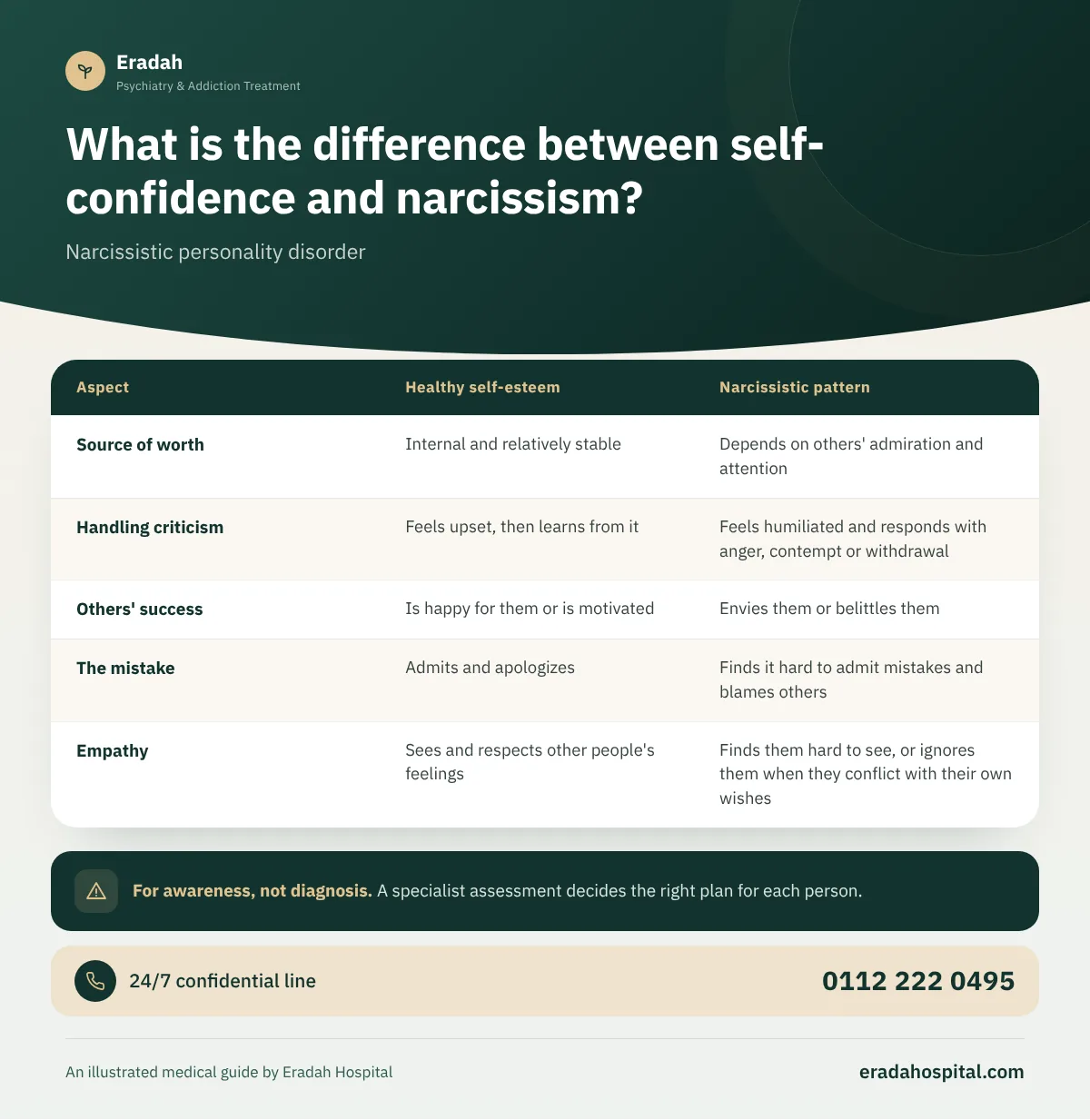
Healthy self-confidence does not need to put others down, while pathological narcissism rests on a constant need for admiration and comparison. The table shows the main differences:
| Aspect | Healthy self-esteem | Narcissistic pattern |
|---|---|---|
| Source of worth | Internal and relatively stable | Depends on others' admiration and attention |
| Handling criticism | Feels upset, then learns from it | Feels humiliated and responds with anger, contempt or withdrawal |
| Others' success | Is happy for them or is motivated | Envies them or belittles them |
| The mistake | Admits and apologizes | Finds it hard to admit mistakes and blames others |
| Empathy | Sees and respects other people's feelings | Finds them hard to see, or ignores them when they conflict with their own wishes |
What is the difference between grandiose and vulnerable narcissism?
Researchers describe two presentations of the same disorder, and a person may move between them depending on circumstances. The grandiose presentation is the better known: visible confidence, frequent talk of achievements, dominating conversation, and a boldness that can reach aggression. The vulnerable presentation is less obvious: a person who seems shy, anxious or depressed but is very sensitive to any neglect, who feels inside that they deserve special treatment, and who fills with bitterness and envy when they do not get it.
There is no separate page for the types because the official classifications do not formally divide the disorder, and these two descriptions are a tool for understanding the picture, not two separate diagnoses. What matters is that the vulnerable presentation is often missed because it does not look like the stereotype of a narcissist.
How common is narcissistic personality disorder?
The figures vary widely between studies because of different ways of measuring; while reviews point to an average of about 1.6%, estimates in community samples range from under 1% to about 6%. It is seen more in men, and more in psychiatric clinics than in the general population. There are no accurate published Egyptian statistics on it.
Its features usually begin in adolescence, but doctors avoid diagnosing teenagers with it because a degree of self-focus is a normal part of development at this stage, and much of it fades with maturity.
How does a person with it feel inside?
Many are surprised to learn that a person with this disorder rarely feels the satisfaction they show. The inner picture is often full of emptiness and boredom, a fear of being “ordinary,” unacknowledged shame, and an exhausting need to keep proving oneself.
The grandiosity that people see from the outside is like a heavy shield: it protects against the pain of feeling inadequate, but it also keeps the person from real closeness.
This is why most people with it come to a psychiatrist not because of narcissism itself, but because of depression, anxiety, a marriage or work crisis, or a problem with alcohol or drugs, and the personality pattern emerges during assessment.
How does it differ from borderline, antisocial personality and bipolar disorder?
| The situation | Point of similarity | The key difference |
|---|---|---|
| Borderline personality | Sensitivity to criticism and troubled relationships | Borderline is dominated by fear of abandonment, shifting emotions and self-harm, while narcissism is dominated by a demand for admiration and grandiosity |
| Antisocial personality | Exploiting others and poor empathy | Antisocial personality is marked by breaking laws, impulsivity and repeated aggression since childhood, while narcissism revolves around self-image and admiration |
| A manic episode in bipolar disorder | A sense of grandiosity and excessive confidence | Grandiosity in mania is a temporary episode with little sleep and racing thoughts, while in narcissism it is a stable pattern |
| The effect of stimulants | Exaggerated confidence and arrogance | Appears during use and disappears afterward, which is why the doctor always asks about substances |
Myths and facts about the narcissistic person
The truth: much hurtful behavior is a defense of a fragile self-image. This does not remove responsibility for their actions, but it changes how they are understood and handled.
The truth: change is slow and hard, but studies and clinical experience show real improvement for those who stay with psychotherapy, and some features fade with age.
The truth: popular tests measure general traits, and diagnosis requires a lengthy interview, a full history and ruling out other conditions.
Depression, anxiety and substance misuse are common among people with it, and they may go through acute psychological crises after losses or humiliations.
When do you need to consult a psychiatrist?
If you notice in yourself that your relationships collapse the same way again and again, that criticism sets off anger you cannot control, or that you feel a constant emptiness despite your successes, then seeking a consultation is a brave step, not an admission of weakness. The same applies if depression, reliance on alcohol or drugs, or thoughts of death appear.
And if you are a partner or relative who has been affected, seeing a therapist for yourself is worthwhile regardless of the other person's diagnosis; it helps you understand what is happening and protect yourself and your children.
Does a narcissistic person improve over time?
Personality disorders are no longer considered fixed forever, as was once thought. Regular psychotherapy helps many people tolerate criticism better, see other people's feelings, and build more stable relationships. The basic condition is that the person feels they have a stake in changing, and finds a therapist who understands this pattern and does not enter into a struggle with them.
What is the family's role?
- Understand that what you see is a repeated pattern with roots, without accepting insults or harm on the grounds of illness.
- Set clear, calm and consistent boundaries; they work better than confrontation or surrender.
- Encourage them to seek help during crises, which are the moments when they are most open to treatment.
- Protect children from being used as a tool in conflicts, and give them a warm, steady relationship.
- Look after your own mental health and seek specialist support for yourselves.
Guide to Narcissistic Personality Disorder: Everything You Need to Know
We have gathered everything about narcissistic personality disorder into 6 pages, each answering one question in detail. Choose what you are looking for:
Symptoms of Narcissistic Personality Disorder
The nine features a doctor looks for, the difference between the grandiose and vulnerable presentations in daily life, and how it shows up at home and at work.
Causes of narcissistic personality disorder
A mix of genetics, temperament and upbringing: excessive pampering, neglect or harsh criticism, and why parenting alone does not explain it.
Harms of Narcissistic Personality Disorder
What the untreated disorder does to relationships, family, children and work, along with depression, substance misuse and the risk of acute crises.
Treatment of Narcissistic Personality Disorder
Long-term psychotherapy is the foundation, medication is limited to accompanying conditions, and how to improve the chances of staying in treatment.
How to deal with a narcissistic person
Healthy boundaries, calm communication, protecting children, and when distancing yourself and seeking help is the right decision.
The Narcissistic Husband: How to Recognize Him and Protect Yourself and Your Children
The narcissistic husband: his real traits beyond exaggeration, how he differs from ordinary marital conflict, manipulation and making you doubt your perception, when it becomes violence, and practical steps to protect yourself and your children.
Suicidal thoughts or danger to yourself or others? Get help now
- Talk of wanting to die or that life is no longer worth it after a loss, failure or scandal
- Severe despair and a relentless sense of humiliation and shame, with sudden withdrawal from people
- Saying goodbye to loved ones, giving away important belongings, or writing farewell notes
- Overwhelming anger with an explicit threat to harm themselves, a partner or children
- Sudden heavy use of alcohol or drugs after a personal or professional crisis
Do not leave the person alone, listen calmly without arguing or blame, and generally keep dangerous items out of their reach. Call the ambulance on 123 or go to the nearest emergency room, or call the mental health support line on 16328, available around the clock. If the danger is directed at you or your children, first move to a safe place and then ask for help.
Ambulance 123 Mental health support line 16328