What is hysteria in psychology?
A young woman loses the ability to move her leg after shocking news, and all her scans are normal. A young man has repeated convulsive seizures and his brain tracing is normal. These people often hear a hurtful sentence: “There's nothing wrong with you, you're just being spoiled.” The truth is that what they are going through is a medically recognized disorder, with a name, an explanation and a treatment, and it used to be called hysteria.
The word hysteria was used for centuries to describe physical symptoms with no clear organic cause, and it was unfairly linked to women, then modern medical classifications abandoned it because of the stigma it carries. Today the American manual DSM-5 calls it functional neurological symptom disorder (conversion disorder), and the World Health Organization classifies it in ICD-11 as dissociative neurological symptom disorder under code 6B60.
The word “functional” is the key to understanding: the brain and nerves are intact in structure, but the way they work is disrupted, like a program crashing on a healthy computer. The MSD Manual stresses that these symptoms arise without the patient's awareness or intention.
How does conversion hysteria show up?
It most often appears as weakness or paralysis in a limb, difficulty walking, tremor and unusual movements, seizures that resemble epilepsy or fainting, temporary loss of voice, sensation or sight, or a feeling of a lump in the throat. It often starts suddenly. We explain each type and how to tell it apart from neurological diseases in symptoms of hysteria.
Is conversion disorder common?
These figures dismantle two false images: that it is rare, and that it is “mild.” A patient may lose their job or studies because of it, and go through years of moving between doctors before hearing the name of their condition. No accurate Egyptian figures are available, but the stigma of the word “hysteria” greatly delays seeking help.
What happens in the nervous system?
A review published in JAMA Neurology in 2018 explains the modern model: the brain does not receive the body's signals as they are, but constantly “predicts” and corrects them. In a person with the disorder, strong expectations about a symptom form, together with excessive attention to the body, and the brain begins to produce the symptom itself. Studies show reduced activity in the supplementary motor area of the brain and weaker connections between it and the regions responsible for choosing movement and for the sense that a movement is “mine.”
This is why a symptom sometimes improves when the patient is occupied with something else and worsens when they focus on it. The doctor uses this in diagnosis, and the therapist later uses it in retraining.
Why does conversion disorder happen?
There is no single cause. The onset or persistence of symptoms is often linked to psychological factors such as stress and trauma, according to the MSD Manual, but the current American manual removed the requirement for a psychological stressor in order to diagnose, because many patients cannot find a clear event. Factors listed by the JAMA Neurology review include:
- A physical injury or passing illness: such as a sprain or an infection, after which the nervous system settles into a lasting pattern of symptoms.
- Stress and trauma: past or recent, including childhood trauma in some patients.
- Frightening physical episodes: such as dizziness, fainting or a panic attack that left a strong impression on the mind.
- Expectations and excessive attention: constant focus on the body and fear of illness.
- Anxiety and depression: they often accompany the disorder and make its symptoms worse.
In some patients it is linked to post-traumatic stress disorder and dissociative symptoms, which is why the assessment asks about trauma history sensitively and without pressure.
Is a person with hysteria faking?
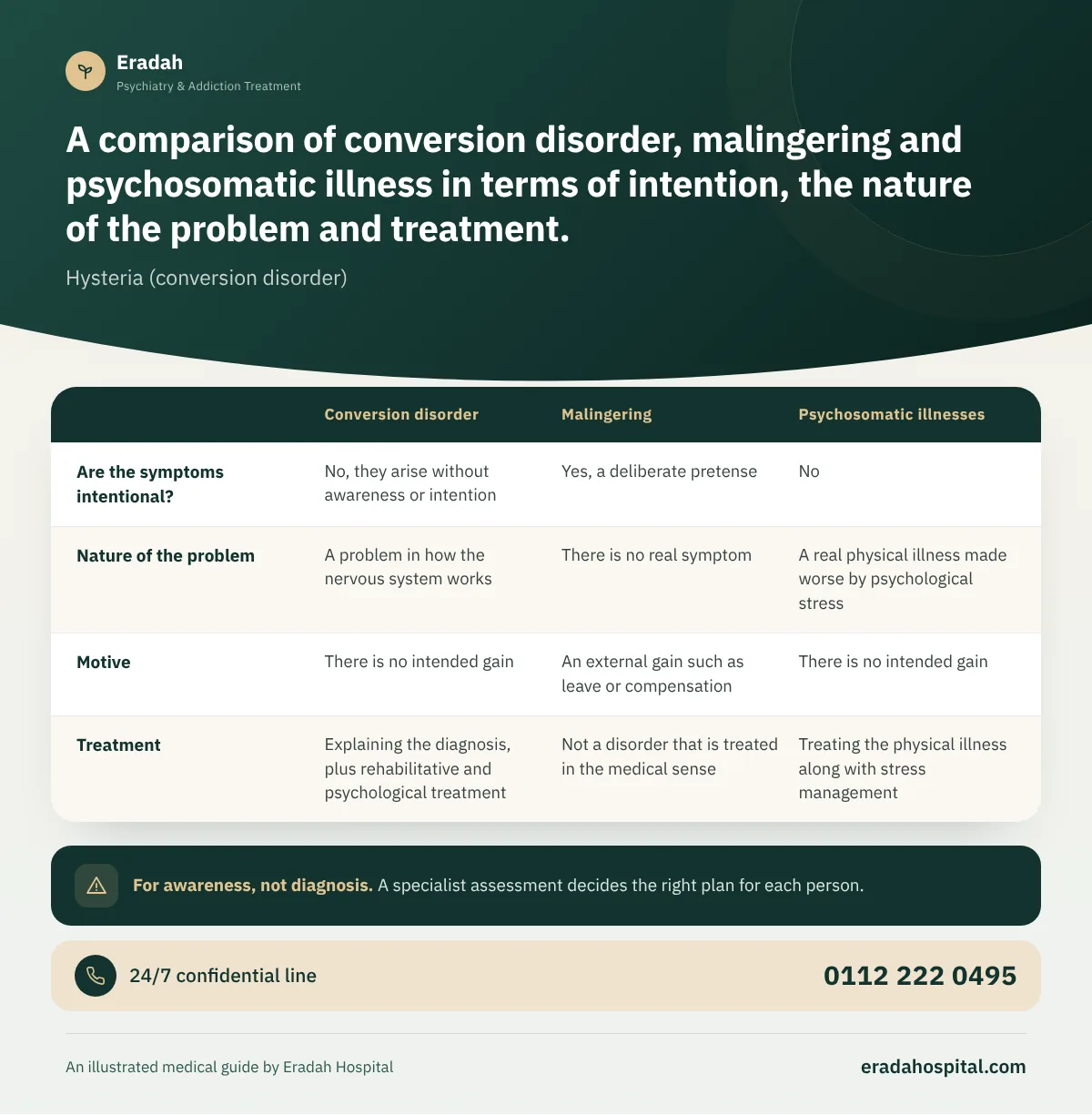
No. And this is the most important thing a family needs to understand. The following table shows the difference between three conditions that people often confuse:
| Conversion disorder | Malingering | Psychosomatic illnesses | |
|---|---|---|---|
| Are the symptoms intentional? | No, they arise without awareness or intention | Yes, a deliberate pretense | No |
| Nature of the problem | A problem in how the nervous system works | There is no real symptom | A real physical illness made worse by psychological stress |
| Motive | There is no intended gain | An external gain such as leave or compensation | There is no intended gain |
| Treatment | Explaining the diagnosis, plus rehabilitative and psychological treatment | Not a disorder that is treated in the medical sense | Treating the physical illness along with stress management |
Calling the patient “an actor” increases their sense of shame and helplessness, and may worsen the symptoms. To learn more about the third condition, read the guide to psychosomatic illness.
What is mass hysteria?
Scientifically it is called “mass sociogenic illness,” in which symptoms such as fainting, dizziness, nausea and shortness of breath spread among a group in one place, such as a school or factory, with no organic cause. A historical study published in the British Journal of Psychiatry in 2002 shows that twentieth-century outbreaks were dominated by anxiety symptoms and often began after exposure to a harmless smell or a rumor of poisoning, and that knowing the features of these outbreaks helps in recognizing them quickly. Once any real environmental cause has been ruled out, the solution is reassurance, separating those affected and handling things calmly.
Common myths about hysteria and the truth
| The myth | The truth |
|---|---|
| Hysteria is a women's illness only | It is more common in women, but it also affects men and children. |
| As long as the tests are normal, there is no problem | The problem is in how the nervous system functions, and tests do not detect it. |
| There must be a psychological trauma behind it | Many patients cannot find a traumatic event, and stress is not required for the diagnosis. |
| It has no treatment | Many cases improve with an explanation of the diagnosis and rehabilitative and psychological treatment. |
Can a person with conversion disorder recover?
The JAMA Neurology review describes it as a cause of disability that is treatable but neglected. The Scottish pathway explains that some patients improve to the point of needing no specialist follow-up, while in others symptoms persist, sometimes relapse or appear in a new form. The chances are usually better when the diagnosis comes early and is explained clearly, and treatment aimed at the symptoms begins. The treatment options are covered in detail in treatment of hysteria.
How should the family handle an episode?
- Stay calm, and move hard or dangerous objects away from them.
- Do not put anything in their mouth, and do not try to restrain their movement.
- Do not accuse them of acting, and do not overreact either.
- Stay with them and speak in a calm voice until the episode ends, and film it on a phone if possible so the doctor can see it.
- If the diagnosis is not confirmed, or the episode is long, or an injury occurs, call an ambulance.
Hysteria guide: everything you need to know
We have gathered everything about hysteria in 2 pages, each answering one question in detail. Choose what you are looking for:
Hysteria (conversion disorder) symptoms
What are the symptoms of hysteria or conversion disorder? Functional weakness and paralysis, non-epileptic seizures and how they differ from epilepsy, tremor and loss of voice or sight, and when symptoms are an emergency.
Hysteria (conversion disorder) treatment: rehabilitative and psychological
Treatment of hysteria and conversion disorder: why it begins with explaining the diagnosis, the role of specialized physiotherapy and cognitive behavioral therapy for seizures, the limits of medication, and a relapse prevention plan.
Sudden weakness or a seizure? Do not assume it is “hysteria” and ask for help
- Sudden weakness or numbness on one side of the body, a drooping mouth, or sudden difficulty speaking for the first time
- A first-time convulsive seizure, or a long or repeated seizure without the person regaining consciousness in between
- A head injury or difficulty breathing during or after the episode
- Taking a large amount of medication or any substance during distress
- Talk about death or a wish to harm oneself
New sudden neurological symptoms cannot be judged at home, since some strokes and epileptic seizures look just like them. Stay with the person, move hard objects away from them, put nothing in their mouth, and call an ambulance (123) or go to the nearest emergency room. If they talk about harming themselves, do not leave them alone, and call the mental health support line 16328 (24 hours).
Ambulance 123 Mental health support line 16328