What is imposter syndrome?
“I must have been accepted by chance, and as soon as they find out I don't understand anything, they'll let me go.” A top-performing doctor, an engineer who just got promoted, or a student who graduated with distinction might say this. This inner voice that discredits every achievement is what is called imposter syndrome, and it is more common than most people who live with it realize.
An article from Cleveland Clinic defines imposter syndrome (or imposter phenomenon) as a persistent feeling of being a fraud, not believing your success is real, along with a fear of being found out. The article stresses that it is not a medical diagnosis; it is a pattern of self-doubt and a negative view of oneself that leads a person to attribute their success to outside factors such as luck, chance or other people's kindness. The phenomenon was first described in the 1970s in high-achieving women, and it later became clear that it affects everyone.
Signs of imposter syndrome
- Downplaying your achievements and crediting them to luck or circumstances.
- Difficulty accepting praise or recognition.
- Excessive fear of failure and of the future.
- Constantly comparing yourself with others.
- Overworking or people-pleasing to cover up a “shortcoming.”
- Holding back from goals you could actually achieve.
- Anxiety tied to performance and managing tasks.
Types of imposter syndrome
The Cleveland Clinic article cites researcher Valerie Young's classification of five patterns:
Feels like a fake at the smallest mistake, and is satisfied only with perfection.
Is ashamed of any gap in their knowledge, and feels there is always something they have not yet learned.
Feels like a failure if they need time or effort to get something done.
Sees asking for help as proof of being incompetent.
Measures their worth by how much they accomplish, and always feels they have not done enough.
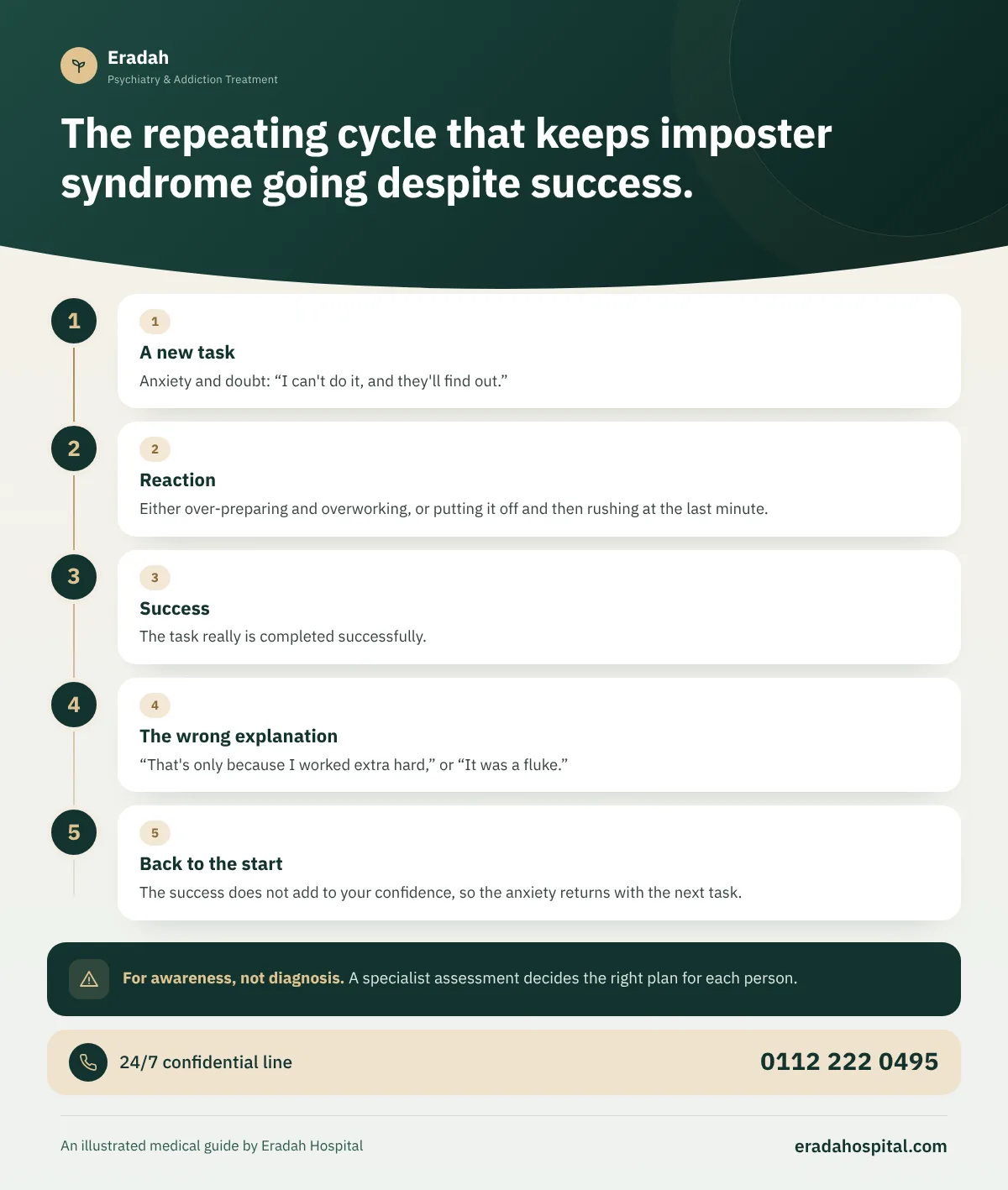
The imposter syndrome cycle: why doesn't success reassure you?
- 1A new task
Anxiety and doubt: “I can't do it, and they'll find out.”
- 2Reaction
Either over-preparing and overworking, or putting it off and then rushing at the last minute.
- 3Success
The task really is completed successfully.
- 4The wrong explanation
“That's only because I worked extra hard,” or “It was a fluke.”
- 5Back to the start
The success does not add to your confidence, so the anxiety returns with the next task.
Causes of imposter syndrome
- Parenting style: according to Cleveland Clinic, intense pressure on a child to excel in school or sports may be linked to years of self-doubt.
- An anxious attachment style and a constant need for reassurance.
- Competitive environments or transitional phases: a new job, a promotion, or advanced study.
- Perfectionism and tying self-worth to achievement alone.
- Cultural and social factors, and the systematic review points to higher rates in some minority groups.
How imposter syndrome harms mental health
In the systematic review published in the Journal of General Internal Medicine in 2020, covering 62 studies and more than 14,000 participants, imposter syndrome was strongly linked to depression and anxiety, to poorer performance and job satisfaction, and to burnout among different groups of employees, including doctors. It also feeds overthinking and spoils the enjoyment of success.
How do you get rid of imposter syndrome?
- Name the feeling: “This is imposter syndrome talking, not the truth.”
- Keep a record of your achievements and positive feedback, and go back to it.
- Separate feeling from fact: feeling incompetent is not proof that you are.
- Accept “good enough” instead of perfect.
- Talk to a colleague or mentor you trust; you will often find they feel the same.
- Ask for help when you need it, since that is part of competence, not the opposite of it.
If the feeling continues and affects your work or mood, cognitive behavioral therapy helps change the thoughts that feed the cycle, and you can start sessions in the outpatient clinics at Eradah. The first consultation is free and confidential.
Performance pressure turned into despair or suicidal thoughts? Get help now
- Talking about wanting to die after a mistake, failure or fear of being “exposed”
- A deep sense of shame and worthlessness that no success calms
- Repeated panic attacks or severe insomnia for days before tasks and exams
- Growing reliance on stimulants or sedatives to keep going at work or school
Do not leave the person alone. Ask them calmly how they feel and listen without minimizing their pain or comparing it with their successes; asking about suicidal thoughts does not plant them, it opens the door to help. Call an ambulance on 123 or go to the nearest emergency room if there is danger, or call the mental health support line 16328, available around the clock, and keep medication and anything they could use to harm themselves out of their reach.
Ambulance 123 Mental health support line 16328