What is overthinking?
You put your head on the pillow and the questions begin: why did I say that? What if I lose my job? Did he mean something by his message? An hour or two later you are still in the same place, with no answer and no sleep. This is overthinking: repeated preoccupation with the same thoughts that produces neither a decision nor a solution, and only adds tension the longer it goes on.
Researchers call it “repetitive negative thinking,” and it usually takes two forms: rumination, which is re-analyzing the past, blaming yourself for it and asking “why am I like this?”, and worry, which is a chain of “what if?” about a future that has not yet happened. The two forms often trade places in the same person within a single day.
When is thinking useful and when does it become excessive?
Not all repetitive thinking is a problem. In a wide review published by researcher Edward Watkins in Psychological Bulletin, repetitive thought was found to have two faces: a helpful one that aids recovery from painful events, planning, preparation and adopting healthy behaviors, and a harmful one linked to depression, anxiety and physical health problems. According to the review, factors that determine which face prevails include whether the content of the thinking is negative or positive, the context in which it occurs, and whether it is abstract and general or specific and concrete.
| Useful thinking | Overthinking | |
|---|---|---|
| The question it asks | “What is the next step?” | “Why did this happen?” and “What if?” |
| Its level | Specific and concrete | General, abstract and growing |
| Its duration | Has a beginning and an end | Returns again and again with no clear end |
| Its result | A decision, a plan or acceptance | Tension, exhaustion and postponing |
| Its effect on sleep | Usually ends before sleep | Intensifies at night and delays sleep |
Is overthinking a mental illness?
There is no diagnosis called “overthinking” in medical classifications. But it is a transdiagnostic thinking pattern, meaning it appears in many disorders: in depression rumination and self-blame predominate, in generalized anxiety disorder excessive worry that is hard to control predominates, and in OCD unwanted disturbing thoughts intrude on the mind and the person tries to neutralize them with rituals. It is also linked to insomnia.
A review by Susan Nolen-Hoeksema and her colleagues indicates that rumination is linked not only to depression but also to anxiety, binge eating, heavy drinking and self-harm. So the question worth asking is: “Is the overthinking part of a condition that needs diagnosis and treatment?”
How does the overthinking cycle work?
Overthinking goes around in a loop that feeds itself, and each stage has a signal you can catch:
- 1The spark
A small incident: an unanswered message, a comment at work, or a minor physical symptom.
- 2The first question
“What if?” or “Why?”, followed by a possible negative interpretation.
- 3Escalation
One scenario after another, and the body tenses so the threat seems bigger.
- 4Trying to control it
More analysis, asking for reassurance, and reviewing the situation again and again.
- 5The return
A short relief and then the thought returns, bringing more tiredness and less confidence.
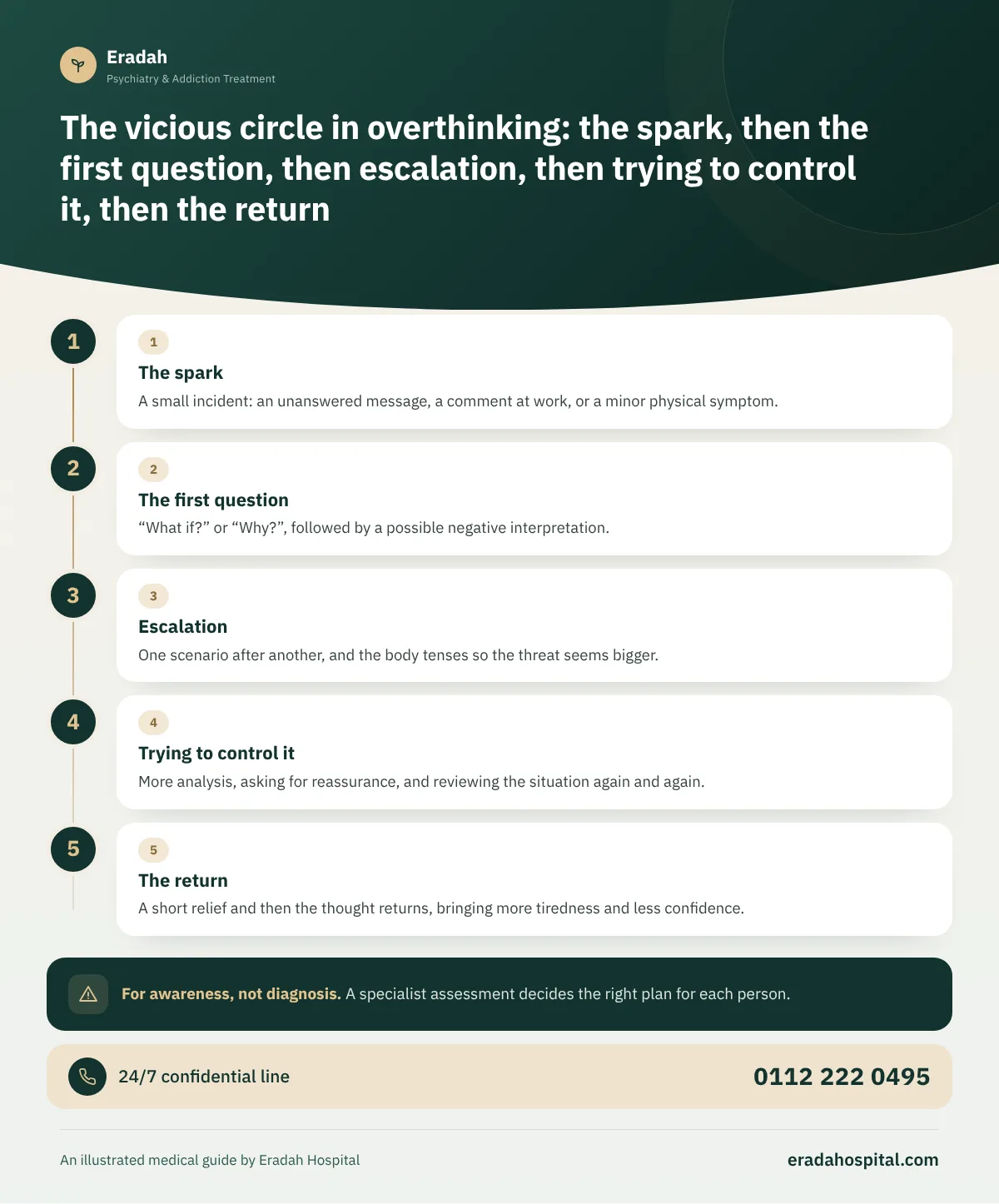
The irony is that every attempt to “settle” the thought with more thinking gives it fresh fuel. That is why treatment approaches focus on getting out of the circle, not on winning the argument inside it.
Why doesn't telling yourself “don't think about it” work?
In a famous experiment published by Daniel Wegner and colleagues in 1987, participants were asked not to think about a “white bear” for five minutes and could not. When they were later allowed to think about it, they thought about it more than those who had been asked to think about it from the start. Participants who were given a specific alternative thought to focus on while suppressing were less preoccupied with the bear afterward.
The practical lesson: forced suppression backfires, while directing attention to a specific alternative activity or thought helps. Exercises for treating overthinking are built on this.
Symptoms of overthinking in brief
Overthinking shows up as thoughts that repeat and never end, long hesitation over decisions, repeated requests for reassurance, and difficulty sleeping because the mind is active at night, along with physical effects such as headaches, muscle tension and fatigue. Detailed signs and non-diagnostic self-assessment questions are in overthinking symptoms and signs.
Causes of overthinking in brief
Its causes overlap among a temperament inclined to anxiety, perfectionism and difficulty tolerating uncertainty, earlier painful experiences, present stress, and habits that feed it such as lack of sleep and late nights on screens, along with mental health conditions such as anxiety and depression. The details and what research says are in causes of overthinking.
Overthinking treatment in brief
Overthinking can be changed with daily exercises such as setting aside a fixed worry time, writing, and changing the question from “why?” to “what is the next step?”. A systematic review by Querstret and Cropley suggests that mindfulness-based interventions and cognitive behavioral therapy may reduce rumination and worry together. The full steps and the role of medication are on the overthinking treatment page.
Is overthinking dangerous?
Overthinking in itself is not dangerous, but continuing it has a cost. In a study by Susan Nolen-Hoeksema published in 2000 in the Journal of Abnormal Psychology, rumination predicted the onset of new depressive episodes, and anxiety symptoms as well. Her later review summarizes that rumination increases negative thinking, weakens problem-solving, blocks action, and over time weakens social support. Physically, a review by Brosschot and colleagues suggests that worry and rumination prolong the activation of the stress response in the heart, glands and immune system.
Because overthinking steals sleep and raises tension, some people turn to sleeping pills, sedatives or cannabis to “quiet the brain.” This is a solution that starts out comforting and often ends in dependence, and with withdrawal the thinking comes back worse. If you have reached this stage, read about dual diagnosis.
When do you need a psychiatrist because of overthinking?
- The overthinking has lasted weeks and consumes hours of your day.
- Sleep has become difficult most nights.
- It comes with sadness, loss of enjoyment or a feeling of worthlessness.
- Intrusive thoughts have appeared that push you into repeated rituals such as washing or checking.
- You have started relying on pills or substances to calm your mind.
- You have had thoughts about death or harming yourself, in which case help is urgent.
At Eradah you can talk to a specialist in complete confidentiality through the outpatient clinics, to determine whether anxiety, depression or something else is behind the overthinking, and then build a plan that suits you.
Overthinking Guide: Everything You Need to Know
We have gathered everything about overthinking into 3 pages, each answering one question in detail. Choose what you are looking for:
Overthinking symptoms and signs
What are the symptoms of overthinking? Its mental signs such as repeated thoughts, hesitation and seeking reassurance, its effect on sleep and body such as headaches and fatigue, self-assessment questions, and when it is a warning sign.
Causes of overthinking
What causes overthinking? The role of an anxious temperament, perfectionism and intolerance of ambiguity, painful experiences and stress, lack of sleep and screens, depression and anxiety, and why it happens in a particular person.
Overthinking treatment
How do you get rid of overthinking? Tried-and-tested exercises such as a set worry time, writing and changing the question, solutions for thinking before sleep, cognitive behavioral therapy, mindfulness and the role of medication.
When thinking turns into thoughts about death: ask for help now
- Repeated thoughts about death, that life is not worth living, or that the person is a “burden” on those around them
- Severe hopelessness and a feeling that the thoughts will never stop and there is no way out
- Almost completely stopping sleeping or eating for several days
- Overusing sleeping pills or sedatives, or mixing them with alcohol, to “quiet the brain”
- Strange thoughts, intense suspicion or hearing voices that others do not hear
Do not leave the person alone. Ask them calmly and directly how they feel and what they are thinking, and listen without blame or lectures; asking directly does not plant the idea, it opens the door to help. Call an ambulance on 123 or take them to the nearest emergency room, or call the mental health support line 16328 (24 hours), and keep medications and anything they could use to harm themselves out of reach.
Ambulance 123 Mental health support line 16328