What is generalized anxiety disorder?
Generalized anxiety disorder, also known as chronic anxiety, is excessive, ongoing worry that is not tied to a single situation. It moves from one subject to another: health, then work, then the children, then money, even when there is no real reason for so much preoccupation.
Anxiety in itself is a normal and useful feeling. It alerts us to danger and pushes us to prepare for an exam or a job interview. In generalized anxiety disorder, however, anxiety loses its purpose. It becomes far bigger than the situation warrants, lasts most days for months, and the person feels unable to stop it no matter how hard they try.
Established medical classifications such as the DSM-5 and ICD-11 describe this disorder as excessive worry and apprehension that is hard to control, lasts at least six months, comes with a number of physical and mental signs, and causes marked distress or disrupts work, study and relationships.
How common is generalized anxiety disorder?
Anxiety disorders as a group are the most common mental health conditions in the world. The World Health Organization notes that women and girls are more likely to be affected, and that only about one in four people who need treatment actually receive it.
Sources: the US National Institute of Mental Health (NIMH, NCS-R survey) and StatPearls. We do not have documented Egyptian figures, so we rely on global numbers.
In our communities, many people delay seeking help because anxiety is seen as a "temperament," "nervousness," or "overthinking," or because physical symptoms send them to internists and cardiologists many times before anyone considers the psychological side.
What does generalized anxiety feel like from the inside?
Many patients describe their state as "a mind that never stops." The person wakes up with a long list of bad possibilities in their head: What if one of my children gets sick? What if I lose my job? What if this headache is something serious? Even when things turn out fine, they do not feel relief; they move straight on to the next worry.
"I know my worry is exaggerated, and I hear everyone telling me, 'Don't think so much.' But I don't know how to stop." Many people living with chronic anxiety say something like this; it is not a quote from any particular patient.
The person lives in a constant state of readiness, as if waiting for a disaster. Their muscles tire, their sleep is disturbed, and they lose the ability to enjoy the moment. They often try to reassure themselves by asking the same question repeatedly, searching online, or avoiding the news, but this reassurance is short-lived and soon increases the anxiety.
What happens in the brain, briefly?
Research suggests that the brain's fear and threat circuits, chiefly the amygdala, are more sensitive in people with the disorder, while the prefrontal regions responsible for assessing danger and calming the response exert less control. The disorder is also linked to changes in neurotransmitter systems such as serotonin, norepinephrine and GABA, which are the systems that anxiety medications target.
What matters is that these changes are patterns of functioning that can be modified with psychotherapy and medication. They are not permanent "damage," which explains why most patients improve with appropriate treatment. Details on genetic and environmental factors are on the causes page.
What is the difference between generalized anxiety, normal anxiety and panic attacks?
Many people confuse generalized anxiety with other, similar conditions. The table below summarizes the main differences, though telling them apart accurately is the psychiatrist's job:
| The situation | Nature of the anxiety | Duration and pattern | The key difference |
|---|---|---|---|
| Normal anxiety | Proportionate to a real situation | Goes away when the situation passes | Does not disrupt life and can be controlled |
| Generalized anxiety disorder | General, moving between many topics | Most days for six months or more | The anxiety itself is the problem, not a specific situation |
| Panic attacks | Sudden intense fear that peaks within minutes | Intermittent episodes | Acute attacks followed by fear of having another |
| Social phobia | Fear of being judged by others and of embarrassing oneself | Tied to social situations | Limited to what people think of you |
| Obsessive-compulsive disorder (OCD) | Intrusive thoughts that feel foreign to the person | With repetitive compulsive actions | Rituals performed to ease the anxiety |
You can read more about panic attacks and social phobia. Some physical conditions can also cause symptoms that resemble anxiety, such as an overactive thyroid, excess caffeine or withdrawal from certain substances, which is why the doctor rules them out before making a diagnosis.
Is exam anxiety a type of generalized anxiety?
Exam anxiety is tied to a specific situation. It is normal and useful as long as it drives preparation and then settles, and it differs from generalized anxiety disorder, which extends to many topics for six months or more. But if a student's anxiety spreads to everything and not just exams, or panic attacks occur, or they refuse to go to the exam, a psychological assessment helps, and cognitive behavioral therapy is among the most effective treatments.
You will find the signs of exam anxiety and steps to ease it for the student and family, before and during exams, in the guide Exam anxiety: when is it normal and how do you ease it?. If thoughts of self-harm appear, call the mental health support line 16328.
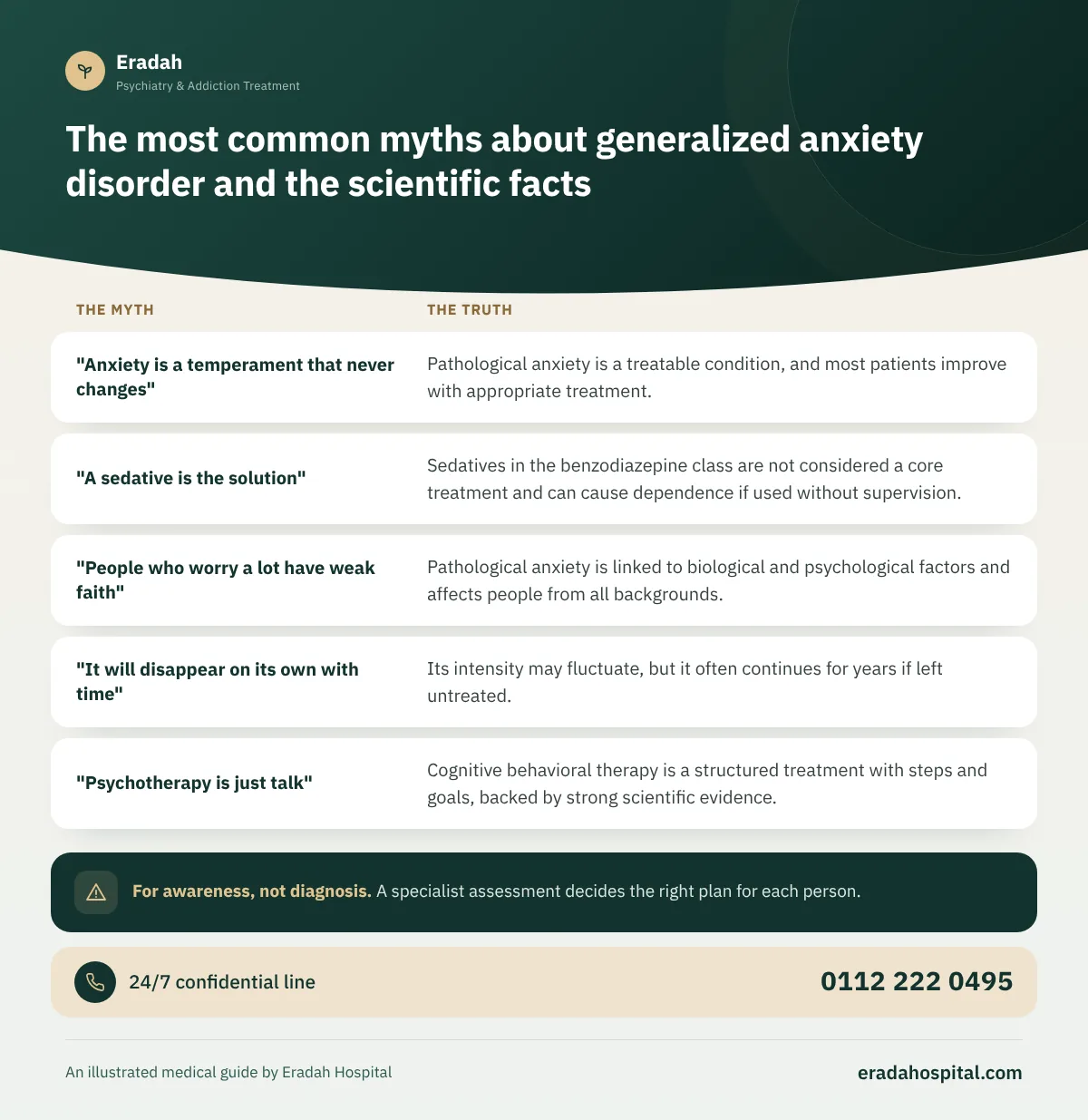
Common myths about chronic anxiety
| The myth | The truth |
|---|---|
| "Anxiety is a temperament that never changes" | Pathological anxiety is a treatable condition, and most patients improve with appropriate treatment. |
| "A sedative is the solution" | Sedatives in the benzodiazepine class are not considered a core treatment and can cause dependence if used without supervision. |
| "People who worry a lot have weak faith" | Pathological anxiety is linked to biological and psychological factors and affects people from all backgrounds. |
| "It will disappear on its own with time" | Its intensity may fluctuate, but it often continues for years if left untreated. |
| "Psychotherapy is just talk" | Cognitive behavioral therapy is a structured treatment with steps and goals, backed by strong scientific evidence. |
When should you see a psychiatrist about anxiety?
- If the anxiety continues most days for several months and you find it hard to control.
- If it clearly affects your sleep, work, studies or relationships.
- If you keep visiting doctors for physical symptoms and they find no physical cause.
- If you have started relying on sedatives, alcohol or hashish to calm down.
- If the anxiety is accompanied by persistent sadness, loss of enjoyment, or thoughts that life has no value.
Seeing a psychiatrist does not mean "madness." It is a step like visiting any specialist doctor. Early assessment can save years of suffering and lowers the risk of complications.
Can generalized anxiety disorder be cured?
Yes, and the outlook is good with treatment. Many patients return to a normal life and learn skills that make anxiety less in control, even in times of stress. There may be periods when anxiety returns, especially under heavy pressure, but the person is then more experienced in handling it and quicker to ask for help.
Outcomes improve the earlier treatment begins and the more that co-occurring conditions, such as depression or overuse of sedatives, are treated as well.
How can a family support a person with generalized anxiety?
- Believe their suffering: saying "You're exaggerating" increases their sense of loneliness, while "I understand this is exhausting for you" opens the door to conversation.
- Don't become an endless source of reassurance: answering the same question dozens of times brings brief relief but feeds the anxiety.
- Encourage a specialist assessment instead of settling for painkillers, sedatives or popular home "remedies."
- Watch for warning signs: withdrawal, hopelessness, or overuse of sedative medication or alcohol.
- Take care of yourselves too: supporting an anxious person for a long time is exhausting, and families have every right to ask for guidance.
Generalized anxiety disorder guide: everything you need to know
We have gathered everything about generalized anxiety disorder into 6 pages, each answering one question in detail. Choose what you are looking for:
Generalized anxiety disorder symptoms
The psychological and physical signs of chronic anxiety, how they appear in men, women, children and older adults, and non-diagnostic self-assessment questions.
Causes of generalized anxiety disorder
How genetics, brain chemistry, personality, stress and early experiences combine to produce chronic anxiety, and the difference between a cause and a trigger.
Harms of generalized anxiety disorder
What untreated anxiety does to sleep, the heart, the digestive system, work and relationships, and why it raises the risk of depression and substance misuse.
Treatment of generalized anxiety disorder
Cognitive behavioral therapy and applied relaxation, the classes of medication a psychiatrist prescribes, and why sedatives are not a long-term solution.
Generalized anxiety disorder and addiction
Why some people with the disorder turn to benzodiazepines, pregabalin, alcohol or hashish, and how anxiety and addiction are treated together.
Night-time anxiety: why does it get worse at bedtime, and how do you calm it?
Night-time anxiety: why thoughts and palpitations increase when you lay your head on the pillow, how it differs from night-time panic attacks, practical tried-and-tested steps to calm it before sleep, and when you need a doctor.
Suicidal thoughts or severe hopelessness along with anxiety? Get help now
- Talking about wanting to die or being a "burden" on those around them
- Severe hopelessness and a feeling that the anxiety will never end and there is no way out
- Suddenly saying goodbye to family or giving away things that are dear to them
- Complete withdrawal from people and work with severe sleeplessness for consecutive days
- Overusing sedatives or alcohol, or mixing them, in search of relief
Stay with the person and do not leave them alone. Listen calmly, without judgment or blame, and ask them directly about their thoughts; asking does not plant the idea, it opens the door to help. Keep medications and dangerous objects out of their reach as far as possible, and call the ambulance (123) or go to the nearest emergency room, or call the mental health support line 16328, available around the clock.
Ambulance 123 Mental health support line 16328