What is the difference between loneliness and isolation?
You can be in a house full of people, or in a group of friends on your phone, and still feel that no one truly sees you. Loneliness is a sense of distance between you and those around you, however many they are.
| Loneliness | Social isolation |
|---|---|
| An internal feeling | A measurable state: few meetings and little contact |
| Can happen in the middle of a crowd | Someone can live it without feeling lonely |
| Relates to the quality of relationships | Relates to the number and frequency of relationships |
| Psychologically painful by nature | May be a comfortable choice for some people |
Both affect health, and the most harmful is when they come together: a person with little contact who suffers because of it.
The effect of loneliness on health
The World Health Organization Commission on Social Connection issued a global report in 2025, estimating that loneliness is linked to about 100 deaths every hour worldwide. An analysis of studies covering hundreds of thousands of people found that loneliness and isolation raise the risk of early death to a degree comparable to known risk factors. Its effects include:
- Increased risk of depression and anxiety.
- Disturbed and poorer-quality sleep.
- Higher stress hormones and levels of inflammation in the body.
- Increased risk of heart disease and strokes.
- Declining memory and increased risk of dementia in older adults.
- Increased risk of suicidal thoughts.
- Turning to alcohol, drugs or screens to fill the void.
Why does loneliness feed itself?
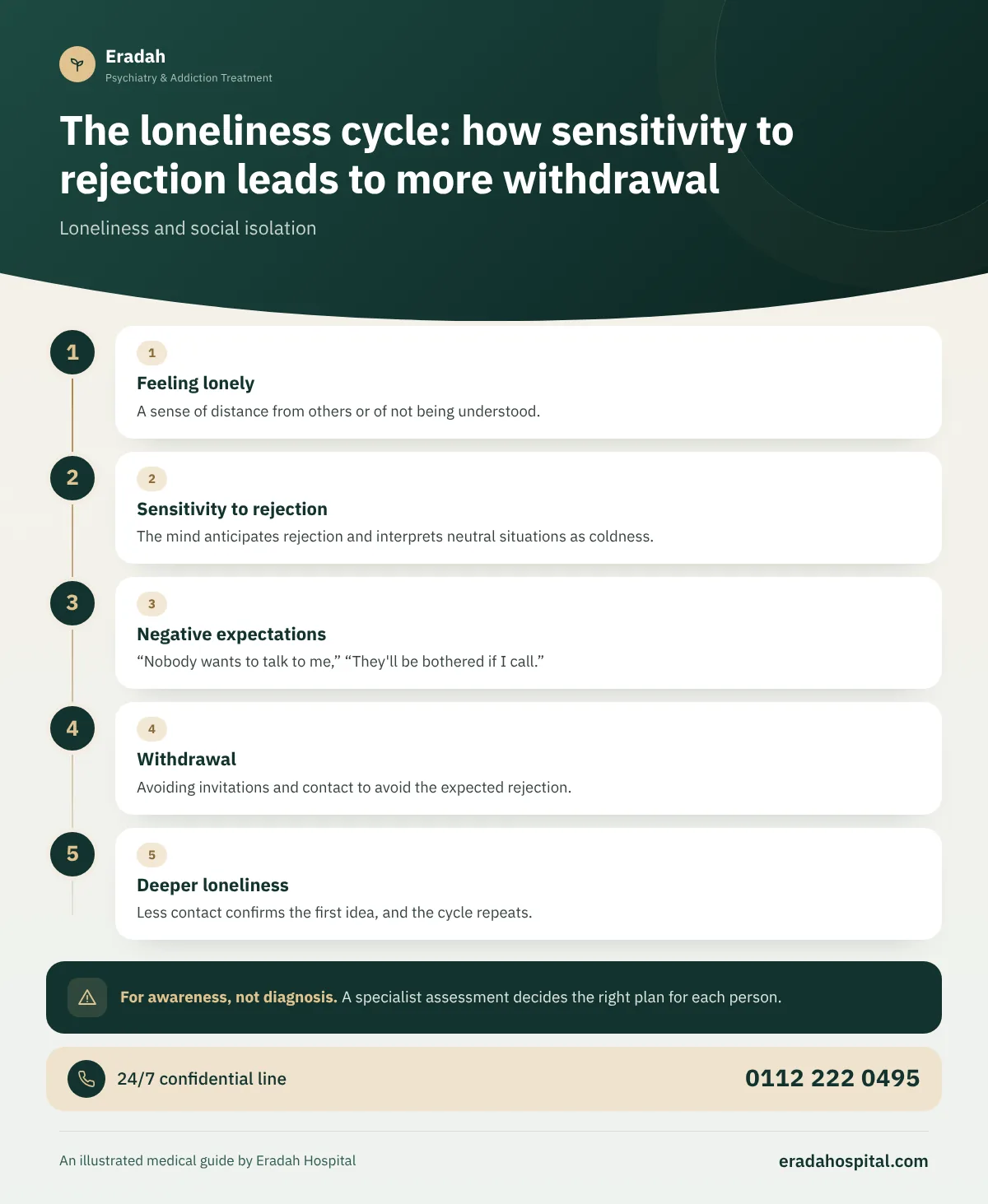
Researchers explain that long-term loneliness puts the brain in a state of social alert, making it more sensitive to any sign of rejection, and a self-feeding cycle forms:
- 1Feeling lonely
A sense of distance from others or of not being understood.
- 2Sensitivity to rejection
The mind anticipates rejection and interprets neutral situations as coldness.
- 3Negative expectations
“Nobody wants to talk to me,” “They'll be bothered if I call.”
- 4Withdrawal
Avoiding invitations and contact to avoid the expected rejection.
- 5Deeper loneliness
Less contact confirms the first idea, and the cycle repeats.
Loneliness and addiction
Loneliness is one of the strongest drivers of substance use and relapse: alcohol and drugs give a temporary feeling of relief or of belonging to a group that uses, then deepen isolation over time. Many people in recovery say that the loneliness after stopping was harder than the physical withdrawal. This is why recovery programs focus on building a support network and therapy groups, which are an essential part of follow-up and relapse prevention.
How do you overcome feeling lonely?
- Start small: a message to an old friend, a call to a relative, or a greeting to a neighbor. Do not expect a deep relationship from the first step.
- Pay attention to your thoughts: when you tell yourself “nobody cares,” ask: what is the evidence? What is the other explanation? Studies have shown that working on these thoughts is one of the most successful ways to ease loneliness.
- Join a regular activity: a team sport, volunteering, a course, or a religious activity; repetition builds familiarity.
- Help others: volunteering and helping others reduce loneliness and give meaning.
- Cut back on comparison on social media, and use it for real connection, not just watching.
- Look after the basics: sleep, movement and sunlight improve mood and make connecting easier.
- Ask for help if the loneliness comes with persistent sadness or social anxiety that keeps you from approaching people.
When do you need a specialist?
If loneliness continues with sadness and loss of pleasure for more than two weeks, or anxiety keeps you from approaching people as in social phobia, or you have started to rely on alcohol, sedatives or drugs to fill the void, or thoughts about death have crossed your mind, a psychological assessment is an important step. If you are in danger now, contact the mental health support line 16328, and you can find more on the page about suicidal thoughts.
Loneliness that turned into despair or suicidal thoughts? Get help now
- Talking about wanting to die or that no one would miss them
- Severe hopelessness and a feeling that no one cares and there is no way out
- A sudden, complete break from family and friends, or saying goodbye to them
- Obvious neglect of eating, hygiene or medication, especially in older adults who live alone
- Increased drinking or substance use to fill the void
Do not leave the person alone; visit them or stay with them on the phone, ask calmly and openly about their thoughts and listen without blame, since asking does not plant the idea, it opens the door to help. Call an ambulance on 123 or take them to the nearest emergency room if they are in danger, or call the mental health support line 16328, available around the clock, and keep medication and anything they could use to harm themselves out of their reach.
Ambulance 123 Mental health support line 16328