“Every time I confront him, he turns it around on me, and by the end I'm the one apologizing.” After years with a manipulative person, many people begin to doubt their memory, their feelings and their worth. A manipulative personality does not always shout or threaten; it moves the people around it quietly, which is why it is hard to spot.
What is a manipulative personality?
Psychological manipulation is an attempt to influence a person's thoughts, feelings or behavior through crooked means that serve the manipulator at the other person's expense. The difference from ordinary persuasion is that persuasion is open and respects your freedom to say no, while manipulation is hidden and exploits your vulnerabilities, such as fear of rejection, guilt or the need for love. A manipulative personality is not a diagnosis in the medical manuals; it describes a person who repeats this pattern across more than one relationship.
Tactics of a manipulative personality
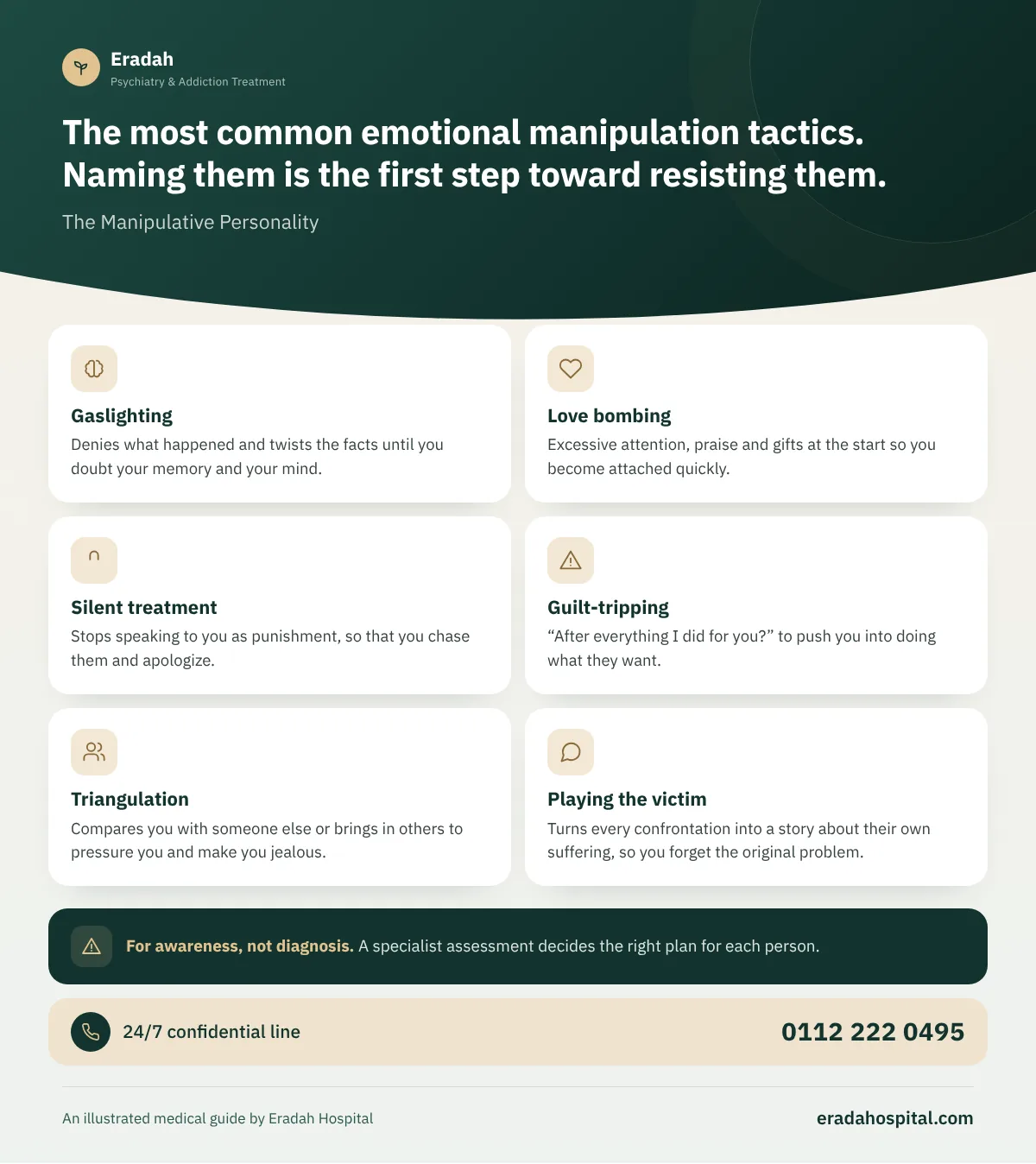
Denies what happened and twists the facts until you doubt your memory and your mind.
Excessive attention, praise and gifts at the start so you become attached quickly.
Stops speaking to you as punishment, so that you chase them and apologize.
“After everything I did for you?” to push you into doing what they want.
Compares you with someone else or brings in others to pressure you and make you jealous.
Turns every confrontation into a story about their own suffering, so you forget the original problem.
Gaslighting: when you doubt your own mind
The Cleveland Clinic describes gaslighting as patterns of behavior one person uses to make another doubt their sanity and their ability to make decisions, and treats it as a specific form of emotional abuse and mental manipulation. The name comes from a British play staged in 1938. Common phrases include: “You're imagining it,” “I never said that,” “You're too sensitive,” “I was just joking.” Over time, the source says, the victim begins to question their worth, their self-esteem and their mental abilities.
Love bombing, then deprivation
The Cleveland Clinic defines love bombing as a form of psychological and emotional abuse in which a person showers you with excessive praise, nonstop contact and grand gestures, to make you indebted to them and dependent on them. It describes three stages: idealization, in which they flood you with love, then devaluation, then discard or the threat of it. It notes that this behavior is often linked to an anxious or insecure attachment style or to narcissistic personality disorder, and that it can later develop into gaslighting or violence.
Silent treatment
The Cleveland Clinic explains that the silent treatment means withholding communication, and that for some people it is a way of coping with feelings they do not know how to express, while for others it is a deliberate way of causing hurt. The difference is that someone who withdraws to calm down comes back to the conversation, while a manipulator uses silence to make you chase them and give in every time.
Why do some people manipulate?
Not everyone who manipulates has a disorder. Some learned this style in a home where manipulation was the language of dealing with each other, and some do it out of a deep fear of abandonment or insecurity. But repeated, deliberate manipulation combined with little empathy appears in some personality disorders, such as narcissism, which involves exploiting others, and antisocial personality, in which lying and deceit recur. The description also overlaps heavily with the toxic personality.
How do you deal with a manipulative personality?
- Name the tactic in your own mind: “this is guilt-tripping” or “this is gaslighting.”
- When you are being made to doubt yourself, write down what happens with dates, so you can trust your memory.
- Set clear boundaries and repeat them calmly without long justifications.
- Do not decide under pressure; say “I'll think about it and get back to you.”
- Keep your relationships with your family and friends and do not allow yourself to be isolated.
- If the pattern does not change, reduce contact or end it when that is possible and safe.
When do you need psychological support?
Staying a long time with a manipulative person can leave an effect similar to trauma: anxiety, low self-confidence, depression and difficulty trusting people, and the victim may become attached to the person who harms them, as in Stockholm syndrome. Psychotherapy helps you regain trust in your own perception and set healthy boundaries. If things reach threats or violence, call the police on 122, and if you have thoughts of harming yourself, call the mental health support line on 16328. You can start with a session in Eradah's outpatient clinics, and the first consultation is free and confidential.