What is a toxic personality?
“Every time I sit with him I leave feeling I did something wrong, even if I don’t know what.” This repeated feeling of guilt, confusion and exhaustion after meeting a particular person is what leads many people to search for the meaning of “toxic personality.” The term is not a medical one, but what it describes is real and harmful, and understanding it is the first step to protection.
“Toxic personality” is a common expression that you will not find in the diagnostic manual of mental disorders. It refers to a person who repeatedly behaves in ways that drain or harm those around them: twisting the facts, controlling, belittling others, and not taking responsibility for their mistakes. It could be a parent, partner, manager or friend. What matters is that “toxicity” is measured by the repeated effect of the behavior, not by a passing angry moment that can happen to anyone.
Signs of a toxic personality
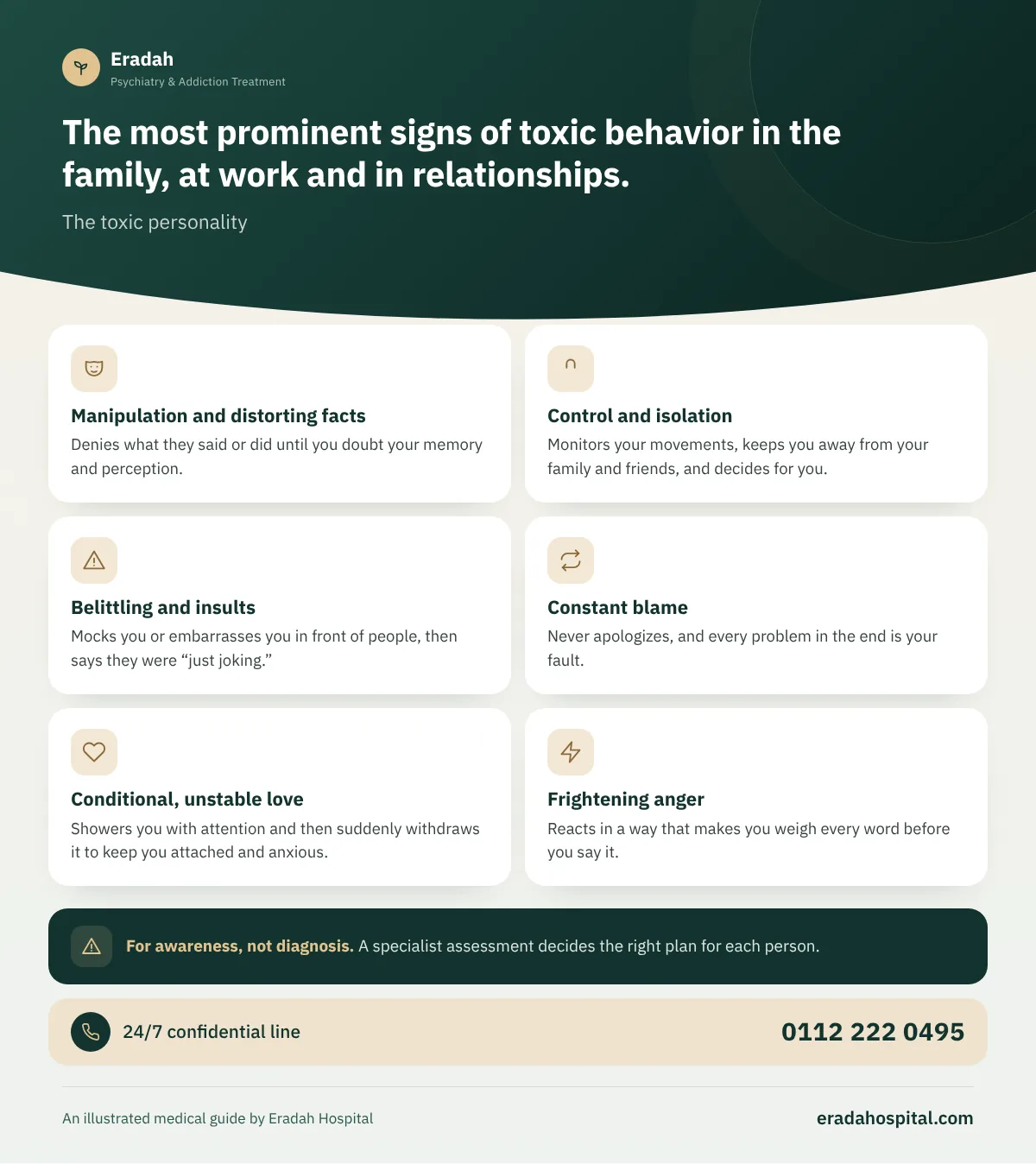
Denies what they said or did until you doubt your memory and perception.
Monitors your movements, keeps you away from your family and friends, and decides for you.
Mocks you or embarrasses you in front of people, then says they were “just joking.”
Never apologizes, and every problem in the end is your fault.
Showers you with attention and then suddenly withdraws it to keep you attached and anxious.
Reacts in a way that makes you weigh every word before you say it.
The US Office on Women’s Health (womenshealth.gov) lists these signs of psychological and verbal abuse: constant monitoring and demanding passwords, extreme jealousy and accusations of cheating, being kept from seeing family or from working, control over money, humiliation in front of others, and threats. It warns that the effects of this abuse can be as serious as those of physical abuse, and it may sometimes come before it.
Why does a toxic person behave this way?
There is no single explanation. Some of this behavior is linked to personality traits, and may reach a disorder that needs diagnosis, such as narcissistic personality disorder or antisocial personality. A Cleveland Clinic article explains the “Dark Triad” concept introduced by researchers Paulhus and Williams in 2002, which combines three overlapping traits: narcissism, psychopathy (little empathy or remorse), and Machiavellianism (lying and manipulation to gain power). The article makes clear that many people with these traits do not meet the diagnosis of any specific disorder. Harmful behavior may also have other causes, such as substance use, pathological jealousy, or repeating what the person learned in their family.
The effect of a toxic personality on your mental health
- Constant doubt about yourself and your judgment.
- Constant anxiety and tension, and overthinking every word and action.
- Low self-esteem and guilt with no clear reason.
- Symptoms of depression and sleep disturbance.
- Isolation from family and friends.
- Sometimes turning to sedatives or alcohol to cope.
Why is it hard to walk away from a toxic person?
This is not a sign of weakness on your part. Swinging between kindness and harm creates a strong attachment similar to unhealthy attachment, and womenshealth.gov notes that some abusers start the relationship with a flood of love and attention before the harm and control begin, leaving the victim in a state of shock and confusion. Add to that fear, financial dependence, family pressure, and hope that the person will change.
How do you protect yourself from a toxic personality?
- Name the behavior clearly to yourself, and write down incidents with their dates so you do not doubt your memory.
- Set short, clear boundaries: “I won’t continue the conversation this way.”
- Reduce emotional engagement: Cleveland Clinic describes the “gray rock” method, which relies on calm, brief replies that reduce stimulation, and notes that it suits some situations, not all.
- Do not get into a long argument to prove you are right.
- Keep a support network of safe family and friends.
- If the person is from the family or work, reduce shared spaces as much as possible.
- Consider walking away completely if the harm continues despite boundaries.
When do you need psychological support?
If anxiety, sadness or loss of self-confidence continue after you have left, or you find yourself going back to similar harmful relationships, psychotherapy helps you understand what happened and regain your voice. Psychotherapy in Eradah’s outpatient clinics offers confidential sessions, and if the harmful person has an addiction or a mental disorder and wants treatment, there is a family support program that also helps relatives.
Threats, violence or thoughts of self-harm? Safety first
- A threat of harm or physical violence, even once
- Fear for your safety or your children’s safety at home
- Being prevented from going out or contacting your family, with constant monitoring
- Severe despair and thoughts of death or self-harm because of the harmful relationship
Do not confront the harmful person alone in a moment of anger; move to a safe place near people you trust. Call emergency police on 122 for threats or violence, and ambulance on 123 if there is an injury. If thoughts of self-harm come to you or someone you love, do not stay alone; call the mental health support line 16328, available around the clock.
Ambulance 123 Mental health support line 16328